|
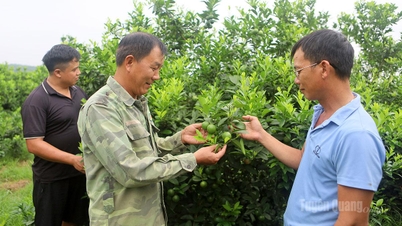
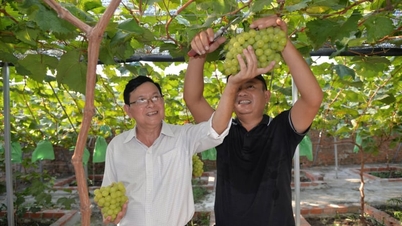
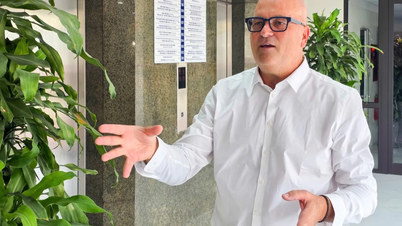
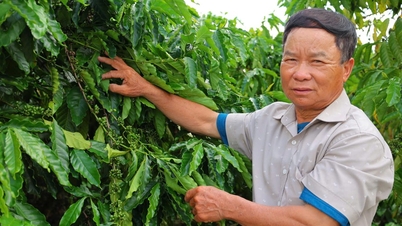
| Mr. Long Van Hanh (left) introduces the lime tree. |
Footprints of "opening up new territories"
Stepping deeper into the farming area, into a simple shack made of corrugated iron sheets, nestled amidst a lemon grove laden with fruit, we were greeted with the genuine warmth of a farmer, Mr. Long Van Hanh, with his square face and welcoming, hospitable smile. Over a cup of fragrant jasmine tea, he slowly recounted his arduous yet glorious entrepreneurial journey. He was very proud that he and his two nephews were the first to bring lemon trees to this place.
In early 2023, Mr. Hanh and two relatives from Dong Thinh commune ( Lao Cai province) sat down to chat, sharing stories about the successful lemon cultivation model in many localities. Concerned about the unproductive corn cultivation on the alluvial land in his hometown, he proactively proposed the idea of leasing and improving the land for lemon cultivation, receiving enthusiastic support from his two nephews, Nguyen Xuan Doan and Le Huu Tinh. Mr. Hanh is grateful that, thanks to the skillful "community mobilization" of the village head and the assistance and support of the local government, the initial difficulties were quickly overcome. After only a few months of campaigning, the local people trusted the three of them and leased over 8 hectares of alluvial land for lemon cultivation. Mr. Hanh's eyes lit up as he fondly remembers the moment the first lemon trees were planted in Phu Luong in October 2023.
The land along the riverbank, originally sandy soil with ideal humidity for lemon trees, benefited greatly from proper cultivation techniques. After a year of hard work, the first harvest from over 8 hectares yielded more than 20 tons of lemons, generating over 200 million VND in income. The sweat shed on the land transformed into radiant smiles.
Standing before thousands of lush lemon trees, I was quite curious about the distinctive differences between the familiar "paper lemon" and the "four-season lemon" varieties. Wiping away a bead of sweat from his forehead, Mr. Hanh meticulously explained: "Paper lemons possess superior advantages such as thin skin, high yield, and juiciness; however, the cultivation process is much more difficult and demanding than that of the four-season lemon. To ensure good growth, growers must almost always be present to observe the trees, monitor for signs of pests and diseases, and continuously prune if they truly want to have superior quality fruit on the market."
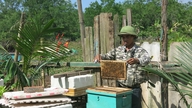
Looking out at the bustling garden, Mr. Hanh explained that to maintain progress, the garden always has 10 workers with salaries exceeding 7 million VND per person per month. The characteristic of lemon trees is that the older they get, the higher the yield. It is projected that by 2026, each hectare will yield over 20 tons of fruit. With a stable selling price of over 20,000 VND/kg, the lemon trees will generate a profit of over 200 million VND per hectare – a dream figure for farmers with calloused hands.
 |
| Traders are buying lemons directly from the orchards at prices exceeding 20,000 VND/kg. |
Spread
Speaking with us, Comrade Luu Thi Lan Huong, Chairwoman of the People's Committee of Binh Ca commune, proudly stated that the lime tree is truly becoming a promising new direction on the alluvial land of Binh Ca commune. To date, Phu Luong village has expanded the model to nearly 20 hectares, and the lime tree has brought outstanding results compared to many traditional crops on the same area.
This transformation not only attracts young people but also ignites enthusiasm in the elderly. In a spacious house next to the old Cap Tien market area, we met Mr. Dao Huy Tien. Although over 70 years old, he is still healthy, agile, and sharp-witted. Mr. Tien surprised and even impressed many young people in Binh Ca when he decided to invest in improving nearly 9 hectares of land to plant lemons. Contrary to common anxieties, Mr. Tien appeared extremely confident. He asserted that this is a relatively safe path for old age because those who came before him have done it and achieved success, plus the stable market for the product makes lemon cultivation a profitable venture.
Busy cutting the glossy green lemons in his garden to catch the traders' truck, Mr. Tran Van Cat paused to share that his family probably has the smallest lemon plantation in the area, with over 300 trees. However, thanks to the trees laden with fruit, his family earns tens of millions of dong regularly each year. What reassures farmers like him is the stable market; all harvested produce is sold immediately, and price drops are very rare.
Looking at the vibrant agricultural landscape in Phu Luong village, besides large-scale farming models, there are also quite a few households with over 1 hectare of lemon trees, typical examples being the families of Mr. Nguyen Van Khai, Thach Minh, or the enthusiastic Deputy Village Head Pham Dinh Quyet.



Recently, during a field trip to the area, after surveying the lemon growing region in Phu Luong village, the Deputy Secretary of the Provincial Party Committee and Chairman of the Provincial People's Committee, Phan Huy Ngoc, made very insightful assessments. From a strategic perspective, he also pointed out that the productivity of the specialized lemon growing area is still low compared to some key production regions nationwide. This assessment serves as both encouragement and a goal for the government and people of Binh Ca commune to continuously strive to improve farming techniques, transforming the alluvial plains along the Lo River into lush green and abundant with sweet fruit, bringing long-term prosperity to this land.
Le Duy
Source: https://baotuyenquang.com.vn/kinh-te/202607/doi-doi-tu-cay-chanh-giay-o-phu-luong-33f43d3/