Don't chase "asset price increases".
For many years, Vietnam's real estate market thrived on a model of rising land prices, asset speculation, and planning expectations. Constantly escalating house prices made real estate a popular asset class, while the demand for actual housing became increasingly difficult to meet.
Mr. Nguyen Quoc Khanh, Vice Chairman of the Vietnam Association of Real Estate Brokers (VARS), believes that this model is revealing many negative consequences such as house prices far exceeding income, a strong flow of money into speculation instead of production, and an increasing number of young people losing access to housing.
"If the focus shifts strongly towards the idea that housing is for living in, not for speculative asset accumulation, and rental properties become the main pillar, then this will be a very large-scale restructuring of the Vietnamese real estate market," Mr. Khanh said.
According to Mr. Khanh, the market will become highly differentiated in the coming period. Segments that have seen price increases primarily due to expectations, such as land plots in suburban areas, subdivided plots far from the city center, or urban areas lacking actual residents, may face significant pressure if policies to curb speculation are implemented more strongly.
Conversely, products that generate stable cash flow, serve genuine housing needs, and are connected to urban infrastructure will have long-term growth potential.
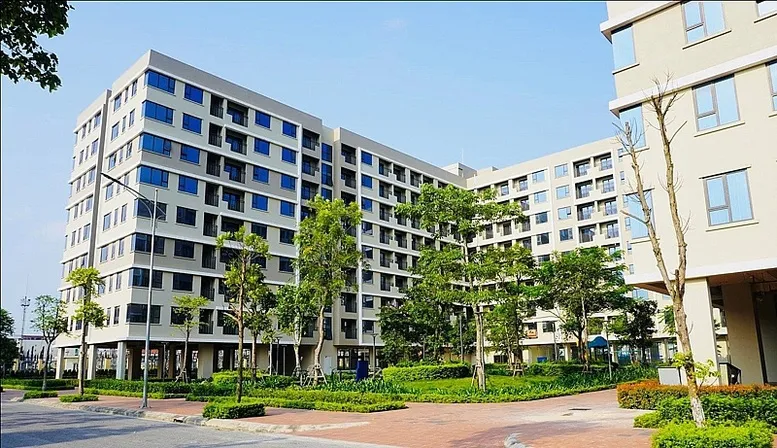
According to many experts, the most important shift in current housing development thinking is the reassessment of the role of rental housing - Photo: Government Newspaper
Rental properties could become a new source of income.
According to many experts, the most significant shift in current housing development thinking is a reassessment of the role of rental housing.
For many years, housing policy in Vietnam has revolved almost entirely around the goal of home ownership. This has placed significant financial pressure on young people, especially in large cities where house prices have risen much faster than incomes.
Currently, a young family in Hanoi or Ho Chi Minh City typically has a total income of around 25-50 million VND per month. According to sound financial principles, housing costs should not exceed 35-40% of income. This means that affordable options mainly lie in apartments priced between 1.5-3.5 billion VND or rent for 6-12 million VND per month.
However, there is currently a severe shortage of suitable properties for this customer group. Mr. Nguyen Quoc Khanh analyzed that the "buy land - wait for price increase - sell for profit" model will gradually give way to a model that generates cash flow through long-term leasing and operation of assets.

This is a path that many countries such as Singapore, Japan, South Korea, and Germany have taken in their urban development process. In fact, over the next 10 years, the fastest-growing segment could be rental housing around industrial zones, thanks to the wave of FDI, the pace of industrial urbanization, and the huge demand from the workforce.
Models such as worker apartments, dormitories, serviced apartments, co-living spaces, or integrated industrial cities are considered to have great potential.
Localities such as Bac Ninh , Hai Phong, Hung Yen, Dong Nai, and Long An are considered major beneficiaries due to high rates of population growth and strong demand for rental housing from professionals and workers.
Based on the general situation of rental housing, many experts believe that Vietnam needs to fundamentally change its approach to social housing.
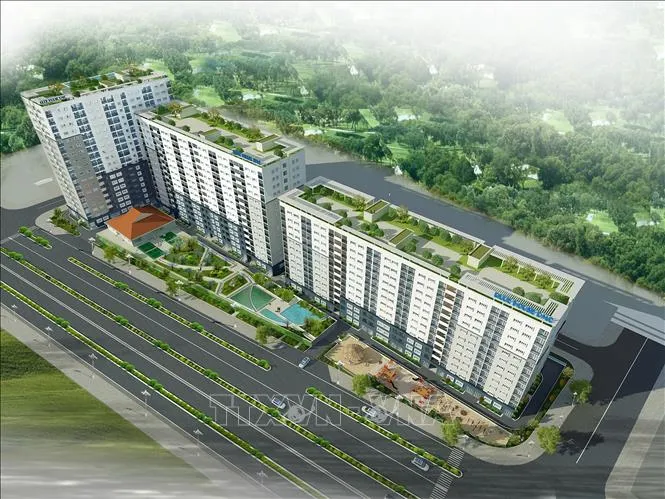
For a long time, social housing projects were primarily implemented with a support-oriented mindset, prioritizing quantity over quality - Illustration image
Changing the mindset regarding social housing development.
For a long time, social housing projects have been primarily implemented with a focus on support, prioritizing quantity over quality. Many projects are located far from the city center, lacking social infrastructure and transportation connections, meaning that while residents may be able to purchase affordable housing, they often have to pay a higher price for living expenses.
Dr. Le Xuan Nghia argues that the biggest weakness of many current projects is that they have only solved the problem of "having a place to live," but not the problem of "being livable." If people spend hours commuting every day, and lack schools, hospitals, and public spaces, then it is not a true housing policy.
According to experts, the new mindset needs to shift from "support and handouts" to "guaranteeing the right to secure housing" for the people. Social housing cannot simply be cheap housing blocks, but must be a living environment with full amenities, safety, and civility.
This requires the simultaneous investment in technical and social infrastructure from the outset, rather than building houses first and then adding amenities later. In particular, social housing for rent needs to be prioritized to become a strategic segment.
Regarding this matter, Mr. Nguyen Quoc Khanh suggested that, with adequate support in terms of land, credit, and taxes, social housing for rent could completely become a national strategic segment.
Currently, many international investment funds, especially ESG funds and pension funds from Japan, Singapore, and South Korea, may show strong interest in this segment if Vietnam completes the legal framework for Build-to-Rent, REITs, and real estate investment funds.
However, for the market to develop sustainably, the State needs to play a leading role instead of leaving everything entirely to businesses. Experts suggest that the State must proactively plan for clean land, invest in connecting infrastructure, and reform administrative procedures before inviting businesses to participate.



Social housing also needs to be planned within the overall urban development plan, prioritizing locations near public transportation, industrial zones, and employment centers, instead of continuing to be pushed to remote suburban areas.
In addition, it is necessary to design long-term credit packages of 20-30 years with stable interest rates for tenants, buyers, and investors alike; and to have sufficiently attractive tax exemptions and reductions to attract large businesses to participate.
However, Mr. Khanh also warned that the biggest risk to the current real estate market is tightening regulations too quickly without creating sufficient supply of rental housing and alternative preferential credit. Without new supply, the market could freeze, businesses would face difficulties, and bad debts would increase.
Therefore, experts believe that the transition needs to be carried out according to the right roadmap to move the Vietnamese real estate market into a new development cycle - where the focus is no longer on asset speculation but on generating cash flow, operating urban areas, and serving actual housing needs.
What people need is not just an affordable apartment, but the opportunity to live a stable life, in accordance with their income, and with a future in the very city they are helping to build every day.
Source: https://vtv.vn/doi-vai-trong-cac-phan-khuc-nha-o-100260617182319534.htm
![[Image] Ho Chi Minh City: Ma Lang area, Chicken-Rice Market about to change its appearance](https://vphoto.vietnam.vn/thumb/1200x675/vietnam/resource/IMAGE/2026/06/25/1782377698627_ndo_br_m1-jpg.webp)
![[Image] Schools organize meetings and introduce teaching models to students admitted to grade 10.](https://vphoto.vietnam.vn/thumb/1200x675/vietnam/resource/IMAGE/2026/06/25/1782368077271_ndo_br_z7970052192242-1ec8daeb77a6eed1a4e9f58c564ddd3e-jpg.webp)

![[Photo] General Secretary and President To Lam receives Palestinian Ambassador Saadi Salama](https://vphoto.vietnam.vn/thumb/1200x675/vietnam/resource/IMAGE/2026/06/25/1782365384740_a1-bnd-9423-8322-jpg.webp)