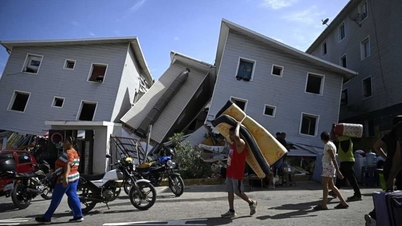
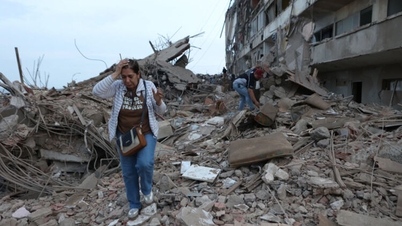
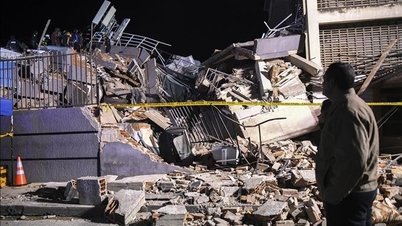
The earthquake recorded a magnitude of "above 6". A rare event, according to the Japanese seismic intensity scale (scale 0 to 7), occurred in Hashikami town, Aomori prefecture. No tsunami warning has been issued yet.
The earthquake caused intense shaking in many areas of northern Japan, with even mild tremors felt as early as Tokyo.
The office of Japanese Prime Minister Sanae Takaichi has established a task force to respond to the earthquake. Speaking to reporters at the office, Prime Minister Sanae Takaichi said the government is actively gathering information to assess the extent of damage and the impact of the earthquake.
According to local reports from Hashikami and Hachinohe, four injured people have been taken to the hospital.



There have been no reports of casualties, nor have any abnormalities been detected at nuclear power plants in the area.
According to the operators, no abnormalities were recorded at the Higashidori or Onagawa nuclear power plants (in Aomori and Miyagi prefectures), as well as the Fukushima Daiichi and Daini plants in Fukushima Prefecture.
In Hashikami town, five schools have been temporarily closed. Meanwhile, Hachinohe city has decided to close all 65 schools in the area to ensure the safety of students.
Regarding transportation, JR East announced that the Tohoku Shinkansen high-speed train service between Tokyo and Shin-Aomori had to be temporarily suspended immediately after the earthquake.
Japan lies on the Pacific Ring of Fire, making it one of the countries most frequently affected by earthquakes in the world .


The Japan Meteorological Agency has issued a warning to residents in affected areas to be vigilant due to the potential for strong aftershocks in the near future.
Source: https://baovanhoa.vn/doi-song/dong-dat-manh-tan-cong-mien-bac-nhat-ban-240128.html














































![[Image] Ho Chi Minh City: Ma Lang area, Chicken-Rice Market about to change its appearance](https://vphoto.vietnam.vn/thumb/1200x675/vietnam/resource/IMAGE/2026/06/25/1782377698627_ndo_br_m1-jpg.webp)