

In the first six months of 2024, state budget revenue in Dong Trieu town reached 50%. This figure demonstrates the efforts of the entire locality amidst the current economic difficulties.

It has been put into use, increasing budget revenue.
Since the beginning of the year, the town has decisively directed the disbursement of investment capital and the management of budget revenue and expenditure for 2024; directed the development of a budget revenue plan for 2024; focused on key areas, improving the effectiveness and efficiency of state budget revenue management, ensuring accurate and sufficient collection, nurturing revenue sources, and increasing the proportion of sustainable revenue sources; thoroughly saving on expenditures from the task identification and budget preparation stages, especially saving on recurrent expenditures to increase investment in development. Reviewed, evaluated, and assessed the implementation of land use fee collection plans for 2023 and projected for 2024. Submitted for appraisal and approval the plan for rearranging 107/107 land and housing facilities in the town…
Total state budget revenue in the first six months of 2024 reached VND 1,111 billion, equivalent to 50% of the provincial and town-level budget estimates, and 91.6% compared to the same period in 2023. The town's revenue (collected by the Tax Department) reached VND 363.933 billion, achieving 63.3% of the assigned budget estimate and increasing by 45.1% compared to the same period . Of which: Land use fee collection reached VND 139.293 billion, achieving 55.7% of the allocated budget and increasing by 140.2% compared to the same period last year; remaining taxes, fees, charges and other revenues. It reached VND 224.64 billion, achieving 69.2% of the allocated budget and increasing by 16.5% compared to the same period last year.

Six out of eleven revenue items met or exceeded the average collection rate (revenue from central state-owned enterprises; revenue from the non-state sector; personal income tax; land and water lease fees; mineral resource exploitation rights fees; other budget revenues); five out of eleven revenue items did not meet the average collection rate for the first six months of the year (revenue from local state-owned enterprises; registration fees; non- agricultural land use tax; fees and charges; revenue at the commune level). Of the 21 communes and wards, 17 achieved an average collection rate of 50% or more of the fees and charges assigned by the town.
Total budget expenditure of the town for the first six months (excluding advances carried over from the previous year) reached VND 623.713 billion, achieving 30.6% of the town's budget estimate after adjustment of the public investment capital plan, an increase of 57.5% compared to the same period last year. Development investment expenditure (excluding outstanding advances carried over from the previous year and deducting extended provincial budget capital) reached VND 208.775 billion, equivalent to 41% of the initial capital allocation plan; equivalent to 32% of the adjusted capital plan, an increase of 277% compared to the same period last year. Recurrent expenditure reached VND 414.938 billion, achieving 36.6% of the allocated budget estimate; an increase of 21.8% compared to the same period last year .
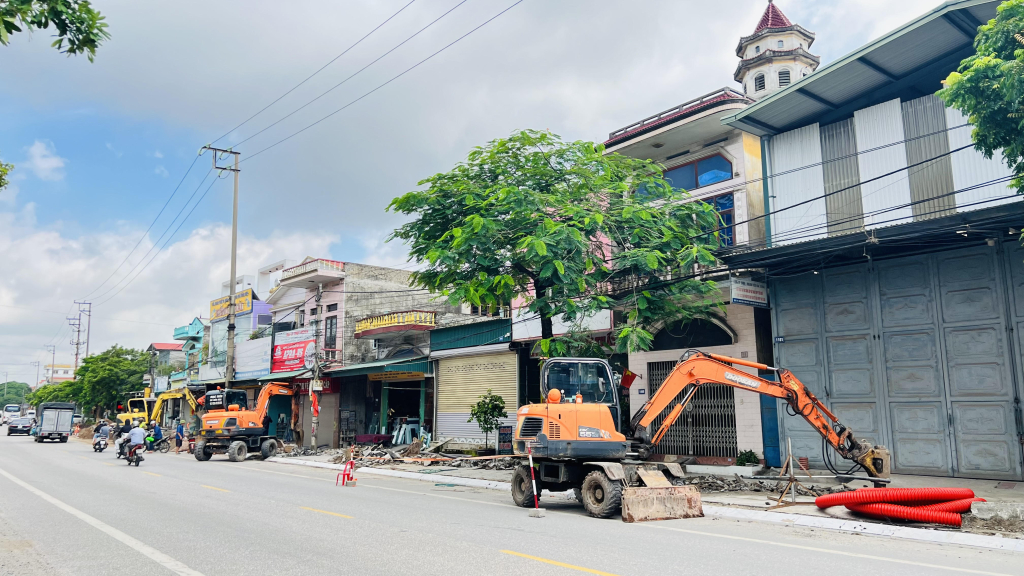
According to Mr. Tran Duy Thanh, Deputy Head of the Finance and Planning Department of the town, in the last six months of the year, the town is determined to ensure budget revenue and expenditure according to the plan, focusing on collecting land use fees and other taxes, fees, and charges. Regarding land use fees, the town will urge the collection of outstanding auction winning bids; supplement the land price plan for resettlement in Vinh Xuan area, Mao Khe ward; organize the implementation of resettlement plans, striving to collect 65 billion VND in resettlement funds; and continue to organize auctions of scattered, small land plots to ensure land use fee collection, aiming for completion in the third quarter of 2024.
Regarding tax and fee collection, the Tax Department, in coordination with relevant agencies, units, and the People's Committees of communes and wards, will continue to focus on the following revenue sources in the first six months of the year: Revenue from central state-owned enterprises; revenue from the non-state sector; non-agricultural land use tax; land and water surface lease fees; fees and charges; mineral resource exploitation rights fees; and other budget revenues . They will review emerging revenue sources, accurately identify taxpayers in the area and sector to develop appropriate and effective collection solutions, and exploit remaining revenue sources with potential (digital platforms, e-commerce, etc.). They will also boost revenue from the coal industry, maintaining its role as the largest contributor to domestic revenue. Alongside this, they will implement solutions to increase non-state tax revenue; revenue from local state-owned enterprises; personal income tax, registration fees; non-agricultural taxes; land and water surface lease fees; and other budget revenues.
Source



![[Photo] National Assembly Chairman Tran Thanh Man attends the policy seminar to promote Vietnam-Türkiye cooperation.](https://vphoto.vietnam.vn/thumb/1200x675/vietnam/resource/IMAGE/2026/04/16/1776351415367_vna-potal-chu-tich-quoc-hoi-tran-thanh-man-du-toa-dam-chinh-sach-thuc-day-hop-tac-viet-nam-tho-nhi-ky-8705791-jpg.webp)
















![[Image] Bridges and roads connecting the eastern part of Ho Chi Minh City](https://vphoto.vietnam.vn/thumb/1200x675/vietnam/resource/IMAGE/2026/04/16/1776328595108_ndo_br_bh-vt5-jpg.webp)
































![[Infographic] Details of the Hanoi-Quang Ninh High-Speed Railway Project](https://vphoto.vietnam.vn/thumb/402x226/vietnam/resource/IMAGE/2026/04/16/1776338188424_anh-man-hinh-2026-04-16-luc-18-16-10.png)

![[Photo] National Assembly Chairman Tran Thanh Man meets with the Speaker of the Georgian Parliament](https://vphoto.vietnam.vn/thumb/402x226/vietnam/resource/IMAGE/2026/04/16/1776338494029_anh-man-hinh-2026-04-16-luc-18-21-21.png)

















Comment (0)