

5 challenges of the AI economy
Data and AI are opening up new development opportunities for countries in the digital age. Not only are they changing the way we produce, do business, and manage, but AI is also expected to become a crucial driver of economic growth, increased labor productivity, and enhanced competitiveness.
However, to effectively capitalize on these opportunities, in addition to its existing potential and advantages, Vietnam is also facing many challenges that need to be identified and addressed promptly in order to create a solid foundation for the development of the digital economy and AI economy in the future.
At the workshop "Data & AI: From Infrastructure to Practical Value," organized by the Institute of Technology & Digital Economy (Hanoi University of Science and Technology) in collaboration with the Institute for Advanced Studies in Mathematics, Dr. Ha Huy Ngoc, Director of the Center for Policy and Strategy Research (Vietnam and World Economics Institute), shared insights on the challenges facing Resolution 57-NQ/TW on breakthroughs in national science , technology, innovation, and digital transformation.

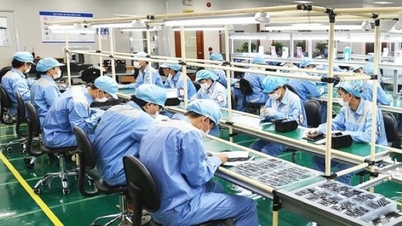
The AI economy is expected to become a new engine of growth. Photo: Thanh Tuan
Dr. Ha Huy Ngoc believes that it is crucial to identify these challenges in order to achieve the set goals, so that data and AI are truly transformed into productivity and competitiveness of the economy, instead of just remaining at the level of individual digital transformation projects.
“ The strategy is in place and the goals are very ambitious. Besides the goal of the digital economy accounting for 30% of GDP by 2030, we also aim for an average growth rate of around 10% during the period up to 2030. This means that, in addition to traditional growth drivers such as consumption, exports, and public investment, the digital economy, AI, and data are expected to become a new growth space that we need to exploit more strongly to contribute to economic growth ,” said Dr. Ha Huy Ngoc.
According to forecasts, AI could contribute approximately $120-130 billion to the Vietnamese economy by 2040. This is a very large figure. However, to achieve that scale, we must also overcome many challenges ourselves.
First , there's the infrastructure. This is one of the biggest challenges today. We lack large-scale data infrastructure, data centers, computing power, and high-speed network infrastructure. Although large companies like Viettel,FPT , and others are investing heavily in this field, given the current growth rate and demand for AI, infrastructure remains a major bottleneck.
Secondly , we lack a complete ecosystem for a data-driven economy. An economy where every decision, from corporate governance to policymaking, is based on data requires a comprehensive data ecosystem, encompassing data collection, sharing, connection, and exploitation. Currently, that ecosystem is not yet fully formed.
Thirdly , there are institutional and legal issues. Regulations related to AI, data, algorithm transparency, legal liability, and even ethical principles in the use of AI are currently lacking and incomplete. These are crucial factors in building trust among society and businesses when applying AI on a large scale.

Fourthly , there's the issue of people, human resources, and talent. We are lacking a high-quality workforce in the field of AI. Many AI startups, once they reach a certain scale, become competitive, or are preparing to enter a strong growth phase, relocate abroad.
“ This is a very thought-provoking story. Many AI startups begin in Hanoi, expand to Ho Chi Minh City, but as they grow, they choose to relocate abroad to seek a more favorable investment and development environment, ” shared Dr. Ha Huy Ngoc.
Fifthly , there is the issue of investment capital. Currently, financial resources for AI are still very limited. We lack mechanisms for mobilizing long-term capital for this sector, large-scale investment funds, the participation of insurance funds and financial institutions, as well as public-private partnership models for large-scale AI infrastructure projects.
“ These are the five challenges I have identified. In my opinion, these are the issues we need to overcome if we want to realize our very ambitious goals regarding the digital economy and AI ,” emphasized Dr. Ha Huy Ngoc.
According to Dr. Ha Huy Ngoc, the best way to overcome these challenges is to overcome ourselves, to change our mindset, change our approach, and boldly remove the barriers that we ourselves have been creating for development.
Unlocking growth potential from AI
Sharing further insights on how private businesses can participate more strongly in the digital economy, data economy, and AI economy, Dr. Ha Huy Ngoc suggested that all three groups—the public sector, state-owned enterprises, and private enterprises—need to work simultaneously.
“ Because infrastructure is directly related to businesses. If we talk about establishing institutions first but lack infrastructure, then operations cannot function. Conversely, if we have infrastructure but lack institutions and business participation, it is very difficult to create a genuine market. Therefore, these three pillars must be implemented simultaneously ,” Dr. Ha Huy Ngoc expressed.

Data and artificial intelligence are becoming crucial drivers of economic growth. (Illustrative image)
For the business sector, the government could launch a nationwide AI transformation program, particularly targeting small and medium-sized enterprises (SMEs). This could be accompanied by the establishment of AI credit packages, including tax incentives, consulting support, testing support, and the development of criteria for assessing the AI maturity level within businesses at different stages of development.
In addition, support is needed for businesses to implement AI internally, such as AI assistants for businesses, intelligent automated search systems, and data analytics platforms for management, production, sales, and customer service.
For the public sector, a common set of AI standards needs to be developed for ministerial, provincial, and commune/ward levels. This must be a very clear set of standards for all government agencies to use on a unified platform. With a common set of standards and platform, the results of processing, responding to, and serving citizens and businesses will be more consistent, transparent, and efficient.

For industries and sectors that aim to create high added value, improve labor productivity, and promote rapid growth, priority can be given to sectors such as industry, logistics, finance, healthcare, agriculture, and education... These are all sectors with high demand and significant potential for AI application.
“ Our research shows that AI impacts unevenly across sectors. There are four sectors with the highest AI adoption rates: information technology, finance, science and technology, and manufacturing. These four sectors currently account for approximately 34% of GDP and generate more than 50% of the impact of AI on the economy ,” Dr. Ha Huy Ngoc stated.
Based on these results, it is clear that more focus should be placed on the four sectors with the strongest potential to absorb and spread AI. With the potential to contribute nearly 4 percentage points to GDP growth and generate cumulative value equivalent to approximately US$640 billion by 2045, Vietnam has a tremendous opportunity to develop an AI economy.
“ The period from 2026 to 2028 will be a golden time to establish crucial foundations for the AI economy, from infrastructure, institutions, data, human resources to the market. If we do well during this period, we will have a more solid basis to achieve major goals in the digital economy, data, and AI in the following years ,” emphasized Dr. Ha Huy Ngoc.
Data and AI are opening up tremendous opportunities to enhance productivity, foster innovation, and create new drivers of economic growth. According to experts, improving infrastructure, institutions, and human resources will be key factors in realizing this potential.
Source: https://congthuong.vn/du-lieu-va-ai-co-hoi-lon-cho-tang-truong-moi-459801.html



































































![[Video] Sunset at Lap An Lagoon – Where the sun sets over the fishing nets](https://vphoto.vietnam.vn/thumb/1200x675/vietnam/resource/IMAGE/2026/05/31/1780192137701_beach-landscape-sea-water-nature-grass-745871-pxhere-com.jpeg)








































Comment (0)