

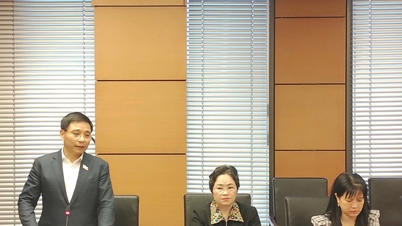
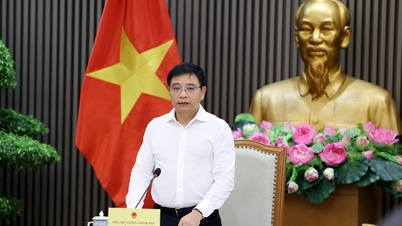
Expressing his views on the revised draft Law on Special Consumption Tax, Mr. Nguyen Van Phung, former Director of the Department of Large Enterprise Tax Management (General Department of Taxation), said that the draft submitted to the National Assembly at the eighth session has many progressive points compared to previous drafts.
The draft Law on Special Consumption Tax has many progressive points.
Expressing his views on the revised draft Law on Special Consumption Tax, Mr. Nguyen Van Phung, former Director of the Department of Large Enterprise Tax Management (General Department of Taxation), said that the draft submitted to the National Assembly at the eighth session has many progressive points compared to previous drafts.
 |
| Mr. Nguyen Van Phung, former Director of the Department of Large Enterprise Tax Management (General Department of Taxation) |
Speaking at numerous seminars on amending excise tax, he supported the proposal to raise tax rates on goods and services currently subject to tax and to broaden the tax base. So what is the basis for his viewpoint?
Resolution 07-NQ/TW (dated November 18, 2016) of the Politburo on the principles and solutions for restructuring the state budget directed the improvement of revenue policies associated with restructuring state budget revenue in a way that encompasses all revenue sources, expands the revenue base, especially new revenue sources, in line with international practices. The Strategy for Tax System Reform until 2030, approved by the Prime Minister in Decision 508/QĐ-TTg (dated April 23, 2022), also sets the goal and tasks for 2030 to continue improving the tax policy system associated with restructuring state budget revenue in a way that encompasses all revenue sources, expands the revenue base, especially new revenue sources, in line with international practices; ensuring a reasonable proportion of domestic revenue and a reasonable proportion between indirect and direct taxes.
Thus, the Party's viewpoint and the Prime Minister 's directives require that the tax policy system must be perfected by 2030. At the eighth session, the National Assembly gave its opinion and passed the Law on Value Added Tax, Corporate Income Tax, and Special Consumption Tax, aiming to restructure revenue sources and expand the tax base, in line with the Party's directives and the Tax System Reform Strategy.
But sir, the taxation of sugary drinks is facing opposition from businesses and consumers?
Decision 508/QD-TTg requires a review and study of amendments and additions to the subjects liable to excise tax in order to regulate consumption in line with the shifting consumption trends in society and the Party and State's orientation on protecting public health and the environment.
Vietnam officially enacted the Law on Special Consumption Tax in 1998, and from 2008 to the present, it has been amended and supplemented four times. Almost every time, the Government has tasked the Ministry of Finance with researching and adding soft drinks to the list of taxable items. The Ministry of Finance has studied international practices, sought input from organizations, individuals, businesses, and experts in various fields; and incorporated feedback, ultimately withdrawing the proposal to levy special consumption tax on soft drinks. I believe now is the opportune time to levy special consumption tax on soft drinks; the deadline should not be postponed.
Not only excise tax, but any tax, when applied or increased, will receive reactions from businesses and consumers. To reduce negative reactions and increase positive ones, the role of the media is crucial.
According to him, what is the role of the media in this matter?
During this session, the National Assembly passed the Value Added Tax Law and provided input on the Corporate Income Tax Law. Currently, countries around the world apply much higher value added tax rates than Vietnam. The Ministry of Finance had previously proposed raising the value added tax rate from the current 10% to 12%, but after considering all factors, decided to keep the rate unchanged. This latest amendment to the value added tax also maintains the same rate.
The draft Corporate Income Tax Law proposes a tax rate of 17% or 15% (depending on revenue), instead of the 20% rate applied to small and medium-sized enterprises. Import taxes will also be gradually reduced according to a schedule.
In balancing the state budget, a reduction in one revenue source must be accompanied by an increase in another. Only then will the State have money to invest in healthcare, education, national defense, security, social welfare, and care for the poor and those eligible for social policies. Businesses and individuals who receive reductions or preferential treatment in other taxes must also contribute back to the state budget when using goods subject to excise tax. The media and press need to educate businesses and the public to understand and agree with this.
However, many experts believe that the proposal to impose a 10% tax on soft drinks with a sugar content exceeding 5g/100ml is unreasonable.
Specific research is needed to determine the direct impact of a 10% or 5% tax rate on businesses, and the indirect impact on other industries such as packaging, can, and bottle manufacturing. Without concrete data, any statement that it is reasonable or unreasonable is merely subjective and based on personal feelings.
According to projections, the National Assembly will only pass the revised Law on Special Consumption Tax in June 2025, so there is still enough time for the Drafting Committee, the reviewing agency, relevant state management agencies, associations, businesses, experts, and scientists to research and determine a reasonable tax rate as well as the sugar content in soft drinks that would be subject to tax. All contributions must be based on scientific principles, objective practical experience, international practices, and people's consumption habits, and should not be based on emotions or subjectivity.
The amended Special Consumption Tax Law will only be passed in June 2025, but he has already stated that the draft submitted to the National Assembly at the eighth session has many progressive points?
Decision 508/QD-TTg mandates research into applying a combination of proportional and absolute tax rates to excise tax, as many countries have already done. Previous drafts of the Excise Tax Law were developed with a focus on absolute and mixed taxation, but the version submitted to the National Assembly still implements a relative tax based on a percentage of the price of goods and services, after the Drafting Committee incorporated feedback.
In Vietnam, the prices of beer, wine, and tobacco products vary widely. Since the majority of consumers use affordable products, applying a mixed or absolute tax method would harm both manufacturers and consumers. Therefore, the current relative tax calculation method is appropriate.
Source: https://baodautu.vn/du-thao-luat-thue-tieu-thu-dac-biet-co-nhieu-diem-tien-bo-d228873.html



![[Photo] General Secretary and President To Lam presides over a meeting on preparations for the review of one year of operation of the three-tiered government system.](https://vphoto.vietnam.vn/thumb/1200x675/vietnam/resource/IMAGE/2026/06/02/1780391821195_a1-bnd-4595-9717-jpg.webp)













































































Comment (0)