

It was only 5 a.m., still pitch black, but Mr. and Mrs. Thanh and Chất, from Zone 10, Phù Ninh Commune, Phù Ninh District, were already getting up to boil water to slaughter a pig. For many years, from the time their children were young until now, when their sons and daughters have all married and moved out, they have maintained the tradition of slaughtering a pig so that their children can share the meat during the Lunar New Year. Like Mr. and Mrs. Thanh and Chất's family, many families still maintain the custom of "sharing a pig" at the end of the year, partly for family and children, and partly to invite siblings, neighbors, and friends to share a little of the delicious meat during the last days of the year.
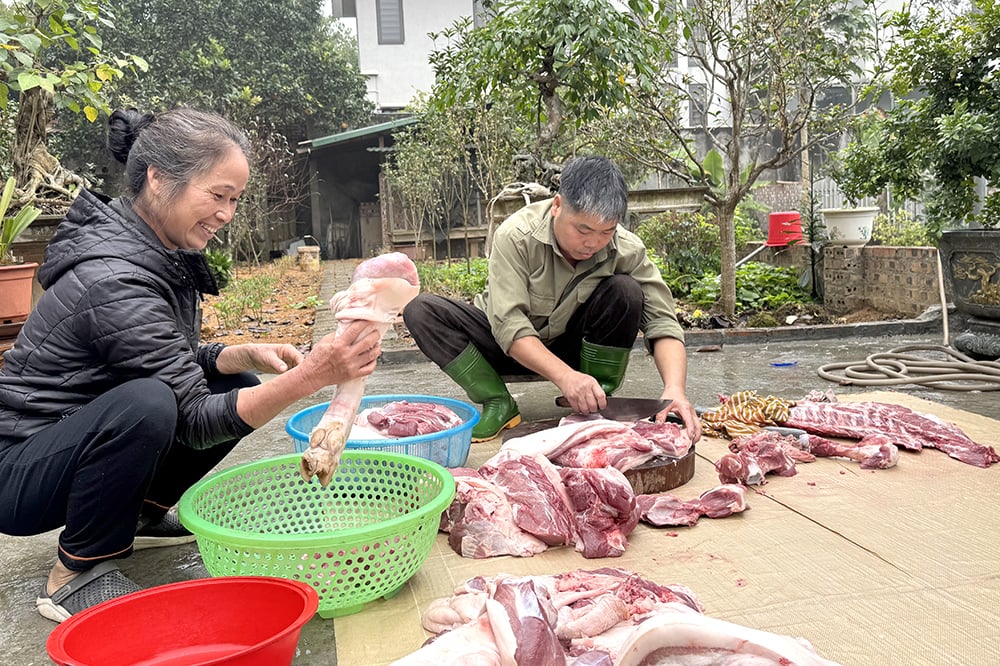
After being butchered, the pig is "cut" into different parts for diners to share.
Starting from the 15th day of the 12th lunar month, in many villages, the sounds of pigs squealing, people talking excitedly, knives and chopping boards clattering, and people calling out to each other fill the air from early morning. For many, the unforgettable memory of the traditional Tet holiday is the slaughtering of pigs for Tet, a beautiful tradition that reflects unity and frugality, common in rural areas. Although not as prevalent as before, it still exists and is continued by many families.
Ms. Thanh shared: "Usually, the idea of sharing a pig is discussed and considered by the whole family months before Tet. We only raise one or two good pigs a year, and since we have three children who all live separately, my family mainly slaughters the pig and shares it among the children. Many families in the neighborhood, however, choose to share. Several families discuss where to find the best, cleanest pigs, buy them together, and then from the end of November in the lunar calendar, they bring them to one house to raise until the day of slaughter. Usually, families of siblings, relatives, neighbors, or close friends share the pig."
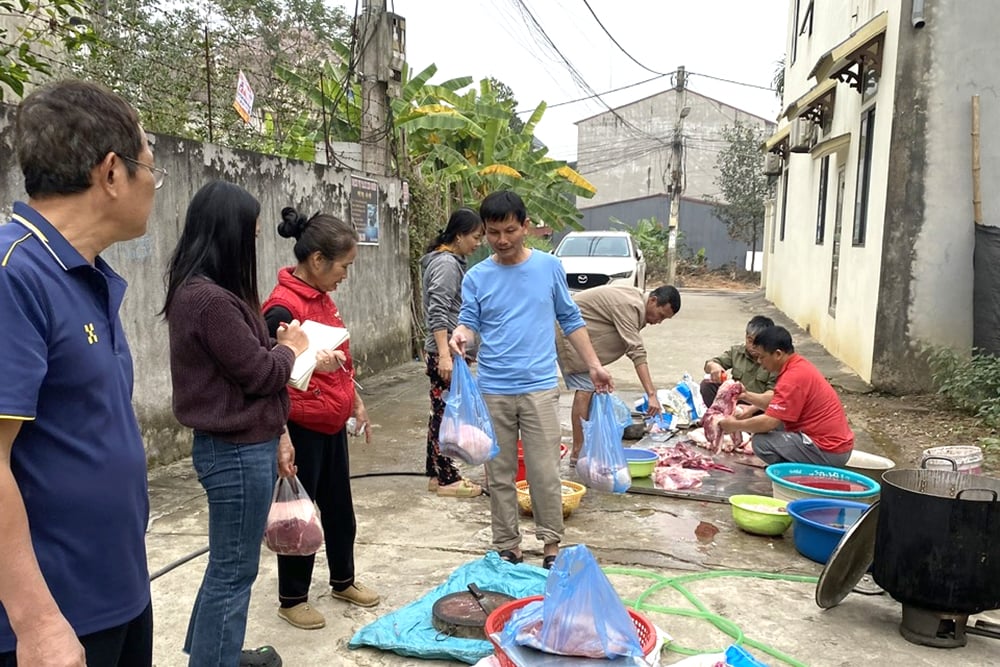
The day of the "pig slaughtering" feast is a day when everyone gathers together for a joyful celebration.
Because choosing a pig for Tet (Lunar New Year) is a tradition, families are more meticulous. Some people visit several houses before finding a suitable pig. The chosen pigs are usually large enough to be divided into portions, as the elders say, "each piece is its own," but they must be lean with little fat and firm meat. Many careful families buy a pig weighing 30-40 kg at the beginning of the year and have it raised jointly, or one household takes responsibility for raising it. The pigs reserved for Tet are also raised on a diet of vegetables and rice bran, not fattened, and sometimes even allowed to roam freely in the garden... to ensure the meat is leaner and tastier. Although many places begin slaughtering pigs after the 15th day of the 12th lunar month, the busiest time is from around the 23rd day of the 12th lunar month onwards, mainly on the 27th and 28th. After the meat is taken, everyone plans to use parts for making banh chung (traditional rice cakes), parts for making gio kojing (a type of Vietnamese sausage), and parts for cha (a type of Vietnamese sausage) to ensure they have enough.
Despite being away from her hometown for many years, Hong Nhung from Tu Liem, Hanoi, still eagerly awaits Tet (Lunar New Year) to return home and share a pig. She shared: "Some years, my family eats with my grandmother's family, other years, friends from my hometown invite me to share the meat. Even though I'm busy with work at the end of the year, I really enjoy the feeling of going back home, hearing the pigs squealing in the sty, the sounds of knives and chopping boards, the chopping and slicing. Usually, many families slaughter pigs around this time. Some years, from dawn until dusk, you can hear the squealing of pigs throughout the village, along with people calling out to each other. Everyone has a task: some with chopping boards and knives, others with baskets and containers, some cutting banana leaves, others preparing boiling water... The men boil water, shave the hair, and prepare the offal. The women prepare salt, fish sauce, baskets, and banana leaves for the portions... All of this creates a warm and intimate picture of Tet in the countryside."
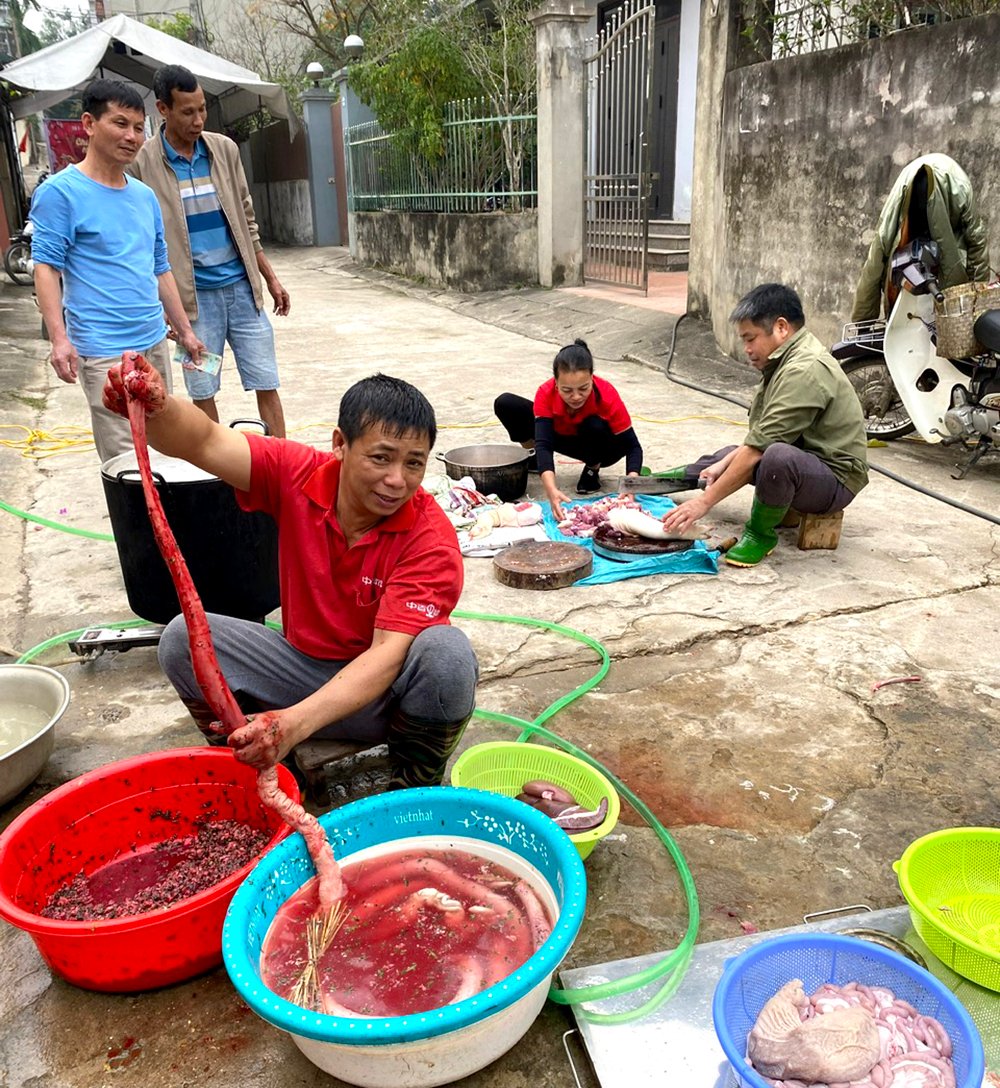
Making sausage is the most time-consuming step.
The most enjoyable part of the "pig slaughtering" day is when the pig is cleaned, laid out on a tray, and the butchers begin to butcher the meat and remove the bones. Usually, the pig is divided into four large sections called "legs." Then, depending on how many people are slaughtering and the size of the pig, these legs are further divided. Families with many members take a whole leg, while those with fewer members take half a leg or less. Everything is distributed evenly according to the number of people eating, from lean meat, fat, bones, head, ears, tongue, to blood pudding, intestines, and sausages... Of all the steps in pig slaughtering, making the intestines and sausages is usually the most time-consuming. Scraps of meat, fat, mung beans, sticky rice, herbs, blood, etc., are mixed together with spices and stuffed into the cleaned intestines. After stuffing, the sausages are boiled and divided. The finished intestines are also divided into sections and distributed along with the heart, liver, and other internal organs.
While busily dividing up portions, Ms. Son from Tho Son ward, Viet Tri city, shared: “Every year, my husband and I return to our hometown of Tam Nong to have a feast with our relatives. Usually, this is also a day when all the children and grandchildren gather together. The meat is divided up, and the remaining offal and pig's head are used to make a feast for the whole family to enjoy together. The offal and sausage are boiled until fragrant, the pork head is boiled until perfectly cooked and crispy, and the broth is used to make porridge. In the past, we used to make blood pudding, but now fewer people eat it, so the blood is usually used to make porridge or a bowl of blood soup to cool the stomach.”
The joyful gathering and reunion during the "pig slaughtering" ritual serves as a prelude to Tet, creating a vibrant and exciting atmosphere. It is also here that a distinctive aspect of Vietnamese culture is clearly expressed: village culture. In recent years, as living standards have improved, the need for food storage during Tet has decreased, and goods are abundant with many types of ready-made food. However, many families in rural areas still maintain the custom of "pig slaughtering" to enhance the Tet atmosphere. This is because "pig slaughtering" is not only a rural custom during times of economic hardship and food scarcity, but it also deeply reflects the cultural identity and characteristics of Vietnamese village culture: the close bond between neighbors and relatives, and mutual support shared during the Tet holiday.
Thu Ha
Source: https://baophutho.vn/dung-lon-ngay-tet-227017.htm
![[Image] Nearly 125,000 Hanoi students completed the Literature exam for the 10th grade entrance exam.](https://vphoto.vietnam.vn/thumb/1200x675/vietnam/resource/IMAGE/2026/05/30/1780117233041_ndo_br_thiet-ke-chua-co-ten-2-png.webp)














![[Video] Sunset at Lap An Lagoon – Where the sun sets over the fishing nets](https://vphoto.vietnam.vn/thumb/800x450/vietnam/resource/IMAGE/2026/05/31/1780187239592_2222.jpeg)

































![[Video] Sunset at Lap An Lagoon – Where the sun sets over the fishing nets](https://vphoto.vietnam.vn/thumb/402x226/vietnam/resource/IMAGE/2026/05/31/1780187239592_2222.jpeg)



































Comment (0)