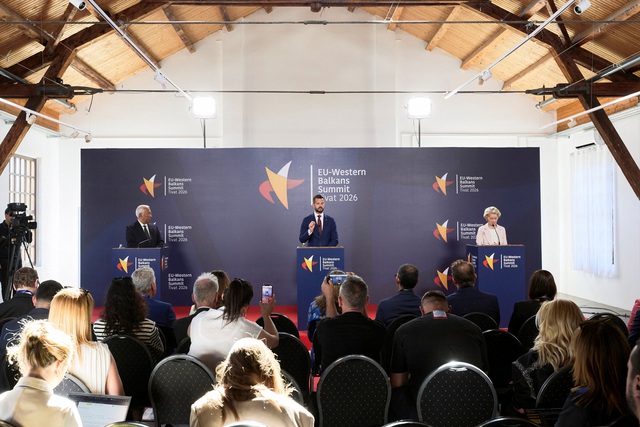
European Council President Antonio Costa, Montenegrin President Jakov Milatovic, and European Commission President Ursula von der Leyen attend a joint press conference during the EU-Western Balkans Summit in Tivat, Montenegro, on June 5, 2026.
Photo: Reuters



The reason is that five countries in the western Balkan Peninsula – Montenegro, Albania, Serbia, Bosnia and Herzegovina, North Macedonia, and Kosovo – have become impatient because they have not yet joined the EU. The bloc now has legitimate reasons to worry that these partners are gradually losing trust, no longer steadfast in their pursuit of closer ties with the EU, and instead leaning towards partners outside the region, particularly Russia and China.
These candidates also have two other reasons to be skeptical about their prospects of joining the EU. Firstly, the EU is currently deeply divided internally regarding the direction, criteria, and roadmap for expansion. Secondly, the EU currently prioritizes countries surrounding Russia, such as Ukraine and Moldova, resulting in clear discrimination between partners in this region and those in the western Balkans in its expansion strategy.
Therefore, the EU urgently needs to organize this high-level meeting to retain its partners, encourage them to remain steadfast in their commitment to EU integration, and prevent them from isolating themselves or leaning entirely towards Russia and China. However, this retention should still be done from a distance, not with the guarantee of immediate acceptance, and certainly not with the intention of immediate acceptance. That would be nothing more than a futile attempt to "put out the fire" with empty promises.


Source: https://thanhnien.vn/eu-niu-giu-de-chua-chay-185260607205928748.htm
![[Photo] General Secretary and President To Lam receives Palestinian Ambassador Saadi Salama](https://vphoto.vietnam.vn/thumb/1200x675/vietnam/resource/IMAGE/2026/06/25/1782365384740_a1-bnd-9423-8322-jpg.webp)

![[Image] Schools organize meetings and introduce teaching models to students admitted to grade 10.](https://vphoto.vietnam.vn/thumb/1200x675/vietnam/resource/IMAGE/2026/06/25/1782368077271_ndo_br_z7970052192242-1ec8daeb77a6eed1a4e9f58c564ddd3e-jpg.webp)

![[Image] Ho Chi Minh City: Ma Lang area, Chicken-Rice Market about to change its appearance](https://vphoto.vietnam.vn/thumb/1200x675/vietnam/resource/IMAGE/2026/06/25/1782377698627_ndo_br_m1-jpg.webp)
















![[GALLERY] Discovering 5 amazing Samsung features that few people know about.](https://vphoto.vietnam.vn/thumb/402x226/vietnam/resource/IMAGE/2026/06/25/1782394498324_tin-6-png.webp)