





South Korea defeated the Czech Republic 2-1, Qatar drew with Switzerland 1-1, Australia beat Türkiye 2-0, Japan drew with the Netherlands 2-2, and Iran shared points with New Zealand in a four-goal match. Not every Asian team achieved a perfect opening day result, but these were all impressive performances against opponents considered to be of equal or higher caliber.
 |
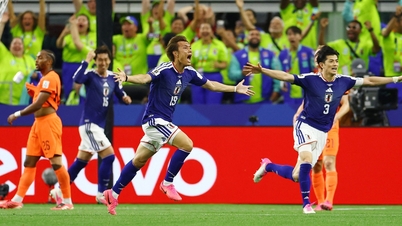
| Japanese players celebrate emotionally after scoring the equalizer to secure a 2-2 draw against the Netherlands. Photo: AP |
For a long time, most Asian teams participating in the World Cup have been considered "underdogs" when compared to the top teams of Europe and South America. They don't possess many stars playing for the world's biggest clubs; nor do they have players among the world's top footballers. Their squad value, FIFA ranking, or track record are hardly comparable to the title contenders.
Asian teams are well aware of their position. They enter the tournament with a "know yourself, know your opponent" mindset, aiming for realistic results and striving to win each match. While title contenders plan for the long term, balancing their physical fitness for the entire journey lasting over a month, for many Asian teams, each group stage match is a final.


While top teams might be hesitant to warm up and sometimes hold back their tactics for the sake of winning the championship, underdog teams often have to unleash everything they have from the very first minute. They don't have many opportunities to correct mistakes; a point earned against a strong opponent is sometimes as valuable as a victory, a historic milestone.
Therefore, fans often witness extremely high-intensity performances from Asian teams. They run more, compete more fiercely, and maintain maximum concentration throughout the 90 minutes. This is the state of play that people jokingly call playing with "100% to 120% effort." Japan is a prime example. Their players are at a disadvantage in terms of physique and stamina compared to the Netherlands. Despite repeatedly falling behind, the "Blue Samurai" persevered in attacking, persistently crossing the ball, and using the Netherlands' strength of aerial play to secure a 2-2 draw. South Korea was trailing against the pragmatic Czech Republic, but with perseverance and an unyielding spirit, they equalized before securing a 2-1 victory with high-quality goals.
When stepping onto the field against stronger opponents, Asian teams carry with them the desire to prove they deserve to be present on the biggest stage on the planet. And sometimes, that "nothing to lose" spirit becomes their most dangerous weapon: playing for their national colors, for the honor of participating in the World Cup, and for honor and the aspiration to rise to the top.
It remains to be seen how far Asian teams will go at the 2026 World Cup. But if they continue to maintain their fighting spirit, discipline, and ability to capitalize on opportunities, they can certainly continue to set new milestones, helping to narrow the gap in football standards between Asia and Europe and South America.

Source: https://www.qdnd.vn/the-thao/worldcup-2026/gang-suc-da-tung-tran-1044992
![[Photo] General Secretary and President To Lam receives Palestinian Ambassador Saadi Salama](https://vphoto.vietnam.vn/thumb/1200x675/vietnam/resource/IMAGE/2026/06/25/1782365384740_a1-bnd-9423-8322-jpg.webp)
![[Image] Schools organize meetings and introduce teaching models to students admitted to grade 10.](https://vphoto.vietnam.vn/thumb/1200x675/vietnam/resource/IMAGE/2026/06/25/1782368077271_ndo_br_z7970052192242-1ec8daeb77a6eed1a4e9f58c564ddd3e-jpg.webp)
![[Image] Ho Chi Minh City: Ma Lang area, Chicken-Rice Market about to change its appearance](https://vphoto.vietnam.vn/thumb/1200x675/vietnam/resource/IMAGE/2026/06/25/1782377698627_ndo_br_m1-jpg.webp)















![[GALLERY] Voidling Bound takes Steam by storm with 94% positive reviews.](https://vphoto.vietnam.vn/thumb/402x226/vietnam/resource/IMAGE/2026/06/25/1782396892878_tua-1-png.webp)