

In the context of increasingly severe and unpredictable climate change, with 7 million hectares of rice-growing land, Vietnam plays a crucial role in ensuring global food security, and the quality of its rice is increasingly highly regarded. This is immediately reflected in the fact that export rice prices remain among the highest in the world.
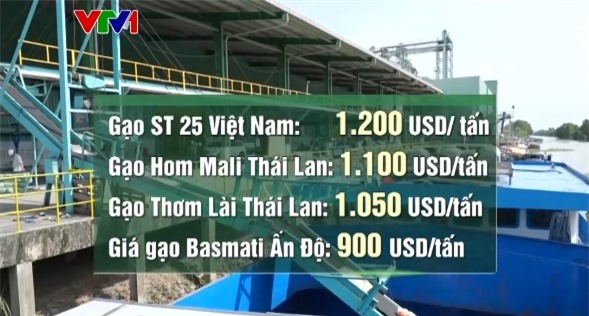
The average export price of Vietnamese rice in the first four months of this year reached over 514 USD/ton. High-end Vietnamese rice is also fetching the highest prices, with 1,200 USD for one ton of ST 25, considered the world's best rice.
Meanwhile, comparable rice varieties from other countries like Thailand or India are priced $100-$300 lower per ton.
Technology opens up a future for rice cultivation.
Beyond simply producing high-quality rice, Vietnam is also pioneering the production of low-emission rice under the brand name "Green Vietnamese Rice with Low Emissions".
In the project to cultivate 1 million hectares of high-quality rice in the Mekong Delta, farmers and businesses have been directly applying and benefiting from the advantages of science , technology, and modern machinery, replacing traditional manual farming processes.
Optimizing production, improving farming efficiency, saving costs, and reducing environmental impact, Vietnamese rice is transforming in line with the technological era. The life cycle of a rice plant is now measured not only by harvests but also by data and technology. Rice cultivation areas are digitized, accurate to the square meter, and the amount of seeds and fertilizer needed for each growth stage of the plant can be calculated.
Technology opens up a future for rice cultivation.
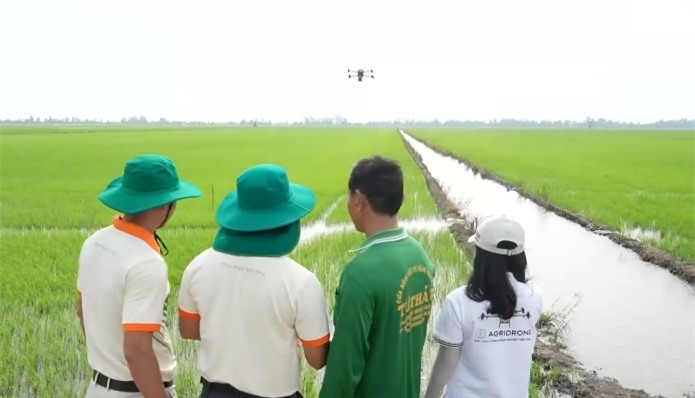
No more wading through mud under the scorching sun; now, from a distance, farmers can control drones to spread fertilizer precisely, gently, and efficiently to each rice plant, all in just two hours.
From untouched fields, we have the world's finest rice varieties, produced in state-of-the-art rice mills with cutting-edge technology.
The Happiness Rice Mill is currently the largest rice mill in Asia, covering a total area of 161,000 square meters. Its daily capacity reaches 4,800 tons. A particularly noteworthy feature is its system of 80 giant silos with a capacity of up to 240,000 tons of paddy rice – the rice reserve of the Mekong Delta, playing a crucial role in the national rice supply chain and exports.
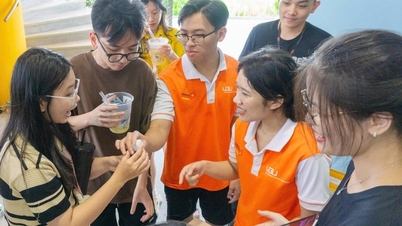
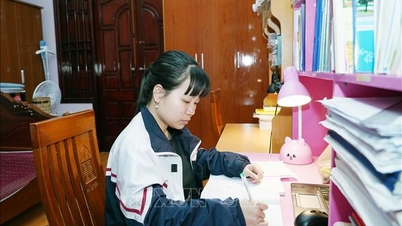
Amidst the ever-changing rice fields, young people with knowledge and passion have chosen to stay in their homeland, becoming a new heartbeat for a green and sustainable agriculture .
From bare hands to rice engineers of the 4.0 era, half a century has built a resilient and ambitious agricultural foundation. Now, green transformation, digital transformation, and smart agriculture are the inevitable paths for Vietnam.
Hopefully, Vietnamese rice will reach further markets.
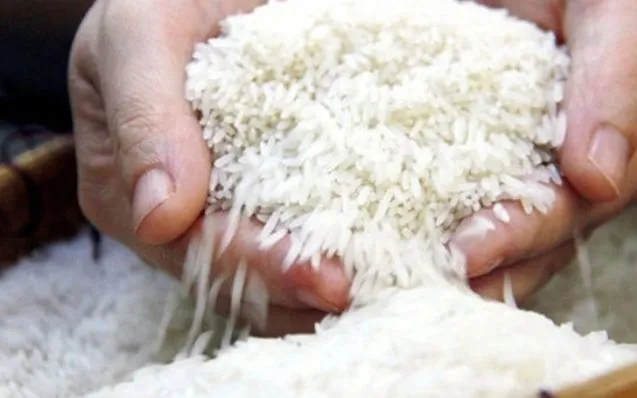
Vietnamese rice is currently present in more than 150 countries and territories, ranking among the top 3 largest rice exporting countries in the world.
This extraordinary journey has not only transformed rice cultivation but also changed the lives of rice farmers. Along this path, every person in the Mekong Delta carries within them a sense of pride and hope for the future.
Mr. Vo Hung Cuong from Tinh Bien town, An Giang province, shared: "I am very proud to be a son of Vietnam and to live in the Mekong Delta region, producing rice to serve my country."
"Duyen feels proud to be a young person of Vietnam and always strives to bring new technologies to develop the Mekong Delta," shared Nguyen Thi My Duyen from Can Tho City.
Mr. Vo Thanh Nhon from An Giang said: "I want the 1 million hectare project to be implemented widely soon so that farmers can receive support from the government to help them produce rice that can reach a wider market."
Source: https://doanhnghiepvn.vn/kinh-te/gao-viet-dat-hang/20250503114114987
![[Photo] Prime Minister Pham Minh Chinh presides over a meeting on private sector economic development.](/_next/image?url=https%3A%2F%2Fvphoto.vietnam.vn%2Fthumb%2F1200x675%2Fvietnam%2Fresource%2FIMAGE%2F2025%2F12%2F20%2F1766237501876_thiet-ke-chua-co-ten-40-png.webp&w=3840&q=75)


![[Photo] Prime Minister Pham Minh Chinh presides over the conference announcing the establishment of the International Finance Centre in Vietnam.](/_next/image?url=https%3A%2F%2Fvphoto.vietnam.vn%2Fthumb%2F1200x675%2Fvietnam%2Fresource%2FIMAGE%2F2025%2F12%2F21%2F1766309817714_ndo_br_dsc-3400-jpg.webp&w=3840&q=75)

















































Comment (0)