

Chi Bao, 25, says he frequently uses AI chatbots and social media to find information about destinations and plan his trips.
Chi Bao, a communications employee at a company in Ho Chi Minh City, said that his habit before each trip is to open TikTok, Instagram, and Facebook groups to read reviews from previous travelers before deciding to book tickets and accommodations. But since the beginning of the year, a series of information about ChatGPT has appeared, making Bao curious, and since then he "regularly uses artificial intelligence chatbot applications" in combination with social media to "research destination information and plan itineraries" for his trips .
Bao says his "approach to travel" is vastly different from the previous generation. While his parents always sought help from travel agency consultants, Bao often "figures things out on his own," believing that proactively seeking information from multiple sources helps him "understand the destination better."
According to the male media employee, information from travel companies is "very useful and comprehensive," but he always feels they're just advertising to get customers to book tours quickly. "The itineraries haven't changed much over the years; for example, the Fenghuang Ancient Town tour in 2019 is exactly the same as in 2023, there's no novelty," Bao said. For him, "every step from booking rooms to tickets is done on my phone. Each time I book, I change hotels and try new experiences."
Some travel experts consider Generation Z (born between 1997 and 2012) and Millennials (1980-2000) to be "digital consumers." A user behavior research report on Klook, an e-commerce platform for travel and experiences, published on October 4th, shows that 54% of Gen Z in the Asia-Pacific region and 69% of Gen Z in Vietnam use social media as their primary tool for finding information, inspiration, and planning trips. 73% of Gen Z in Vietnam consider social media reviews and recommendations to be a "reliable" source before making booking decisions.
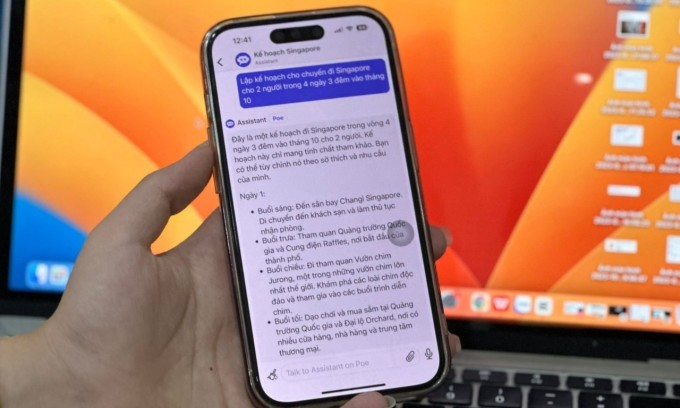
This Singapore travel itinerary is suggested by Poe AI based on user requests. Photo: Ha Thu
Dr. Nuno F. Ribeiro, Senior Associate Dean of the Tourism and Hospitality Management Department at RMIT University Vietnam, believes that the use of artificial intelligence (AI) and machine learning is emerging as a "game changer in the tourism industry".
These technologies are being applied to create personalized travel experiences for customers. For example, AI-powered chatbots can help travelers plan trips, suggest local attractions, and even assist with bookings.
"The rise of digitalization" has reshaped how people travel. This reinforces the view that businesses in the tourism industry need to adapt to the trend and provide mobile-friendly solutions, Ribeiro said.
CS Soong, Vice President of Market Development at Klook, noted that the application of technology in tourism is booming, especially after the pandemic. Generations Z and Millennials are accustomed to using integrated applications to plan trips, book tickets, quickly search for information, and want immediate answers to their questions. Understanding user behavior, in 2023, the Klook platform tested the Klook AI (K.AI) chatbot, which answers customer questions about travel experiences, tour bookings, and attraction ticket reservations, helping travelers plan detailed trips to destinations worldwide . The K.AI chatbot can translate 15 languages worldwide, including Vietnamese. The answers are explained in an easy-to-understand manner in each language.
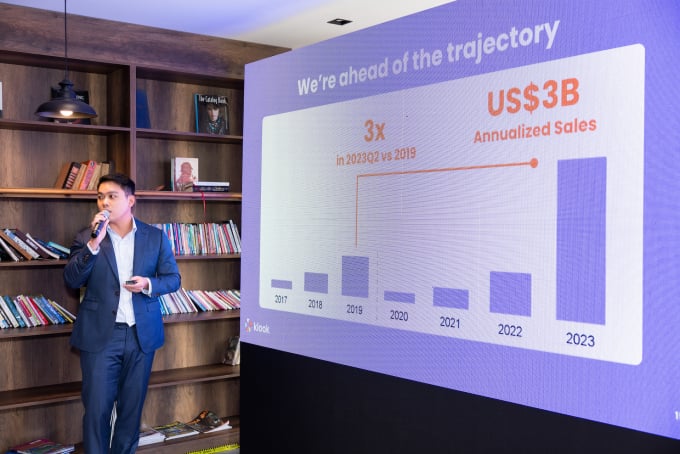
CS Soong, Deputy General Manager of Market Development at Klook, announced the report on the Vietnamese tourism market at a press conference on October 4th. Photo: Bich Phuong
Besides the K.AI chatbot, young Vietnamese people also have other options to search for information and build travel itineraries, such as the Poe AI chatbot. Ha Thu, 27, a graphic designer in Ho Chi Minh City, requested: "Plan a four-day, three-night trip to Singapore for two people in October" and received a "quite detailed" itinerary.
Thu said the chatbot provides quick and comprehensive results, but suggests only "famous and familiar" destinations. She rated the suggested itineraries at only 6 out of 10. If users want more specific information, they have to ask for details such as opening hours, ticket prices, and places to eat in specific neighborhoods or streets. "The tool is convenient but incomplete; tourists still need to proactively research further from other sources," Thu said.
According to a survey by travel market research firm The Outbox, in the first quarter of 2023, 80% of Vietnamese travelers, mainly Gen Z and Millennials, chose to travel independently with family, friends, or alone. In 2019, this figure was around 60%. The percentage of Vietnamese independent travelers increased by 4.2 percentage points in the second quarter compared to the first. The survey indicates that the development of information technology and travel media platforms contributed to this trend.
Bich Phuong - Van Khanh
Source link
![[Photo] First session of the 14th Congress of the Vietnam Trade Union](https://vphoto.vietnam.vn/thumb/1200x675/vietnam/resource/IMAGE/2026/06/03/1780465947883_ndo_br_img-3852-jpg.webp)
![[Photo] General Secretary and President To Lam presides over a meeting with the Central Organizing Committee.](https://vphoto.vietnam.vn/thumb/1200x675/vietnam/resource/IMAGE/2026/06/03/1780482764658_a1-bnd-4741-3342-jpg.webp)

![[Photo] Secretary of the National Assembly Party Committee, Chairman of the National Assembly presides over the meeting of the Standing Committee and Executive Committee of the National Assembly Party Committee.](https://vphoto.vietnam.vn/thumb/1200x675/vietnam/resource/IMAGE/2026/06/03/1780480353201_ndo_br_bnd-2585-jpg.webp)


















































![[Video] Sunset at Lap An Lagoon – Where the sun sets over the fishing nets](https://vphoto.vietnam.vn/thumb/1200x675/vietnam/resource/IMAGE/2026/05/31/1780192137701_beach-landscape-sea-water-nature-grass-745871-pxhere-com.jpeg)




































Comment (0)