The monument depicts the image of teachers and students at the construction site of the southern dike of the Ma River on June 14, 1972.
Within the memorial space, the memories of the heroic soldiers and people of Ham Rong who fought and served in combat under the rain of bombs and bullets from the American imperialists are vividly portrayed, like slow-motion film footage.
It was the summer of June 1972. To ensure the vital transportation route serving the battlefield and to guarantee safety during the flood season, even amidst intense American bombing raids, Thanh Hoa province mobilized thousands of people to urgently reinforce the crucial section of the Ma River dike from Nam Ngan to Ham Rong. Due to frequent enemy attacks, the workforce on the construction site was divided into three shifts, each with no more than 2,500 people. Working hours were limited to 9 am in the morning and 4 pm in the afternoon. Air defense warnings were issued using alarm systems at artillery units, loudspeakers, and visual surveillance...


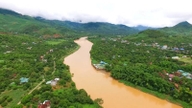
On the morning of June 14, 1972, more than 2,000 people were present at the dike construction site. The sounds of hoes, shovels, and shouts echoed in the summer sun; the work was urgent and full of enthusiasm. Around 9 a.m., some units withdrew to rest, leaving 1,697 people on the site. At 9:10 a.m., American planes suddenly swooped down and dropped bombs on the Nam Ngạn dike section, about 270 meters from the village. In an instant, the construction site, which had been bustling with voices and laughter, turned into a scene of tragedy. 841 people were in the bombed area, including 64 dead and 213 injured from the following units: the Medical School, the 7+3 Teacher Training School, and the Town Education Department.
“Torn hats flew like butterflies, about 100 crumpled ones were picked up, along with children's shirts, women's trousers, and balls of wool... amidst the swirling smoke. Most were 17-22 years old, unmarried”... Each statistic, each line of record documenting the scene on the Ma River dike construction site on that fateful morning, leaves each of us with a lump in our throats today. Behind the numbers are lives lost in the prime of youth, dreams forever left unfulfilled...
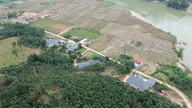
To honor the teachers, students, and laborers who sacrificed their lives in the bombing on June 14, 1972, Thanh Hoa province invested in and built a memorial area covering approximately 2 hectares, divided into two main sections. The inner dike area covers 11,230 square meters and includes a memorial house, a reception and management building, a memorial area for female students, and external access roads. The outer dike area covers 9,270 square meters and includes various features such as a boat dock for releasing lanterns, a shrine, a monument commemorating the historical event, a recreation of the traditional Nam Ngan village, and depictions of the Nam Ngan soldiers and civilians working together to fight and treat the wounded. Among these, one of the most striking architectural features, evoking strong emotions, is the monument sculpted from natural granite, recreating the image of teachers and students on the construction site of the Nam Ma River dike on June 14, 1972. From here, the memorial area is connected to historical sites and scenic spots such as: Ham Rong Bridge, Ngoc Mountain, the C4 anti-aircraft artillery battleground, Quyet Thang Hill, the Monument to the Victorious Youth Volunteers, the Monument to the Victorious Nam Ngan, the temple dedicated to the Heroic Vietnamese Mother and the heroic martyrs... These landmarks are not only tourist attractions that draw large numbers of visitors, but also contribute to educating present and future generations about patriotic traditions, national pride, and revolutionary spirit.
Standing at the foot of the monument today, has anyone ever asked: If there had been no war, what kind of lives would the teachers and students who sacrificed their lives on the Ma River dike construction site have lived? All we know is that on that June morning 54 years ago, some youthful lives were immortalized.
Standing at the foot of the monument, in the memorial space, today's young generation is even more deeply aware of the value of peace, and even more appreciative and grateful for the great sacrifices and contributions of their forefathers.

Text and photos: Hoang Linh
Source: https://baothanhhoa.vn/ghi-duoi-chan-tuong-dai-290215.htm

![[Image] Ho Chi Minh City: Ma Lang area, Chicken-Rice Market about to change its appearance](https://vphoto.vietnam.vn/thumb/1200x675/vietnam/resource/IMAGE/2026/06/25/1782377698627_ndo_br_m1-jpg.webp)
![[Photo] General Secretary and President To Lam receives Palestinian Ambassador Saadi Salama](https://vphoto.vietnam.vn/thumb/1200x675/vietnam/resource/IMAGE/2026/06/25/1782365384740_a1-bnd-9423-8322-jpg.webp)
![[Image] Schools organize meetings and introduce teaching models to students admitted to grade 10.](https://vphoto.vietnam.vn/thumb/1200x675/vietnam/resource/IMAGE/2026/06/25/1782368077271_ndo_br_z7970052192242-1ec8daeb77a6eed1a4e9f58c564ddd3e-jpg.webp)



![[GALLERY] Voidling Bound takes Steam by storm with 94% positive reviews.](https://vphoto.vietnam.vn/thumb/402x226/vietnam/resource/IMAGE/2026/06/25/1782396892878_tua-1-png.webp)