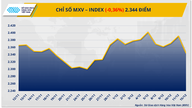
Amidst the Fed's hawkish stance on interest rates and signs of easing tensions in the Middle East, capital flowed out of both precious metals and energy stocks, dragging the MXV-Index down 1.67% to 2,589 points.
The market's focus shifted to precious metals as silver prices plunged more than 5%, extending their decline for a third consecutive session. Meanwhile, crude oil prices continued to weaken, falling to their lowest level since early March as concerns about supply disruptions in the Middle East gradually subsided.

Silver prices fell for a third consecutive session following hawkish signals from the Fed.
In the precious metals market, silver prices continued to face strong selling pressure after investors absorbed information from the Federal Reserve's FOMC meeting on June 17.
Accordingly, the Fed decided to keep the benchmark interest rate unchanged; however, 9 out of 18 FOMC members forecast at least one interest rate hike before the end of the year. New Fed Chairman Kevin Warsh also reaffirmed that the top priority is bringing inflation back to the long-term target of 2%.
Notably, Mr. Warsh's failure to release a personal interest rate forecast has prompted many major financial institutions, such as Deutsche Bank and BofA Global Research, to revise their forecasts toward another rate hike this year. CME's FedWatch tool currently prices the probability of at least one rate hike before the end of the year at approximately two-thirds.
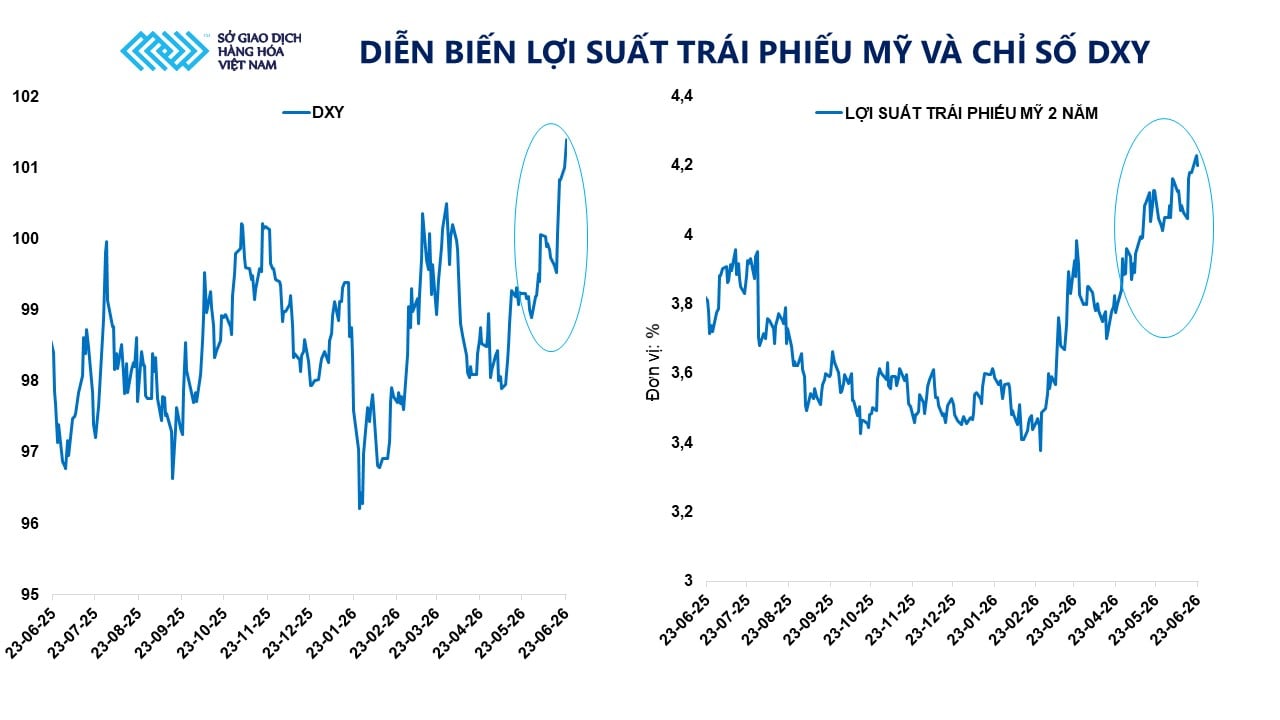
Expectations of persistently high interest rates continue to support the US dollar and US bond yields. The Dollar Index (DXY) rose to 101.14 points, its highest level in 13 months, while the yield on 2-year US Treasury bonds remains near its highest level since February 2025. This context increases the opportunity cost of holding non-yielding assets such as gold and silver.
Compared to gold, silver typically experiences greater volatility due to its dual characteristics as a safe-haven asset and its susceptibility to the outlook for industrial consumption. When the US dollar strengthens and money flows out of precious metals, selling pressure on silver is usually amplified more strongly than on gold.
At the close of trading on June 23, gold futures prices fell nearly 2% to $4,108 per ton, while silver futures prices plummeted 5.34% to $62 per ounce. At the Vietnam Commodity Exchange (MXV), silver continued to be the focus of the metals group, accounting for nearly 80% of the total trading value of the group.



Besides pressure from monetary policy, capital is also showing signs of withdrawing from the precious metals market. According to the World Gold Council, North American ETFs sold a net of approximately 7.3 tons of gold in the last week of May, equivalent to a value of over $1 billion.
However, according to MXV, the current pressures are primarily short-term. In the long term, uncertainties related to public debt, budget deficits, and the economic growth outlook in the US will continue to support demand for safe-haven assets. Currently, the size of the US public debt is approaching $40 trillion, approximately 4.5 times higher than before the 2008 financial crisis.
In fact, demand for gold as a store of value in major economies remains high. According to Chinese customs data, the country imported approximately 163 tons of gold in May, the highest level in two years. For the first five months of the year, gold imports reached approximately 692 tons, a 76% increase compared to the same period last year. Meanwhile, the People's Bank of China (PBoC) recorded its 19th consecutive month of net gold purchases, indicating that the demand for gold reserves from central banks shows no signs of slowing down.
Expectations of improved supply continue to put pressure on oil prices.
In the energy market, oil prices continued to weaken as investors lowered their concerns about supply risks from the Middle East.
According to MXV, the oil market is shifting from concerns about supply disruptions to an assessment of the likelihood of improved global supply in the near future. This is causing the geopolitical risk premium accumulated in previous weeks to continue to narrow.
Much of the current decline stems from positive signals in negotiations between the US and Iran. Previously, the US Treasury Department issued a temporary 60-day sanctions waiver, allowing the resumption of financial, shipping, and insurance services supporting Iran's crude oil and refined product exports. This move has increased expectations that one of OPEC's major suppliers will gradually return to the international market.
In addition, shipping activity through the Strait of Hormuz is gradually recovering. The latest data from the International Maritime Organization (IMO) shows that the volume of ships passing through this vital waterway has been increasing since last week, reaching an average of nearly 25 vessels per day by June 22nd. Meanwhile, data from Kpler suggests that the actual number could be as high as 39 vessels if those whose AIS signals have been switched off or lost are included. This indicates that energy transport in the region is gradually returning to normal.

According to MXV data, at the close of trading yesterday, Brent crude oil prices fell by more than 1%, to below $77.1 per barrel, while WTI crude oil prices fell by nearly 0.9%, to near $73.2 per barrel. These are both the lowest prices since the beginning of March.
Commenting on the developments in the oil market, Mr. Do Xuan Quy - Deputy General Director and Co-founder of 3D Commodity Trading Joint Stock Company (Business Member No. 072 of MXV) said that the downward pressure comes from the market reassessing the supply risks from the Middle East.



"Concerns about disruptions to shipping through the Strait of Hormuz have significantly eased following positive signals from negotiations between the US and Iran, including Washington's move to ease sanctions on Iranian oil. This has increased expectations that global oil supply will improve in the near future," Mr. Quy said.
According to Mr. Quy, although oil prices are trending downwards, this market remains highly sensitive to geopolitical factors, especially as the US and Iran still have disagreements at the negotiating table and there is no official agreement to end the conflict that has lasted since the end of February.

On the other hand, total crude oil inventories in the US have fallen to their lowest level in over 40 years, raising concerns about the ability to meet fuel demand in the world's largest economy, especially as the country enters its peak travel season. This could support oil prices in the near future if actual demand continues to increase.
Source: https://baotintuc.vn/thi-truong-tien-te/gia-bac-va-dau-dong-loat-giam-20260624105534560.htm