

The story of Le Van Khoi's rebellion and coup in Phan Yen (often referred to as Phien An) has always been of great interest to researchers and later generations. And with the latest publications from many valuable sources by researcher Tran Hoang Vu, it is possible to reconstruct a detailed "picture" of Le Van Khoi's rebellion. From this, many historical "mysteries" of this period are also surprisingly "decoded"...
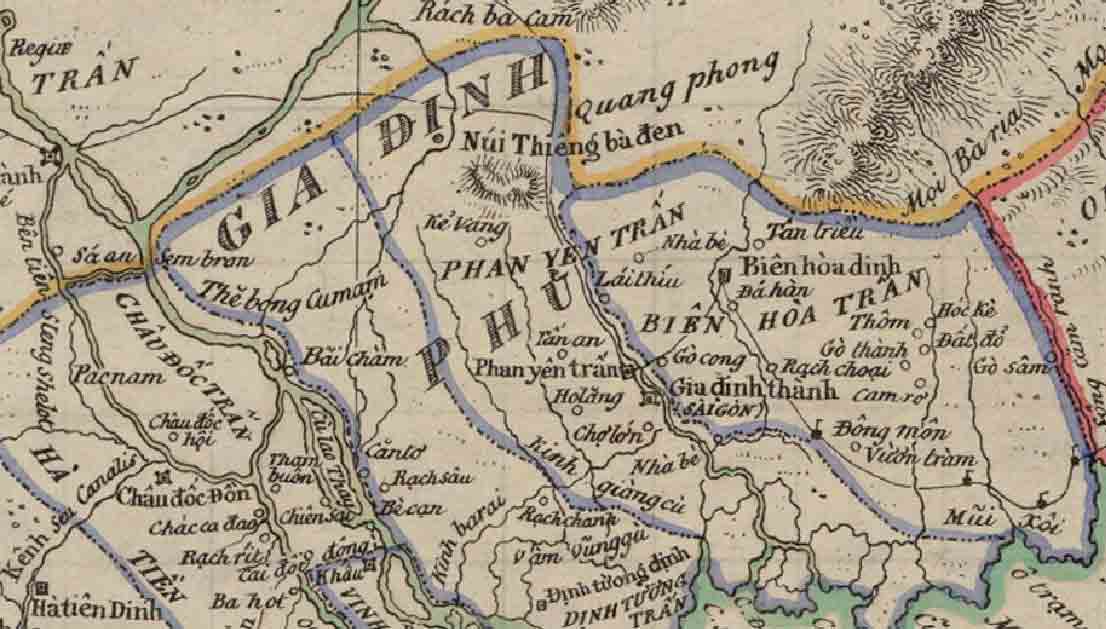
Gia Dinh citadel and Phan Yen town in Taberd's 1838 map of the Great Kingdom of An Nam.
In 1802, Prince Nguyen Anh led a large army across the Gianh River to advance northward. The Tay Son dynasty collapsed like a landslide. Prince Nguyen Anh (Emperor Gia Long) now faced the new task of establishing a new governing system for the territory that had just been unified after more than two centuries of division.
In his early days in Thang Long, King Gia Long had to rely on the knowledge of a former Tay Son official, Nguyen Van Dung. Through him, King Gia Long consulted the tax system established by the Tay Son dynasty in the north. The king also adopted a governmental organization of the Tay Son dynasty, namely the Bac Thanh system.
The predecessor of the Northern Citadel system was a group of officials left behind in Thang Long by Nguyen Hue in 1788, after he had eliminated Vu Van Nham. In early 1789, after temporarily stabilizing the situation in the north, Emperor Quang Trung returned to Phu Xuan. The name Northern Citadel was given by the Tay Son dynasty. When preparing to return to Phu Xuan in September of the first year of Gia Long's reign (1802), Emperor Gia Long secretly reinstated the Tay Son's governing system. He said: "Only the northern land has just been pacified, the people and things are new, and Thang Long citadel is an important place in the north, so it needs important officials to guard it" (National History Institute of the Nguyen Dynasty, Dai Nam Thuc Luc , volume 1).
Gia Long then established the position of Governor-General of Bac Thanh to manage it. However, the king did not view Bac Thanh as a temporary administrative structure. On the contrary, he expanded it southward.
THE BIRTH OF GIA DINH THANH
In the 7th year of Gia Long (1808), he began to establish Gia Dinh Citadel. Trinh Hoai Duc stated: "Gia Dinh takes charge of military, civilian, and service affairs of the five provinces of Phan Yen, Bien Hoa, Vinh Thanh, Dinh Tuong, and Ha Tien; it also takes charge of Binh Thuan province. Military affairs [of Binh Thuan] must follow the regulations, while civilian and service affairs are managed separately."
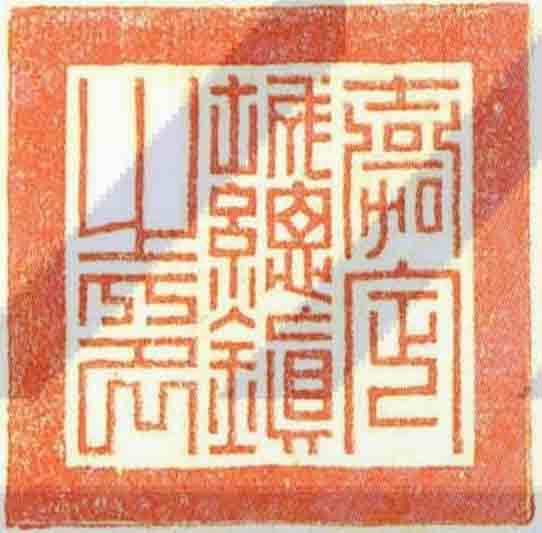
The seal of Gia Dinh Citadel, the seal of the Governor-General.
At the head of Gia Dinh Citadel were the Governor-General (military official) and the Deputy Governor-General (civil official), later supplemented by the position of Vice-Governor-General. Below them was a system of supporting officials. Although significantly smaller in scale than Bac Thanh (Northern Citadel), the regulations of 1808 were an expansion compared to the Gia Dinh administrative system four years earlier. At that time, each department in Gia Dinh had only 100 people, and only four offices: Household, Military, Justice, and Public Works. At the end of the 12th year of Gia Long's reign (1813), King Gia Long began to establish the four offices of Household, Military, Justice, and Public Works in Gia Dinh Citadel. Gia Dinh Citadel had to send representatives to the capital twice a month to report on matters.
During the reign of Gia Long, the governing role was divided equally between two positions: military (Governor-General) and civil (Assistant Governor-General), later supplemented by the addition of a Deputy Governor-General. The top positions in Gia Dinh Citadel were rotated after a certain period. This was likely intended to prevent the establishment of overly close ties between the head of Gia Dinh Citadel and local interest groups. After Gia Long's death, this practice was broken by his successor. King Minh Mang completely entrusted the governing power to Governor-General Le Van Duyet, gradually abolishing the positions of Deputy Governor-General and then Deputy Governor-General. This sowed the seeds of conflict between the Gia Dinh Citadel government and the Hue court. (to be continued)
(Excerpt from the book "Phan Yen Thanh Rebellion Chronicle - An Overview of Le Van Khoi's Uprising ," published by Ho Chi Minh City General Publishing House).
Is it Phan Yen Citadel or Phien An Citadel?
The province of 藩安 is often translated as Phiên An today. However, the Journal of the Asiatic Society of Bengal in 1837 recorded: "the second, Phan Yên or Sài Gòn, which is the fortified town of the same name." The dictionary published by Bishop Taberd (1838) also has an entry for "town," listing the names of towns throughout the country, with both Chinese and Vietnamese characters. In that dictionary, 藩安 is also translated as Phan Yên.
In the Đại Nam Quốc Âm Tự Vị (Vietnamese National Language Dictionary) printed in 1895, under the entry "Yên," Huình Tịnh Của recorded: "Phan (Yên). The old name of Gia Định province." The name Phan Yên continued to be used in publications until the early 20th century. In 1910, Diệp Văn Cương published the novel Phan Yên Ngoại Sử (Unofficial History of Phan Yên). This consistency allows us to determine that the name at that time was Phan Yên, not Phiên An as is commonly used in translations of historical documents today.
Because it was no longer used in legal documents or in daily life, the name Phan Yên gradually faded away. Around the late 1920s, other transliterations appeared. In 1926, in the publication "Lê Tả quân tiểu sử và linh sám" published in Hanoi , the author used the pronunciation Phan An, meaning Phan An province. In the Quốc ngữ translation of Đại Nam liệt truyện tiền biên, produced by the Huế court and distributed to schools (1929), the pronunciation Phiên An appeared. The transliterations Phan Yên, Phan An, and Phiên An are still used by other translators and authors. Notably, the 1972 and 1998 translations of Gia Định thành thông chí both used Phiên An. Because this is a leading source for research on the history, geography, and culture of Southern Vietnam, the pronunciation Phiên An gradually became dominant.
Source: https://thanhnien.vn/gia-dinh-thanh-truoc-con-bao-du-185241227233449365.htm


![[Photo] General Secretary and President To Lam meets with National Assembly delegates from ethnic minorities.](https://vphoto.vietnam.vn/thumb/1200x675/vietnam/resource/IMAGE/2026/04/20/1776696701056_a1-bnd-8331-3342-jpg.webp)
![[Image] National Assembly discusses the implementation of the socio-economic development plan.](https://vphoto.vietnam.vn/thumb/1200x675/vietnam/resource/IMAGE/2026/04/20/1776696707422_ndo_br_img-20260420-185419-jpg.webp)































































































Comment (0)