

THE PERCENTAGE OF FACULTY MEMBERS WITH DOCTORATES IS STILL VERY LOW
According to statistics from the Ministry of Education and Training, there are currently about 85,000 university and college-level teacher training lecturers nationwide. However, only 26,800 lecturers hold doctoral degrees, accounting for 32%. Regionally, the Red River Delta has the highest rate at 51.01%. This is followed by the Southeast region at 24.66%, the North Central and Central Coastal regions at 11.67%, the Mekong Delta at 7.21%, the Northern Midlands and Mountains at 4.52%, and the lowest is the Central Highlands region at only 1.04%.
Thus, except for the Red River Delta region, many universities in other regions have a very low percentage of lecturers with PhDs compared to the standards set by the Ministry. According to publicly available information from universities, only a few large universities in the above regions (excluding the Red River Delta) meet the requirements, such as Ho Chi Minh City University of Economics, Ho Chi Minh City University of Technology , Ho Chi Minh City University of Social Sciences and Humanities, Ho Chi Minh City University of Economics and Law, Ho Chi Minh City University of Natural Sciences, Ho Chi Minh City International University, Da Nang University of Technology, Hue University of Medicine and Pharmacy, Hue University of Education, Hue University of Economics, Can Tho University, Da Lat University...
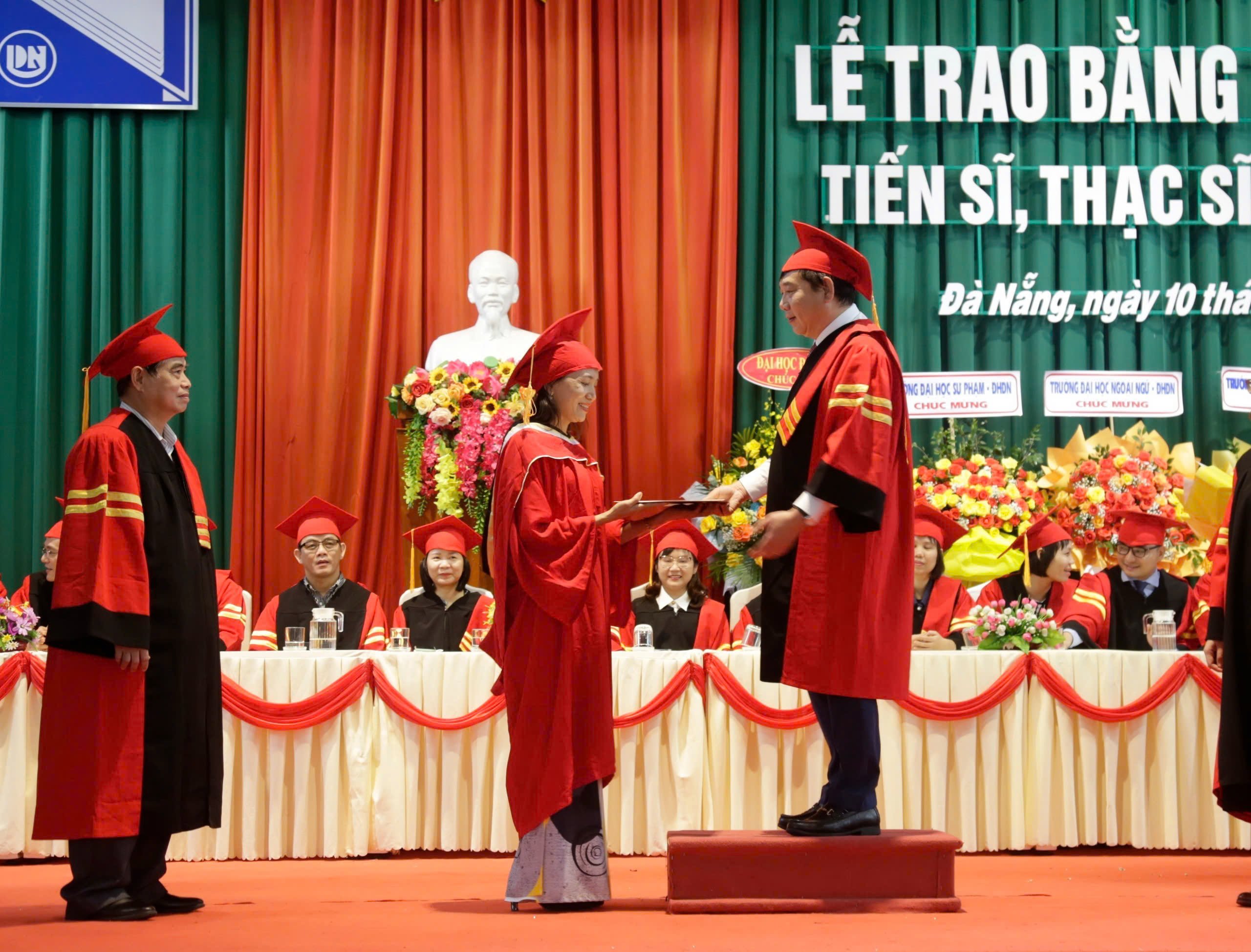
To offer doctoral programs, in addition to meeting the requirements for opening a new program, a university must have a percentage of faculty members holding doctoral degrees of 40%.
Meanwhile, many universities are training PhDs, but the rate is still very low. Nam Can Tho University has 1,072 lecturers, including 8 professors, 33 associate professors, and 222 PhD holders, currently only reaching 24.5% of the required number, lacking 165 PhDs to meet the standard. Ton Duc Thang University has 997 lecturers, including 6 professors, 12 associate professors, and 245 PhD holders, reaching 26.3%, still lacking 135 PhDs. Nguyen Tat Thanh University has 1,325 lecturers, including 13 professors, 60 associate professors, and 337 PhD holders, reaching 30%, still lacking 120 PhDs. Van Lang University's PhD rate is only 22%, still lacking approximately 370 PhDs. Ho Chi Minh City University of Industry has reached over 35%, still lacking nearly 100 PhDs. Ho Chi Minh City University of Industry and Trade has achieved over 30% of its target, but still lacks 49 PhDs; Ho Chi Minh City University of Information Technology has achieved 34%, but still lacks 16 PhDs...
Is there a shortcoming for a university that only offers 1-2 doctoral programs?
Dr. Vo Van Tuan, Vice Rector of Van Lang University, believes that the criterion of a high percentage of full-time lecturers holding doctoral degrees is very difficult and impractical to implement, especially for private universities. Accordingly, Dr. Tuan noted that the current supply of human resources with doctoral degrees in some fields is limited. Attracting and retaining highly qualified lecturers is challenging due to competition from other educational institutions. Furthermore, the doctoral training process requires a long time and significant resources.
"Van Lang University is currently training PhDs in one field: environmental science. Currently, the university has over 2,000 full-time lecturers, with only 22% holding PhDs. Therefore, to reach 40% by 2025, the university needs at least 370 more lecturers with PhDs. And by 2030, if the current number of faculty remains the same, the university would need at least 580 more PhDs. This is impossible!" Dr. Tuan stated.
According to Dr. Tuan, there is an inconsistency: some universities, even those offering only one doctoral program, still apply the regulation that they are "higher education institutions offering doctoral programs," thus requiring a uniform ratio of doctoral degree holders for the entire institution, similar to universities offering dozens of doctoral programs. "In the past, to open a doctoral program, universities had to meet regulations regarding the conditions for opening a program and the standards for faculty teaching doctoral degrees. Now, Circular 01 introduces a more restrictive regulation, meaning that even if universities meet the requirements for opening a doctoral program, if the entire institution does not have 40% of its faculty holding doctoral degrees, they are not allowed to offer doctoral programs. So where will universities find the recruitment resources to increase the percentage of faculty with doctoral degrees, especially in fields where not all universities offer doctoral programs?" Dr. Tuan pointed out the inconsistency.
Given these difficulties, higher education institutions may also abandon doctoral training to "avoid" this standard, and only need to meet the requirement of 20% (30% by 2030) of faculty holding doctoral degrees (for universities that do not offer doctoral programs). "However, if they want to become true higher education institutions, in addition to undergraduate training, scientific research, and community service, they must also offer postgraduate training. Therefore, universities are compelled to develop a suitable roadmap to meet the standard if they want to improve the quality of training and ensure sustainable development," Dr. Tuan commented.
SUPPORT AND MANDATORY FOR FACULTY MEMBERS TO PURSUE DOCTORATES
Associate Professor Dr. Nguyen Xuan Hoan, Rector of Ho Chi Minh City University of Industry and Trade, believes that achieving 40% of lecturers holding doctoral degrees is very difficult, but there is no other way than to make an effort to ensure improved training quality.
Universities are proposing various solutions to increase the percentage of PhDs who meet the standards of higher education institutions.
According to Associate Professor Hoan, the university is implementing a policy of attracting talent from outside and providing support from within to drastically increase the percentage of PhDs meeting the standards of a higher education institution. For example, a professor who comes to work at the university will immediately receive 200 million VND, an associate professor 150 million VND, and a PhD holder 100 million VND.
"Starting in 2024, the school mandates that female teachers under 45 and male teachers under 50 must enroll in a doctoral program in their respective fields, over a period of six years. If they fail to enroll by the third year, their contracts will be terminated. Teachers pursuing a doctorate will receive 100% tuition support and will continue to earn income as if they were employed."
Dr. Nguyen Trung Nhan, Head of the Training Department at Ho Chi Minh City University of Industry, also informed that the university will immediately reward professors or lecturers who achieve this degree with 250 million VND, associate professors with 200 million VND, and PhD holders with 150 million VND. Lecturers pursuing a PhD will receive 100% tuition support and a 50% reduction in teaching hours. "This year, the university has 100 doctoral students, so the goal is to reach 40% by 2025 and 50% by 2030, as stipulated in Circular 01," Dr. Nhan shared.
REDEFINING GOALS, CHOOSING THE RIGHT DIRECTION
Meanwhile, Dr. Tran Huu Duy, Head of the Training Department at Da Lat University, commented that achieving a 40% rate of lecturers with doctoral degrees, and 50% by 2030, is not difficult in terms of solutions, but the biggest challenge is retaining lecturers. "There are only two ways to retain highly qualified lecturers: firstly, income; secondly, working conditions, autonomy, and responsibility. Prioritizing incentives for lecturers along with accountability, and abandoning current administrative management practices, will achieve the goal," Dr. Duy stated.
It is known that Da Lat University has been implementing a policy to support lecturers in pursuing advanced training for the past 10 years, with 80 million VND for PhDs, 100 million VND for associate professors, and 150 million VND for professors, and will continue to strengthen this policy in the future.
According to Dr. Duy, if a university does not meet the standards for faculty, it may not offer doctoral programs and should instead focus on practical, professional training. "The standards for higher education institutions will serve as a benchmark for career guidance and will also help eliminate the problem of low-quality doctoral training. Universities must redefine their goals and vision to find a suitable direction," Dr. Duy stated. (to be continued)
According to Circular 01 promulgating the Standards for Higher Education Institutions, effective from March 2024, Standard 2 on lecturers stipulates that the percentage of full-time lecturers with a doctoral degree must not be less than 20%, and from 2030 not less than 30% for higher education institutions that do not offer doctoral programs; and not less than 5%, and from 2030 not less than 10% for specialized training institutions that do not offer doctoral programs.
For higher education institutions offering doctoral programs, the percentage should not be lower than 40%, and not lower than 50% from 2030 onwards. For universities specializing in specific fields that offer doctoral programs, the percentage should not be lower than 10%, and not lower than 15% from 2030 onwards.
Source: https://thanhnien.vn/gian-nan-dat-chuan-co-so-giao-duc-dh-185240919203546668.htm
![[Photo] National Assembly Chairman Tran Thanh Man arrives in Türkiye to attend IPU-152](https://vphoto.vietnam.vn/thumb/1200x675/vietnam/resource/IMAGE/2026/04/15/1776261003665_tnk10-jpg.webp)

![[Photo] Mrs. Ngo Phuong Ly meets and exchanges views with Mrs. Peng Li Yuan](https://vphoto.vietnam.vn/thumb/1200x675/vietnam/resource/IMAGE/2026/04/16/1776277858080_phu-nhan-1-jpg.webp)
![[Photo] My Son at night: A thousand-year-old heritage site amidst the Milky Way](https://vphoto.vietnam.vn/thumb/1200x675/vietnam/resource/IMAGE/2026/04/15/1776261039184_ndo_br_chon6-jpg.webp)
![[Photo] National Assembly Chairman Tran Thanh Man attends the opening session of IPU-152](https://vphoto.vietnam.vn/thumb/1200x675/vietnam/resource/IMAGE/2026/04/16/1776277863731_ctqh5-jpg.webp)
![[Photo] The General Secretary, President and his wife meet with Vietnamese-Chinese friendship leaders.](https://vphoto.vietnam.vn/thumb/1200x675/vietnam/resource/IMAGE/2026/04/15/1776264829725_vna-potal-tong-bi-thu-chu-tich-nuoc-to-lam-gap-mat-nhan-sy-huu-nghi-viet-nam-trung-quoc-8703641-3130-jpg.webp)



























































Comment (0)