

Tasks in the new era
Resolution No. 29-NQ/TW dated November 4, 2013, of the Central Committee of the Communist Party of Vietnam (11th term) and Resolution No. 71/NQ-TW dated August 22, 2025, of the Politburo clearly stated the viewpoint of "fundamental and comprehensive reform" and "breakthrough development in education and training". Building a modern national education system, on par with the region and the world, in our country in the new era has been defined through breakthrough tasks and solutions.
For Da Nang city, in Part V. Key Tasks and Solutions, Section 5. Developing culture and society in a comprehensive, closely linked, harmonious, and commensurate manner with economic development, building a city rich in identity, and improving the lives of its people, the Political Report of the City Party Committee presented to the First City Party Congress, term 2025-2030, stated: Implement comprehensive solutions to innovate, diversify, and improve the quality of education and training, linked with raising the intellectual level of the people, promoting the building of a learning society and lifelong learning citizens; building Da Nang into a learning city.
Ensure that at least 20% of the total state budget expenditure, coupled with promoting socialization and international integration in education and training, is invested in school infrastructure and facilities towards standardization, synchronization, and modernization, ensuring two-session schooling per day at the primary level and promoting its implementation at the lower secondary level.
Encourage the development of new school models such as digital schools, smart schools, and happy schools; promote integrated education methods combining science, technology, culture, arts, mathematics (STEAM), and scientific research in secondary schools; and enhance foreign language proficiency for students, gradually making English the second language in schools.
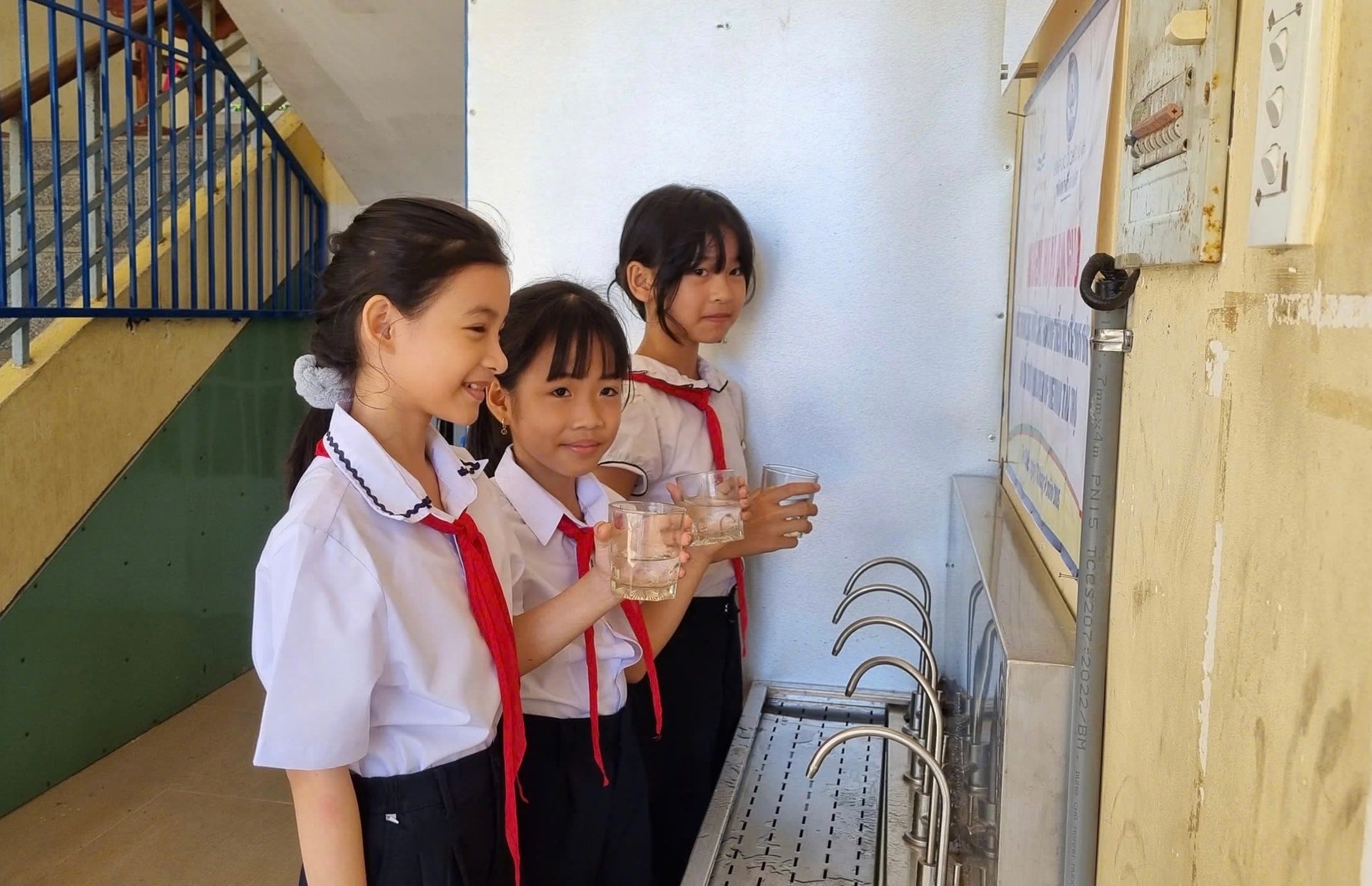
Providing 100% tuition fee support for preschool children, primary and secondary school students, and students at vocational education institutions in the area; providing lunch support for primary and secondary school students in border and island communes.
In this section, educational tasks and solutions are integrated into the tasks and solutions for socio-cultural development. It is thought that education should be separated into a key task and solution (as drafted in the Central Committee report, Section VI: Building a modern national education system with regional significance) to be commensurate with its position and breakthrough role in the city's development in the new era, and in line with the vision of Resolution No. 71-NQ/TW dated August 22, 2025, of the Politburo on focusing on breakthrough development of education towards modernization, with the goal of holistic human development.
Regarding the concept of lifelong learning, it should be written as "lifelong learning." The title "learning citizen" is understood according to Decision No. 677/QD-TTg dated June 3, 2022, of the Prime Minister; while lifelong learning is the approach of citizens in a learning society.
Fundamental and groundbreaking solutions in the digital age.
The first and most crucial step, both in the short and long term, is none other than investing in and developing human resources in education. Teachers are the decisive factor in the quality of education; no matter how modern the facilities or how advanced the technology, the quality of the teachers remains the core element determining the effectiveness of teaching. A team of well-trained teachers with deep expertise, excellent pedagogical skills, technological sensitivity, and dedication to their profession will be the strongest driving force for improving the overall quality of education.
Policies should be implemented to attract and retain talented administrators and teachers, especially in subjects with shortages and in disadvantaged areas. Consideration should be given to incentive policies, housing support, and opportunities for further education. Training and professional development in information technology skills and modern teaching methods for the teaching staff is a primary requirement of the digital age.
Investing in and developing human resources in education requires special attention to management and the people in charge. In the current situation, whether policies, solutions, and their implementation are appropriate to practical realities and development requirements largely depends on this team, from the department to the schools, from city leaders to local governments.
The review and streamlining of the education management apparatus is crucial for efficiency, with clear assignment of responsibilities, avoiding omissions in tasks and areas, and preventing it from being merely administrative work, especially in the current context of a two-tiered government system.
Focusing investment on infrastructure and technology is a supporting solution for modern education, for achieving the set goals – it is a prerequisite, not the primary goal or task as some reports and guidelines have identified.
To achieve rapid and sustainable development in education and training, Da Nang needs to prioritize key areas and platforms in educational technology, viewing them as a "lever" to focus on improving quality, managing effectively, and preparing human resources for the future; optimizing the management of students, teachers, timetables, grades, and electronic academic records in a transparent and interconnected manner; supporting diverse forms of online teaching combined with self-study - a key factor in promoting the autonomy, democracy, and personalization of learners - helping Da Nang's education sector adapt to unexpected situations (as demonstrated by the COVID-19 pandemic).
Prioritize resources for improving and upgrading school facilities and equipment, especially in disadvantaged and mountainous areas, in order to rapidly reduce existing disparities.
Innovation in teaching methods must be based on modern teaching perspectives, approaching regional and global standards. This is no longer a general, repetitive mindset of the past 40 years, nor is it merely a struggle with one or more textbooks. Instead, it should focus genuinely on developing students' self-learning abilities, critical thinking, problem-solving skills, and creativity, in line with the principle of "lifelong learning," applying active teaching methods, combining theory with practice and experience; promoting scientific and technical research, and connecting schools with businesses to give students opportunities to access real-world situations.
Source: https://baodanang.vn/giao-duc-da-nang-thoi-co-va-thoi-ky-moi-3303076.html


![[Photo] National Assembly Chairman Tran Thanh Man attends the policy seminar to promote Vietnam-Türkiye cooperation.](https://vphoto.vietnam.vn/thumb/1200x675/vietnam/resource/IMAGE/2026/04/16/1776351415367_vna-potal-chu-tich-quoc-hoi-tran-thanh-man-du-toa-dam-chinh-sach-thuc-day-hop-tac-viet-nam-tho-nhi-ky-8705791-jpg.webp)















![[Image] Bridges and roads connecting the eastern part of Ho Chi Minh City](https://vphoto.vietnam.vn/thumb/1200x675/vietnam/resource/IMAGE/2026/04/16/1776328595108_ndo_br_bh-vt5-jpg.webp)























![[Infographic] Details of the Hanoi-Quang Ninh High-Speed Railway Project](https://vphoto.vietnam.vn/thumb/402x226/vietnam/resource/IMAGE/2026/04/16/1776338188424_anh-man-hinh-2026-04-16-luc-18-16-10.png)

![[Photo] National Assembly Chairman Tran Thanh Man meets with the Speaker of the Georgian Parliament](https://vphoto.vietnam.vn/thumb/402x226/vietnam/resource/IMAGE/2026/04/16/1776338494029_anh-man-hinh-2026-04-16-luc-18-21-21.png)











Comment (0)