

With the changing seasons, viral meningitis increases.
Currently being treated at the National Center for Tropical Diseases, National Children's Hospital, 4-year-old NTH (from Chuong My, Hanoi ) has been diagnosed with encephalitis caused by the EV virus. Her mother said that before hospitalization, after eating dinner at home, her daughter suddenly developed symptoms of abdominal pain, vomiting, and then a progressively worsening headache.
Seeing that the child's symptoms did not improve, the family took the child to the National Children's Hospital for emergency treatment the following morning. At the hospital, the cerebrospinal fluid test confirmed that baby H had meningitis caused by EV. Currently, after 4 days of treatment, the child has stopped vomiting and fever, is eating well, and is not paralyzed in the arms and legs.
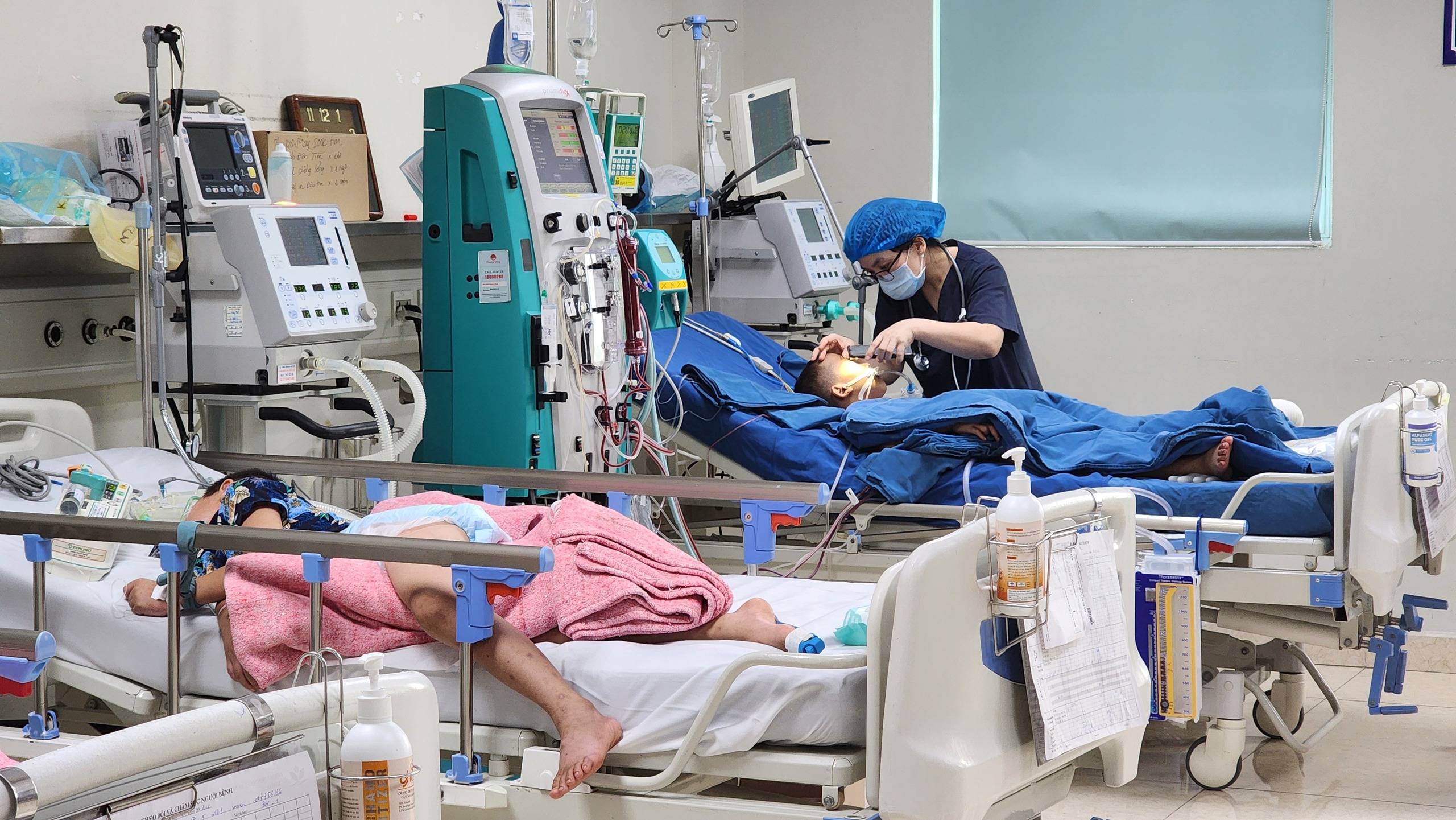
Many children hospitalized with EV viral encephalitis are receiving treatment at the National Children's Hospital. (Photo: HV).
Eight-year-old D.M.M. from Gia Lam, Hanoi, also tested positive for the EV meningitis virus. She showed no signs of vomiting but experienced severe headaches and fever. Upon admission, she was alert but suspected of having meningitis, so a lumbar puncture was ordered to confirm the diagnosis. Fortunately, she has recovered well and has not suffered any neurological complications. M.'s mother said that although no other students in her child's class had been diagnosed with the disease, she had heard about this dangerous illness. Therefore, one day after her child showed symptoms, the family rushed her to the hospital for examination.
The National Children's Hospital has recorded an increase in cases of EV-induced meningitis compared to previous months. According to statistics, from September 1st to October 9th, at the Tropical Diseases Center alone, approximately 200 children were hospitalized for treatment of this disease.
The main symptoms of viral meningitis in children, and EV in particular, are usually fever, chills, headache, stiff neck, nausea or vomiting, photosensitivity (photophobia), loss of appetite, and fatigue. Sometimes, children may also have symptoms of a viral infection such as runny nose, cough, body aches, or rash before the onset of meningitis symptoms. In infants, symptoms are often nonspecific and include: fever, vomiting, bulging fontanelle, poor feeding, excessive sleepiness, etc.
Dr. Le Thi Yen, from the Outpatient Department of Tropical Diseases Center (National Tropical Diseases Hospital), stated that viral meningitis is inflammation of the meninges caused by a viral pathogen. The disease affects all ages, but the risk is higher in immunocompromised individuals and children. The most common causes of viral meningitis include EV, Herpesvirus, and the Arbovirus group (Japanese encephalitis virus, dengue fever virus, etc.).
The weather changes erratically, especially during transitional seasons, creating favorable conditions for the growth of various bacteria and viruses that cause diseases, including viral meningitis. Furthermore, EV meningitis is a contagious disease, so its incidence is likely to increase when children return to school after the summer break.
It is possible to form small outbreaks.
Most cases of EV-induced meningitis have a benign course, with children recovering completely after 3-5 days of treatment and without sequelae. However, Dr. Do Thien Hai, Deputy Director of the Center for Tropical Diseases, emphasized that the disease can form small outbreaks and leave more severe symptoms in older children, causing headaches and significant discomfort. Furthermore, with central nervous system infections, it is difficult to accurately predict potential problems in the next 5-10 years.
To diagnose the disease, children undergo cerebrospinal fluid aspiration and PCR testing to identify the viral cause. Currently, there is no specific treatment or vaccine for EV meningitis. Treatment is primarily symptomatic, using pain relievers, fever reducers, anti-inflammatory drugs, and nutritional support to improve overall health. Therefore, experts advise that families should not be complacent when children show signs such as fever, vomiting, headache, etc.
"If a child vomits more than 3 times per hour and 5 times per day, or experiences severe headaches that don't respond to painkillers, parents should immediately take them to a medical facility for examination because the child may have dangerous diseases such as EV meningitis, intussusception, etc.," Dr. Le Thi Yen advised parents not to self-treat or buy medicine for their children at home.
Source: https://www.baogiaothong.vn/giao-mua-tre-viem-mang-nao-nhap-vien-tang-manh-192241023082455434.htm

![[Photo] Prime Minister Pham Minh Chinh presides over a meeting on private sector economic development.](/_next/image?url=https%3A%2F%2Fvphoto.vietnam.vn%2Fthumb%2F1200x675%2Fvietnam%2Fresource%2FIMAGE%2F2025%2F12%2F20%2F1766237501876_thiet-ke-chua-co-ten-40-png.webp&w=3840&q=75)


![[Photo] Prime Minister Pham Minh Chinh presides over the conference announcing the establishment of the International Finance Centre in Vietnam.](/_next/image?url=https%3A%2F%2Fvphoto.vietnam.vn%2Fthumb%2F1200x675%2Fvietnam%2Fresource%2FIMAGE%2F2025%2F12%2F21%2F1766309817714_ndo_br_dsc-3400-jpg.webp&w=3840&q=75)




















































































Comment (0)