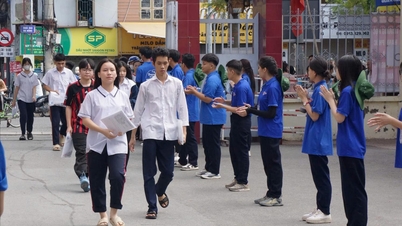
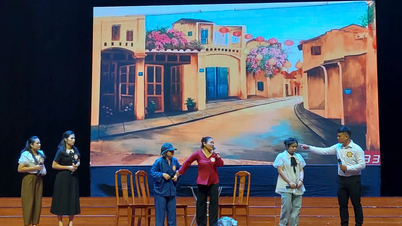
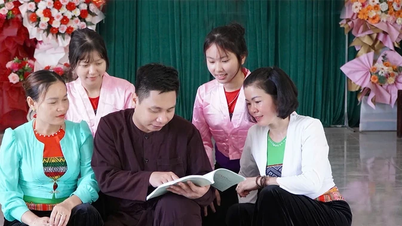
Teachers and students of Tran Quoc Toan Primary School on Lai Son Island. Photo: Hanh Chau
Currently, the entire special administrative region has 10 schools. The basic school network is arranged in accordance with the residential planning, meeting the learning needs of students at all levels. There are 3 preschools with 7 locations, of which 4 locations are temporarily housed within secondary schools. In the 2025-2026 school year, the entire special administrative region will have 27 classes with 603 children. The primary school level has 3 schools with 46 classes and 1,092 students; and 1 primary and lower secondary school with 25 classes and 561 students. The secondary school level has 1 lower secondary school and 2 upper secondary schools with a total of 38 classes and 1,213 students. Currently, 6 out of 10 schools in the special administrative region meet national standards level 1.
Over the years, the state budget has prioritized investment in building and repairing schools, supplementing teaching equipment, libraries, and functional rooms. To date, the system of 117 classrooms from preschool to secondary school has been solidly built, meeting the requirements for organizing educational activities and gradually improving teaching and learning conditions in the island area. However, the biggest difficulty currently remains the shortage of teachers. For the 2025-2026 school year, the education sector of the special zone was allocated 249 positions, but in reality, only 203 are available, a shortfall of 46 positions compared to the need.
Despite facing many challenges, educational institutions are striving to improve the quality of teaching and learning. At Kien Hai Junior and Senior High School, at the end of the 2025-2026 school year, 5 staff members were rated as having excellently completed their duties; 1 teacher received the title of excellent teacher at the provincial level. The school also had 9 students who won awards in the provincial-level student excellence competition, 24 outstanding students, and 73 excellent students.
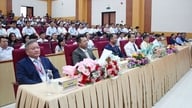


Mr. Tran Hot Lai, Principal of Kien Hai Junior and Senior High School, stated that the school's facilities are still limited, teaching equipment is not standardized, and a portion of the students face many difficulties in their lives. Many students have to overcome obstacles related to living conditions and transportation to attend school. Nevertheless, the school staff always strives to successfully complete the academic year's tasks.
The difficulties are even more pronounced in the Nam Du archipelago, located more than 60km from the special administrative region's center and more than 90km from Rach Gia ward. The area comprises many small islands, and transportation is entirely dependent on water transport and weather conditions. The Nam Du commune area alone previously had more than 11 inhabited islands, with the most densely populated being Hon Ngang and Hon Mau. On Hon Mau, students face many obstacles because the local education system only supports up to grade 5. After completing primary school, many children have to move to other islands to continue their studies.
According to Mr. Tran Anh Can, Principal of Nam Du Primary and Secondary School, the school currently provides education from preschool to secondary level, and also offers high school classes under the continuing education system. For the 2025-2026 school year, the school will have 25 classes with approximately 540 students. Although allocated 58 staff positions, only 48 are currently employed, forcing some teachers and staff to take on multiple responsibilities. Furthermore, teaching equipment for some subjects still does not fully meet requirements.
According to Mr. Le Minh Tri, Vice Chairman of the People's Committee of Kien Hai Special Zone, the quality of education at all levels continues to be maintained and has seen many positive changes. Universal education and literacy programs are firmly maintained. The management staff and teachers basically meet the requirements of their tasks, have a sense of responsibility, and continuously improve their professional capacity. However, the local education sector still faces many difficulties such as a shortage of teachers in some subjects, inadequate infrastructure, limited socio-economic conditions of the people, and the inability of some staff and teachers to apply information technology to meet the requirements of digital transformation.
The unique characteristics of many schools, with multiple grade levels, scattered locations, and widespread areas across the islands, create numerous challenges for management and operation. The majority of teachers and staff come from the mainland, making the need for staff housing crucial for stable living conditions and long-term commitment to the profession.
To address these difficulties, the People's Committee of Kien Hai Special Zone proposed that the province invest in the construction of a boarding school for primary, secondary, and high school levels in Nam Du, covering an area of approximately 10,000 square meters, to provide convenient accommodation and study facilities for students on the small islands. Simultaneously, they proposed repairing the dilapidated teacher housing complex in Nam Du, which has been in use for over 15 years; adding approximately 15 more staff rooms; and establishing a preferential recruitment mechanism for local teachers and staff to address the shortage of personnel and contribute to improving the quality of education in the island region in the future.



Source: https://baoangiang.com.vn/giu-con-chu-giua-trung-khoi-a489380.html




![[Photo] "Hanoi Lotus Festival" honors the lotus flower that has been associated with Vietnam for thousands of years.](https://vphoto.vietnam.vn/thumb/1200x675/vietnam/resource/IMAGE/2026/06/27/1782516943048_sen-ha-noi-2026-minh-duy-1-jpg.webp)