

(BLC) - Along the majestic Da River, the Thai ethnic people in Le Loi commune (Nam Nhun district) possess many cultural traditions closely linked to their daily lives and passed down through generations. However, over time, these traditions are gradually disappearing. To preserve them, the commune's Party committee and government are implementing various solutions to safeguard their cultural identity.
Le Loi Commune, home to the Thai ethnic group, comprises 5 villages, 350 households, and over 1,500 inhabitants. Situated at the confluence of three rivers (Da River, Nam Na River, and Nam Lay Stream), the lives of the people are closely intertwined with the waterways. This has given rise to many cultural traditions, including stilt houses, traditional clothing, fan dances, folk dances, the "to ma le" ritual, and customs such as the custom of the son-in-law living with his wife's family and the "choc sang" ritual. To preserve this cultural identity, the commune actively promotes awareness campaigns and encourages people to preserve these beautiful cultural traditions. The commune also investigates fading cultural aspects to revive them in a way that is suitable for modern life. They establish village and commune performing arts groups, plan playgrounds, and practice traditional sports .
Understanding the value of tradition, the villagers actively preserve and educate their children to never forget their roots. The performing arts group is gradually being rejuvenated, regularly practicing folk songs and dances, and learning about traditional games. During Tet (Lunar New Year), the commune organizes cultural and sports exchanges, including traditional dances and pole dancing between villages, enhancing ethnic solidarity. Particularly noteworthy is the swallow-tailed boat race, which attracts many participating teams and has achieved many successes in competitions both within and outside the province. In addition, the people maintain the annual Le Thai To Temple Festival to promote culture and community tourism.
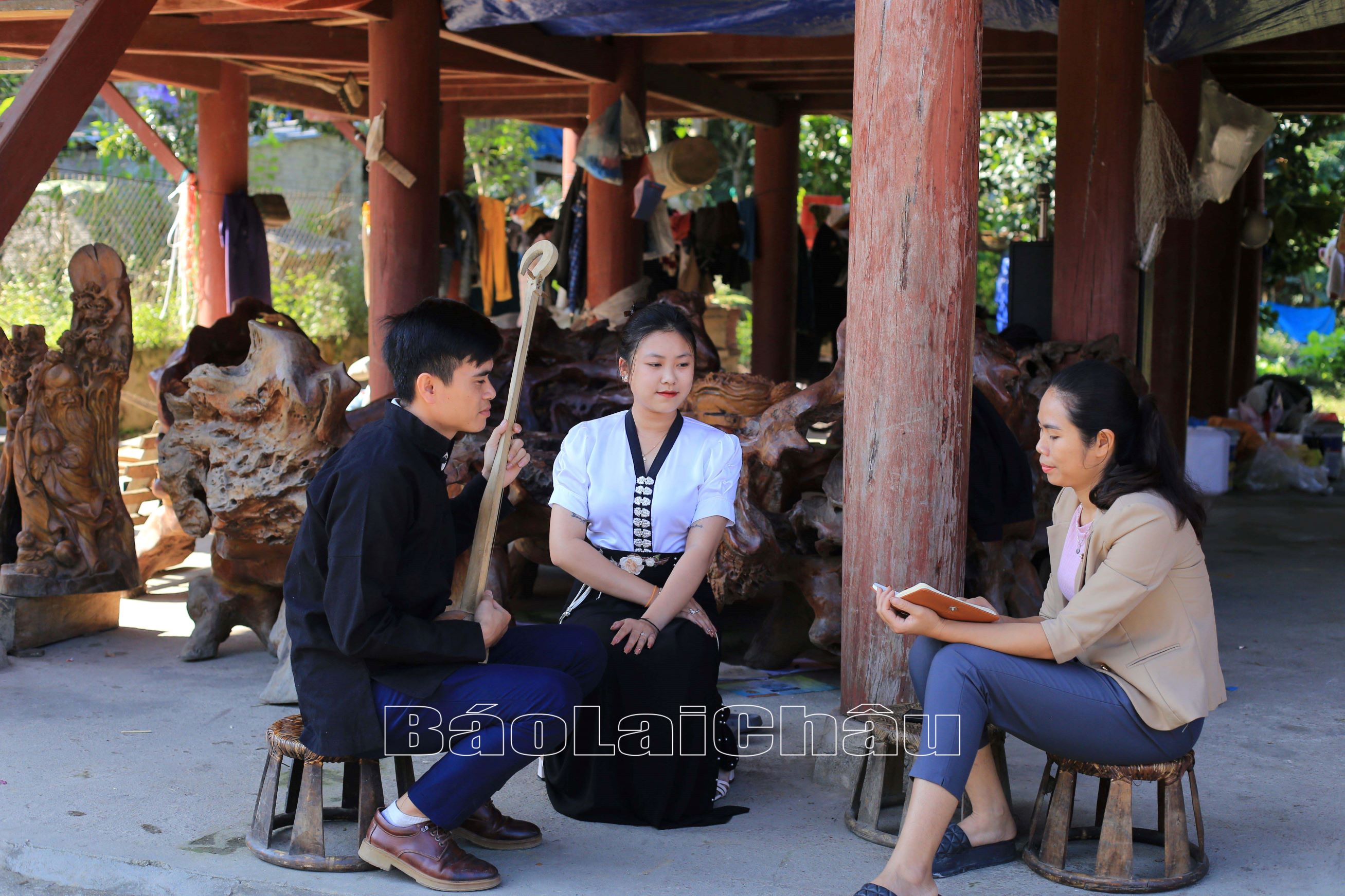
Officials in Le Loi commune (Nam Nhun district) are promoting and encouraging people to preserve their cultural identity.
Outdated customs and social vices have been eradicated, and the cultural life of the people has gradually improved. The people have boosted production, united and helped each other in all endeavors, especially sharing experiences in farming and livestock raising, building economic models, and providing capital and seeds to start businesses. As a result, the poverty rate in the commune decreased to only 12% in 2023, and the average income reached 28.5 million VND per person per year.
Mr. Lo Van Tinh (from Co Mun village) said: "Currently, traditional cultural features are always preserved and promoted by the people in the village. Each family keeps their own traditional black indigo and blue robes to wear on holidays and festivals, and they dance the xoe dance, fan dance, and play folk games such as throwing the ball, stick pushing, and to ma le... I also regularly spread the word to my neighbors and relatives near and far to always preserve our ethnic identity."
Not only is the cultural identity preserved, but the movement to build a cultured way of life has also been promoted. Currently, the commune has 3 out of 5 villages that have achieved the status of "cultural village," and 188 households have been awarded the title of "cultural family" for three consecutive years.
Mr. Luong Van Son, Vice Chairman of the People's Committee of Le Loi commune, said: "In the coming time, to preserve the traditional cultural identity of the ethnic group, the People's Committee of the commune will continue to do a good job of disseminating information and mobilizing the people to unite and wholeheartedly preserve cultural identity and combat social evils; regularly organize cultural and traditional sports exchanges between villages; maintain the village art troupes, and increase participation in cultural festivals organized by the district and province, contributing to enhancing the value of the cultural identity of the Thai people."
Source


![[Photo] General Secretary To Lam receives the Special Envoy of General Secretary and President of China Xi Jinping](/_next/image?url=https%3A%2F%2Fvphoto.vietnam.vn%2Fthumb%2F1200x675%2Fvietnam%2Fresource%2FIMAGE%2F2026%2F01%2F30%2F1769759383835_a1-bnd-5347-7855-jpg.webp&w=3840&q=75)


![OCOP during Tet season: [Part 3] Ultra-thin rice paper takes off.](/_next/image?url=https%3A%2F%2Fvphoto.vietnam.vn%2Fthumb%2F402x226%2Fvietnam%2Fresource%2FIMAGE%2F2026%2F01%2F28%2F1769562783429_004-194121_651-081010.jpeg&w=3840&q=75)

![OCOP during Tet season: [Part 2] Hoa Thanh incense village glows red.](/_next/image?url=https%3A%2F%2Fvphoto.vietnam.vn%2Fthumb%2F402x226%2Fvietnam%2Fresource%2FIMAGE%2F2026%2F01%2F27%2F1769480573807_505139049_683408031333867_2820052735775418136_n-180643_808-092229.jpeg&w=3840&q=75)


Comment (0)