|
In this era of progress, absorbing the best of culture and advanced science and technology from countries around the world is a given, but this absorption must also be selective. Nowadays, wherever you go on the streets, you see countless signs and advertisements written in foreign languages such as English, French, Japanese, Chinese, Korean, etc.
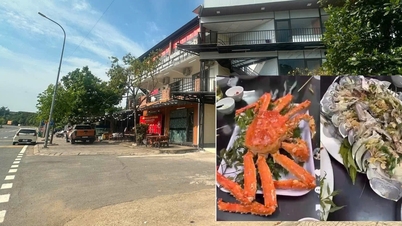
Since 2012, the State has enacted the Advertising Law, which stipulates that all signs and billboards must be in Vietnamese. Foreign languages (if used) can only be written as subtitles and must be below the Vietnamese text, with the font size not exceeding half the size of the Vietnamese text. However, walking through many streets now, one sees numerous shops and businesses displaying signs and billboards entirely in foreign languages. Even the names of very famous Vietnamese brands are obscured!
In the field of education, the Government and the Ministry of Education and Training have also issued quite specific regulations regarding the use of nameplates and signs for educational institutions. Accordingly, the foreign-language name (if any) must be written below the Vietnamese name and in a smaller size. However, in reality, there are still many centers, educational institutions, and schools with foreign elements that prioritize using English names on their signs; some even omit the Vietnamese name or do not use Vietnamese as part of the official name.



In the field of journalism and media, many Vietnamese articles lack clarity and unnecessarily include foreign words. Words like "ok," "hot," "hit," "drama," "livestream," and "check-in" are used quite frequently, even though Vietnamese offers equivalent expressions. Similarly, naming programs with foreign languages or combining Vietnamese with foreign languages is increasingly common. On online news sites and social media, the overuse of foreign languages is also prevalent. This is a manifestation of the misuse of foreign words that President Ho Chi Minh repeatedly cautioned against when speaking and writing Vietnamese. He could write many articles entirely in English or French. However, when writing in Vietnamese, he always prioritized using clear, understandable, and accurate Vietnamese.
Of particular concern is that preserving the purity of the Vietnamese language is not only reflected in how we speak and write, but also in how we treat it in cultural life and media. From this perspective, some ways of expressing the Vietnamese language on television programs can also create different perceptions among the public.
In my opinion, prioritizing the use of Vietnamese program titles, while adding English subtitles when necessary, is a suitable solution in the current context of integration. This approach not only helps a wider audience access program content but also contributes to affirming the position of the Vietnamese language in cultural and media life. Even for programs specializing in foreign languages, using Vietnamese titles combined with foreign language subtitles is a worthwhile option to consider.
If broadcasters, journalists, and educators consistently speak, write, and behave appropriately in Vietnamese, they will not only exemplify exemplary conduct in implementing the law in accordance with the Party and State's policy on the strategy of "building and perfecting the socialist rule of law in Vietnam (by 2045)", but also contribute most effectively to the cause of honoring Vietnamese culture, preserving the purity of the Vietnamese language, and promoting national pride in the Vietnamese language!



Source: https://huengaynay.vn/van-hoa-nghe-thuat/giu-gin-ban-sac-van-hoa-tieng-viet-166841.html