

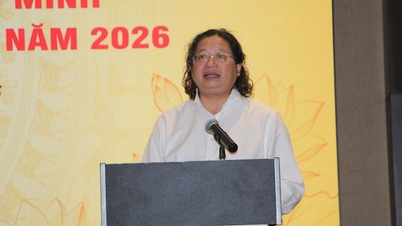
Speaking at a workshop on voice-based teaching methods for teachers at all levels, held in Hanoi on the afternoon of March 23rd, MC and Master's degree holder Thanh Mai, former Deputy Head of the Faculty of Culture and Arts at the Central University of Arts Education, expressed particular concern about preserving the Vietnamese language in the era of integration.
According to MC Thanh Mai, during the development process, many new words, phrases, and purely Vietnamese terms have been created, better serving communication, expressing ideas, and contributing to economic , social, and scientific development.
On the other hand, today's younger generation uses foreign languages more frequently, leading to the emergence of slang and loanwords. The Vietnamese language has suddenly gained more compound words, abbreviations, and symbols, for example, wife = Vk, husband = Ck… The habit of using metaphorical language too frequently in communication also significantly impacts how young people, especially Generation Z, use slang. These slang words are considered everyday communication language, implicitly understood and agreed upon by a group of people, but are becoming increasingly common. For example: "da dẻ" - a humorous way of saying "to show off"; "khum" - a milder way of refusing than "no," often used in intimate conversations; "mai đẹt ti ni" - the Vietnamese transliteration of the English phrase "my destiny" to refer to one's fate…
Currently, the issue of "cultural globalization and linguistic globalization" demonstrates the strong process of linguistic exchange, forcing Vietnamese to simultaneously "compete" with many other languages/foreign languages. In addition, under the impact of urbanization, the market economy, and the continuous and rapidly increasing migration of people into urban areas in the North, Central, and South regions, between urban areas within a region, and between rural and urban areas, the Vietnamese language has also undergone significant changes. During the integration process, dialects gradually influence and "integrate" with the culture of the central region; for example, people from the Central and Southern regions living and working in Hanoi will change their accent and pronunciation to match the way people in Hanoi speak. The majority of people in the provinces and cities only speak their regional accent (dialect) when meeting people from their hometown or communicating with family members.
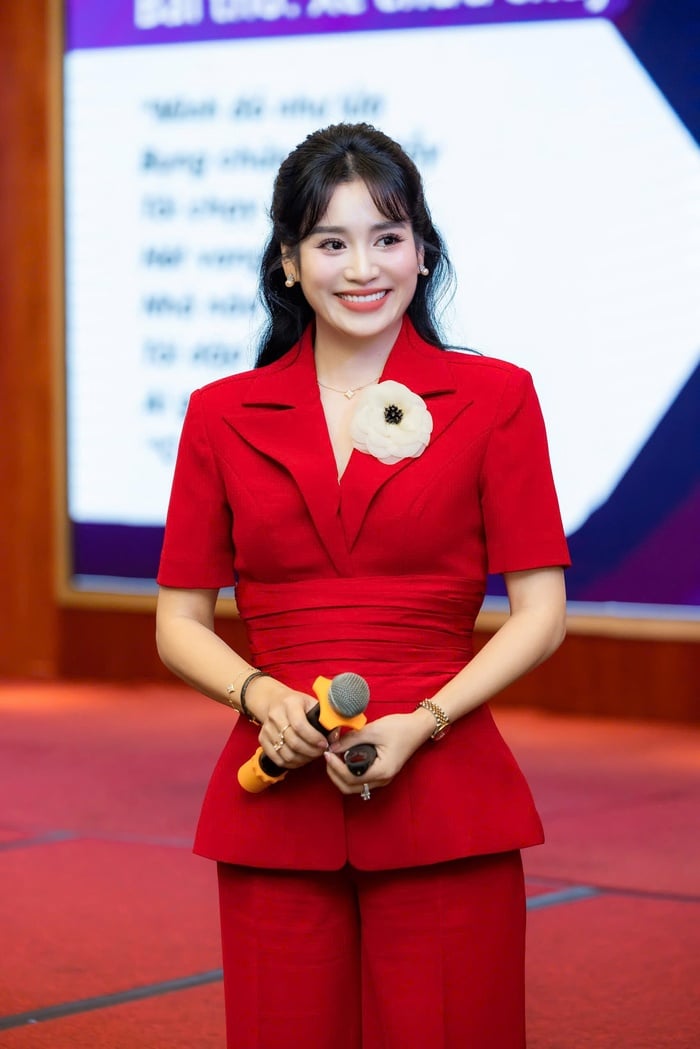
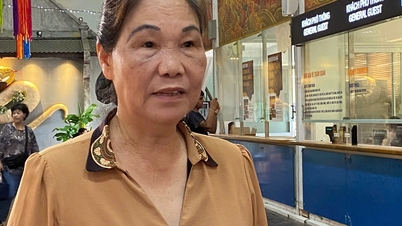
MC Thanh Mai
"It must be said that Vietnamese is the mother tongue of the vast majority of Vietnamese people, the primary and most widely used communication tool in a community of over 100 million people, but its 'variation' is also constantly occurring. The nature of the Vietnamese language to this day is always self-evolving, absorbing a considerable amount of vocabulary from outside, and actively adjusting itself to become unique. The question is how we should inherit traditional linguistic values and integrate in a way that does not lose the identity of our mother tongue in each dialect region, especially in areas inhabited by ethnic minorities."
The process of integrating the Vietnamese language into the globalized world is also part of the trend of integration and globalization, giving Vietnamese many opportunities to absorb new and progressive elements, enriching the language. However, on the other hand, Vietnamese also faces the risk of being assimilated by the overwhelming trend of the "flat world " in terms of language and culture, as some major countries use it. Throughout the past years, although discussed from many diverse perspectives, the unified goal of "preserving the purity of the Vietnamese language" has always been a continuously debated topic," said MC Thanh Mai.
The female MC, author of the book "Handbook for Curing Speech Impediments," argues that: As international integration and global cultural exchange accelerate, the rate of increase in new vocabulary from foreign languages also increases. Over time, newly updated words, adopted and accepted by the majority, will survive and join the common language, enriching Vietnamese. Subsequently, unsuitable words will quickly be discarded, forgotten, or even disappear completely. However, due to the unique nature of language activity, this process occurs much slower than in real-life social situations. We need appropriate policies and mechanisms to create a "filter" that enables the Vietnamese language to adapt during the process of global interaction and integration.
The demands placed upon this require researchers in language, culture, journalism, and media; educational reformers; and experts to conduct comprehensive and in-depth studies of linguistic life in order to provide timely critiques and suggestions to correct deviations in the use of the Vietnamese language. Strict regulations on language in general, and Vietnamese in particular, also need to be standardized and scientific, strengthening the role of state management in the standardization of the Vietnamese language in various fields: politics, society, science, education, journalism, broadcasting, administration, and law. In each school, teachers should spread love for the Vietnamese language, inspiring children, from the moment they learn to speak and write Vietnamese, to be aware of their responsibility to speak and write their mother tongue correctly.
"We understand that in today's fast-paced, globalized world, there are many changes, and each country needs ways to preserve its culture, and Vietnam is no exception. We hope that the Vietnamese language will integrate but not 'dissolve,' that Vietnamese dialects in different regions and provinces will not disappear but will keep pace with the national language so that Vietnamese culture and language remain a cohesive whole," MC Thanh Mai expressed.
Source: https://phunuvietnam.vn/giu-gin-ngon-ngu-tieng-viet-trong-thoi-ky-hoi-nhap-20250324113225216.htm


![[Photo] Prime Minister Pham Minh Chinh presides over a meeting on private sector economic development.](/_next/image?url=https%3A%2F%2Fvphoto.vietnam.vn%2Fthumb%2F1200x675%2Fvietnam%2Fresource%2FIMAGE%2F2025%2F12%2F20%2F1766237501876_thiet-ke-chua-co-ten-40-png.webp&w=3840&q=75)





















































Comment (0)