

Those sounds have become a familiar image over the years, associated with the name of Phan Thi Danh, a woman who quietly but persistently preserves and passes on the folk song heritage of her people.
At the end of December 2025, Ms. Phan Thi Danh was honored with the title of Folk Artisan by the Vietnam Folk Arts Association. This is a well-deserved recognition for her long journey of preserving, practicing, and teaching the folk songs of the Dao Tuyen ethnic group - a unique cultural treasure facing numerous challenges in the context of modern life.
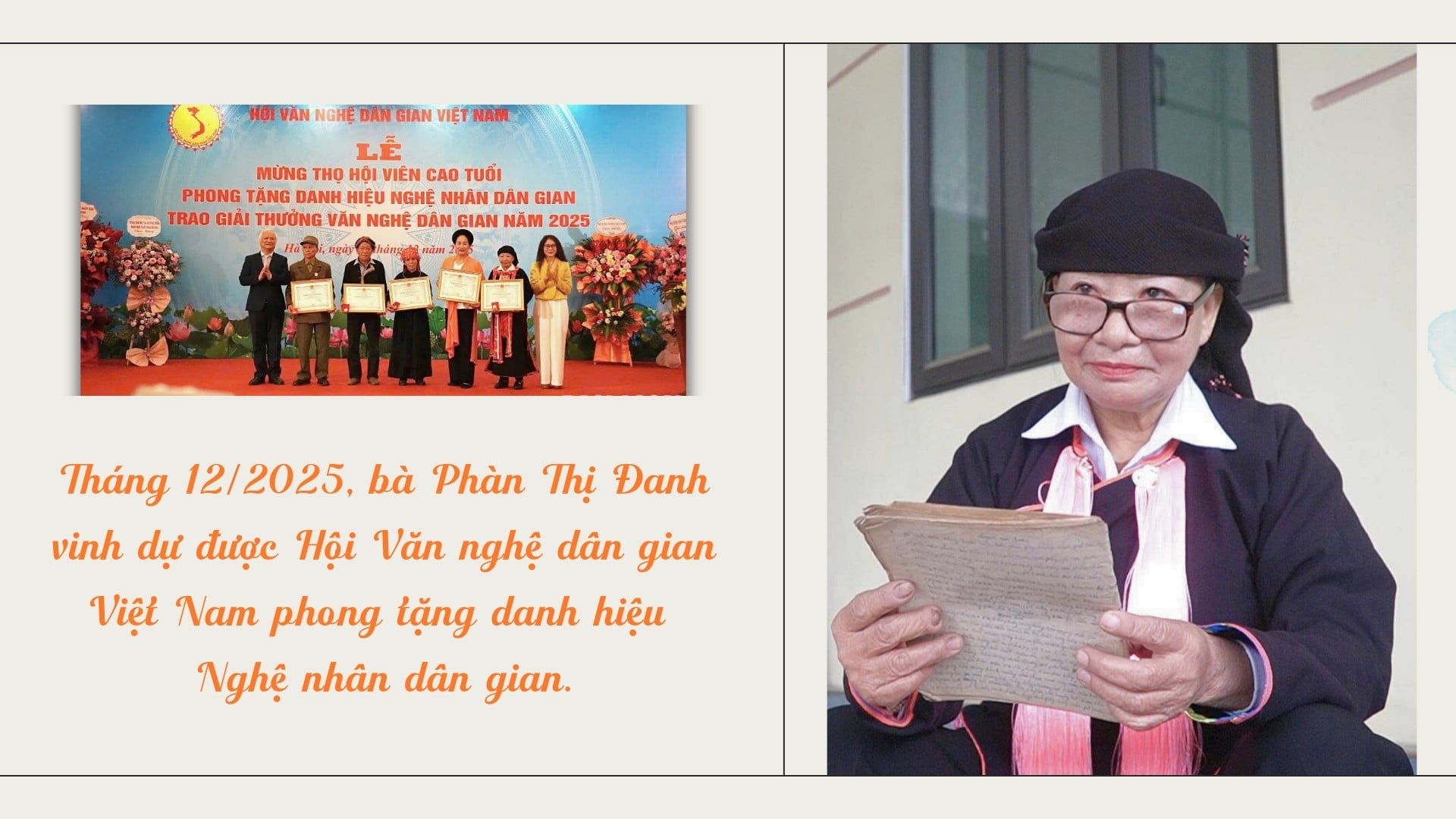
Born into a family with strong traditional values, from a young age, Mrs. Danh was familiar with lullabies and folk songs that resonated in daily life. "When I was little, whenever I heard the women singing, I would hum along. At that time, I didn't think I would be so attached to folk music for so long; I simply found it beautiful and enjoyable," she recounted.
According to Mrs. Danh, at the age of seven, her mother began teaching her short folk songs, from lullabies and nursery rhymes to songs related to labor and daily life. By the age of thirteen, she knew many melodies and learned more call-and-response love songs, and performed them at festivals, New Year celebrations, and village gatherings.
A major turning point in Phan Thi Danh's journey with folk music came in the 1990s, when she received direct guidance from the elderly and talented singer Lo Thi May in her village.
Mrs. Danh clearly remembers: “Mrs. May taught me how to breathe, how to use vocal embellishments so that my voice was clear and high without running out of breath. She also taught me how to stand while singing, how to perform confidently in front of a crowd. And it was she who encouraged and motivated me to preserve and teach the ancient songs of our people.”
Thanks to that guidance, Mrs. Danh's singing voice became increasingly refined. In 1994, she participated in a lullaby singing competition organized by Lao Cai province and won second prize, a memorable experience that further motivated her to continue dedicating herself to folk music.
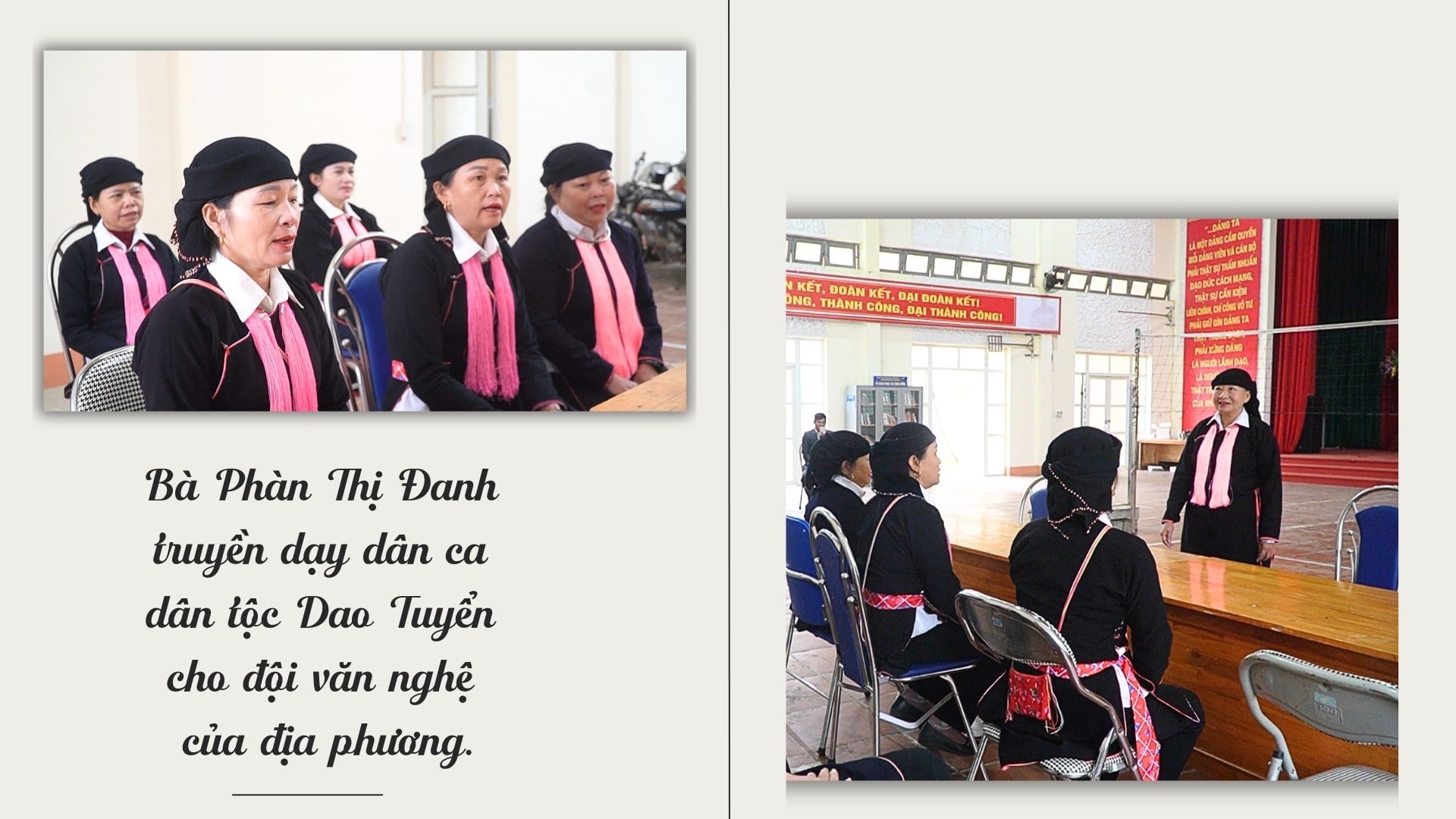

Not only was she a talented singer, but Phan Thi Danh also quickly realized that many folk songs would gradually fade away if not recorded. Despite only completing the third grade, she persistently transcribed Dao songs into the common script. "I was afraid of forgetting them, so whenever I heard a beautiful song, I wrote it down so I could teach it to my children and grandchildren later," she shared.
To date, her four old notebooks contain over 500 Dao Tuyen folk songs of various genres. These include a diverse range of songs such as wedding songs, funeral songs, courtship songs, village festival songs, and call-and-response songs. In addition, she has independently collected, translated, and composed more songs about love for her homeland, notably: "The Hmong People Thank the Party," "The Party Has Given Us a Spring," and "A Song Dedicated to the Party." These are all valuable "living archives" that she has preserved for over 25 years.
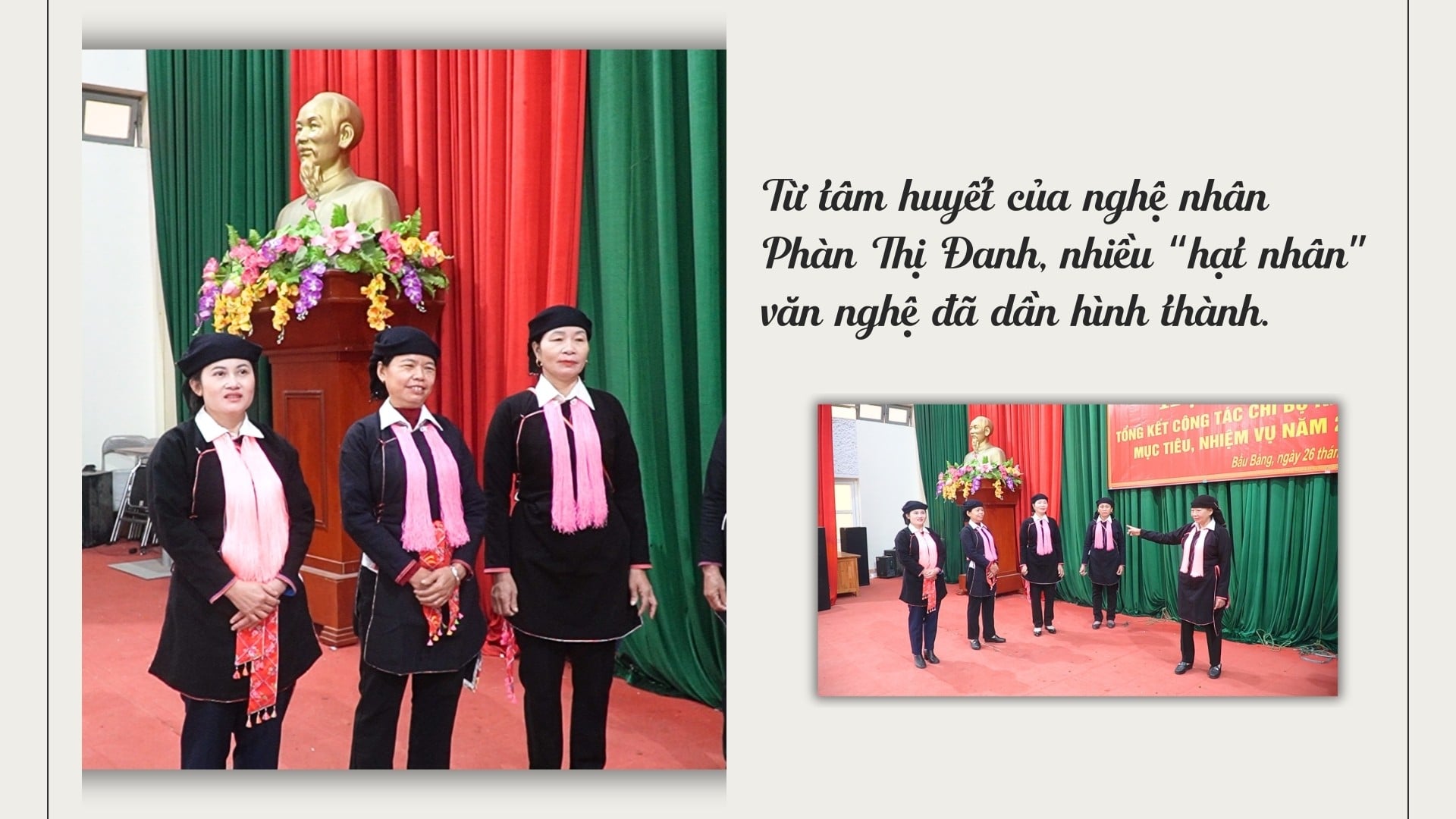
What many people admire about Mrs. Phan Thi Danh is that she doesn't keep this valuable knowledge to herself. Every weekend, she directly teaches folk songs to arts clubs, women's groups, youth groups, and children in the village. She teaches not only lyrics and melodies, but also breathing techniques and breath control. Particularly noteworthy is the ability to distinguish between daytime and nighttime singing voices, a subtle detail in Dao Tuyen folk songs.
Ms. Ly Thi Sang, from Na Lung village, Trinh Tuong commune, one of her long-time students, said: “Ms. Danh taught very thoroughly. She said that to sing well, you have to understand what the song is about and in what context it should be sung. Thanks to her, we not only know how to sing but also understand more about the culture of our ethnic group.”
During her participation in singing exchanges, especially call-and-response singing between men and women, when she encountered difficult melodies she didn't understand, she would write them down and then go to Mrs. Danh to ask for help.
“During those times, Mrs. Danh would meticulously explain each line and phrase, from how to sing correctly to how to behave appropriately according to customs. Her enthusiasm made us love folk songs even more and feel more responsible for preserving them,” Ms. Sang shared.
Thanks to the dedication and persistent teaching of artisan Phan Thi Danh, many talented individuals in the arts have gradually emerged. Her students, such as Tan Thi Phuong, Ly Thi Sang, Phan Thi Hong, Tan Thi Lien, Tan Ta May, and Chao Van Khe, not only sing well but also become core members of village and commune arts groups; actively participating in performances during festivals, holidays, and traditional celebrations, contributing to keeping Dao Tuyen folk songs vibrant in the community's cultural life.

Commenting on the contributions of artisan Phan Thi Danh, Mr. Pham Van Tam, Deputy Head of the Culture and Social Affairs Department of Trinh Tuong commune, said that in the context of many traditional cultural values facing the risk of disappearing, the role of folk artisans at the grassroots level is extremely important.
"Ms. Phan Thi Danh not only preserved a valuable collection of folk songs, but also directly taught them to the younger generation with dedication and responsibility. This is an effective and sustainable way to preserve culture, originating from the community itself," he remarked.
According to him, the model of teaching folk songs through community activities, like that of Ms. Danh, is being encouraged by the commune to be replicated, because it is a way for heritage to continue living in daily life, rather than just existing on paper.
At over sixty years old, Mrs. Phan Thi Danh still regularly opens her old notebooks, reciting each song to teach the younger generation. Her greatest joy, as she shares, is "seeing that my children and grandchildren still enjoy listening to and singing the folk songs of our ethnic group." What she hopes for most is to be able to teach even more, so that the cultural values of the Dao Tuyen ethnic group will not fade away but continue to be preserved and passed down through generations.
The title of Folk Artisan is a well-deserved recognition of Ms. Phan Thi Danh's quiet and persistent contributions. But above all, it is her love for ethnic culture and her dedication to the community that has helped her keep the flame of Dao Tuyen folk songs burning and spreading in contemporary life.
Source: https://baolaocai.vn/giu-lua-dan-ca-dan-toc-dao-tuyen-post890768.html

![[Image] Expediting land clearance at Alley 310 Nghi Tam to facilitate the construction of Tu Lien Bridge](https://vphoto.vietnam.vn/thumb/1200x675/vietnam/resource/IMAGE/2026/04/14/1776160406551_ndo_br_z7724148990408-9e5d4777e3c4504998b4286178b2e66e-jpg.webp)



![[Photo] General Secretary and President To Lam visits and delivers a policy speech at Tsinghua University.](https://vphoto.vietnam.vn/thumb/1200x675/vietnam/resource/IMAGE/2026/04/14/1776164592318_vna-potal-tong-bi-thu-chu-tich-nuoc-tham-va-phat-bieu-chinh-sach-tai-dai-hoc-thanh-hoa-trung-quoc-8700658-5437-jpg.webp)





















































Comment (0)