.jpg)
Unwilling victims
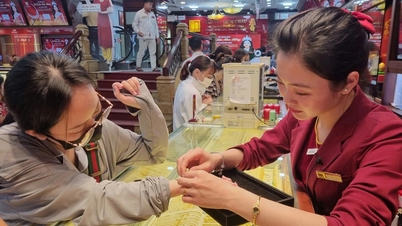
Through news reports, Ms. NTTTr, residing in Son Tra ward, learned that she was a victim of counterfeit goods. She recounted that a few months ago, for her 40th birthday, she treated herself to a black Chanel Coco Handle handbag worth 85 million VND. What reassured her was that the store, located on the bustling Le Duan street, advertised importing goods from Europe and guaranteed a full refund if found to be counterfeit. The handbag came with its original box, paper bag, warranty card, serial number, and purchase invoice in English.
"I'm not an expert on designer brands, but I think that since they spent such a large sum of money, it must be authentic. Moreover, the store sells many famous brands, so I completely trust them," Ms. Tr. said.
She used the bag on important occasions until she read the news that the store had just been fined 103 million VND by the City Market Management Department for counterfeiting famous brands.
"I always thought counterfeit goods were just cheap items sold online or in markets for a few hundred thousand dong. I never imagined I'd spend nearly 100 million dong, buying from a store with a clear address and complete documentation, and still be scammed. To this day, the store hasn't fulfilled its commitment to refund," Ms. Tr. further shared.
According to Lieutenant Colonel Luu Phuoc Nguyen, Deputy Head of the Economic Police Department of Da Nang City Police, many counterfeit and fake goods are openly sold in prime locations, in well-maintained stores with eye-catching signs, making consumers less vigilant. Furthermore, most counterfeit products have packaging, labels, and QR codes for traceability that are so similar to genuine products that consumers find it very difficult to distinguish them.


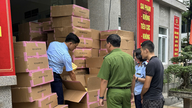
“Previously, counterfeit goods often targeted people's desire for cheap prices. But now, these counterfeiters sell them at quite high prices to build trust. Some counterfeit products are only about 20-30% cheaper than genuine products, or even the same price as authentic ones. Buyers are therefore easily becoming unwitting victims,” Lieutenant Colonel Nguyen stated.
Detecting a suspected counterfeit product is difficult, but proving it is counterfeit is even harder. To handle a case, authorities must check invoices, verify the origin, compare with the trademark owner, and even take samples for quality testing. Not to mention, many sellers operate through social media, livestreaming, and delivery services, with warehouses constantly changing locations. Some businesses are fined but reappear under new names or accounts just days later…
Digital profile solution for commercial products.
According to experts, distinguishing between genuine and counterfeit goods is not as simple as it used to be. While in the past buyers could rely on packaging quality, labels, or price to identify them, these indicators are no longer truly reliable.
Many counterfeiting operations invest in modern machinery, copying almost perfectly everything from designs, logos, QR codes to accompanying documents. Numerous counterfeit products are also heavily advertised on social media, endorsed by celebrities, or sold in upscale stores, giving customers a sense of security.
Mr. Nguyen Van Hoa, the owner of a shop on Tran Phu Street, believes that consumers shouldn't be too trusting of a product's appearance. Many people think that large stores with attractive premises must sell genuine products. But in reality, counterfeit goods are everywhere. The important thing is to buy from reputable sources, with clear invoices and documentation, and to thoroughly research product information before making a decision.
"Instead of relying solely on advertisements, consumers should verify business information, compare selling prices with official listed prices, request invoices, and keep purchase receipts as evidence in case of disputes," Mr. Hoa suggested.
However, the entire responsibility cannot be placed on consumers. In the fight against counterfeit goods, the roles of state management agencies, law enforcement agencies, and the manufacturing businesses themselves are crucial. Strengthening inspections, strictly penalizing violating establishments, tightly controlling e-commerce activities, and applying transparent traceability technology will contribute to shrinking the "breeding ground" of counterfeit goods.

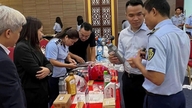

At the business dialogue conference on supporting the "Vietnamese people prioritize using Vietnamese goods" campaign held on June 12th, Ms. Le Thi Kim Phuong, Director of the Da Nang Department of Industry and Trade, stated that the transparency of goods origin is gradually being improved through legal regulations. Specifically, from July 1st, 2026, Circular No. 31/2026/TT-BCT of the Ministry of Industry and Trade, regulating the traceability of products and goods under the Ministry's management, will officially come into effect. Accordingly, products and goods with a high level of risk must have their origin traced through the Ministry of Industry and Trade's product traceability system or an internal system connected to this system.
The circular also stipulates that traders must declare important information such as product name, origin, images, manufacturer, brand, batch number, expiration date, and related supply chain data before releasing goods to the market. For imported goods, in addition to the above information, they must also declare the importer and the official distributor in Vietnam (if any). This is considered an important step in the fight against counterfeit goods, because when each product has a clear "digital record," tracing the origin, determining the responsibility of the manufacturer, and detecting unusual goods will become easier. Consumers also have more tools to protect themselves instead of relying solely on their senses or advertising.
Source: https://baodanang.vn/giua-me-tran-that-gia-3341186.html

![[Photo] General Secretary and President To Lam receives Palestinian Ambassador Saadi Salama](https://vphoto.vietnam.vn/thumb/1200x675/vietnam/resource/IMAGE/2026/06/25/1782365384740_a1-bnd-9423-8322-jpg.webp)
![[Image] Ho Chi Minh City: Ma Lang area, Chicken-Rice Market about to change its appearance](https://vphoto.vietnam.vn/thumb/1200x675/vietnam/resource/IMAGE/2026/06/25/1782377698627_ndo_br_m1-jpg.webp)

![[Image] Schools organize meetings and introduce teaching models to students admitted to grade 10.](https://vphoto.vietnam.vn/thumb/1200x675/vietnam/resource/IMAGE/2026/06/25/1782368077271_ndo_br_z7970052192242-1ec8daeb77a6eed1a4e9f58c564ddd3e-jpg.webp)













![[GALLERY] Voidling Bound takes Steam by storm with 94% positive reviews.](https://vphoto.vietnam.vn/thumb/402x226/vietnam/resource/IMAGE/2026/06/25/1782396892878_tua-1-png.webp)