However, behind these optimistic signs of growth lies a worrying bottleneck: a serious shortage of tour guides fluent in Russian and Korean ...
This is no longer just a problem for travel businesses, but is becoming a pressing human resources issue, directly impacting the quality of service and the competitiveness of the local tourism industry.
When the number of customers increases faster than the workforce.
After a period of stagnation due to the Covid-19 pandemic, the Russian and South Korean tourist markets have returned strongly to Khanh Hoa. According to statistics from the Khanh Hoa Provincial Department of Culture, Sports and Tourism, in the first six months of 2026, the province welcomed over 390,000 Russian tourists, nearly five times more than the same period in 2025; and approximately 800,000 South Korean tourists.
This growth trend is projected to continue as many travel businesses intensify their efforts to exploit traditional markets. Pegas Misr Vietnam Co., Ltd. continuously brings Russian tour groups to Khanh Hoa, while Anex Vietnam Trade and Tourism Co., Ltd. anticipates bringing more than 183,000 Russian and CIS tourists to the locality from April to October 2026.
Notably, Russian tourists are currently showing a tendency to stay longer, from 9-14 days per person, and their demand for cultural experience tours and exploration of local life is increasing. This has led to a huge demand for tour guides who are fluent in the language and knowledgeable about the culture of each tourist market.
However, the current workforce has not kept pace with the growth of tourism. According to the national database of tour guides, the whole country currently has only 499 Russian-speaking tour guides and 1,453 Korean-speaking tour guides. Khanh Hoa province alone has 83 Russian-speaking tour guides and 69 Korean-speaking tour guides. Compared to the millions of international tourists each year, this number is still far too low.
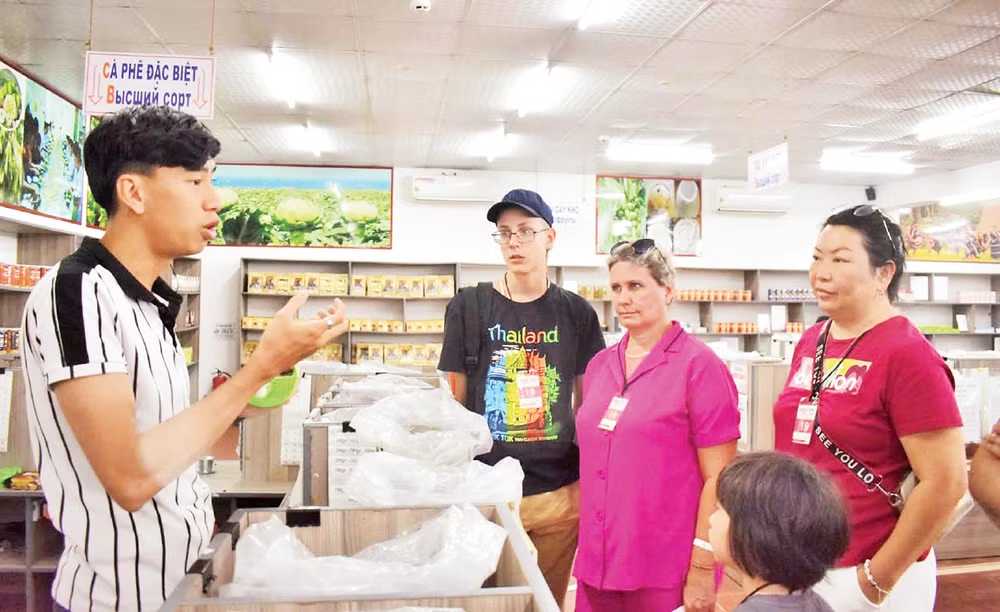
Ms. Nguyen Huong Thuy, Human Resources Manager at Anex Tour Vietnam, stated that the company is willing to pay salaries up to $1,100 per month but still cannot recruit enough Russian-speaking tour guides. Currently, the company only has 12 Russian-speaking guides out of a total of 40 international tour guides.
Similarly, Pegas Misr Vietnam Co., Ltd. also accepts a salary for Russian-speaking tour guides that is double that of English-speaking guides, but it still cannot meet the actual demand.
Mr. Nguyen Phi Hong Nguyen, Deputy Head of the Khanh Hoa Tourism Association, shared that many businesses have to use English-speaking tour guides as a substitute or arrange for foreign tour leaders and staff to accompany the group to support communication with tourists. Some large companies even have to mobilize personnel from Ho Chi Minh City or other localities to Khanh Hoa during peak season.
"Filling the gap" with temporary solutions helps businesses stay afloat, but it cannot replace the role of professional tour guides who are knowledgeable in the local language and culture.


Not only is there a shortage in quantity, but the quality of the current tour guide workforce also raises many concerns. Some businesses report that many guides are older, and their ability to update their language skills and professional expertise is limited. In some cases, guides possess professional licenses but their actual communication skills do not meet the requirements, affecting the tourist experience.
Representatives from the Hon Chong-Hon Do Scenic Area Management Board stated that at key tourist attractions such as the Po Nagar Cham Towers and the Hon Chong-Hon Do scenic area, the number of international visitors remains high every day. Management units have implemented various support solutions, including permanent English-speaking tour guides and multilingual QR code applications in English, Russian, Korean, and Chinese, allowing visitors to listen to explanations independently without relying solely on tour guides.
Tourism is an economy of experiences and emotions. An automated commentary can hardly replace the interaction, connection, and situational awareness of a professional tour guide. They are not only presenters of destinations but also cultural bridges, contributing to building the image and brand of local tourism in the eyes of international visitors.
However, technology can only share a part of the work. Tourism is an economy of experiences and emotions. An automated commentary can hardly replace the interaction, connection, and situational handling skills of a professional tour guide. They are not only presenters of destinations but also cultural bridges, contributing to building the image and brand of local tourism in the eyes of international tourists.
Solve the problem from the root.
According to travel agencies, Khanh Hoa province currently needs approximately 150 dedicated tour guides for the Russian market alone. Meanwhile, the actual number of qualified tour guides is lower than the number of issued licenses.
One of the fundamental reasons is the very limited training resources. Representatives from universities and colleges in the province said that recruiting students for Russian language programs is difficult, while Khanh Hoa currently lacks a specialized institution for training bachelor's degree holders in Russian.
According to Pham Minh Nhut, Chairman of the Khanh Hoa Tourism Association: "We need to acknowledge the reality of market demand. Many tourists tend to want to be accompanied by someone who speaks the same language and culture throughout their journey. Many Russian and Korean tourists only use their native language and have difficulty communicating in English."
We need to acknowledge the reality of market demand. Many tourists tend to want to be accompanied by someone who speaks the same language and culture throughout their journey. A significant number of Russian and Korean tourists only use their native language and have difficulty communicating in English.
This shows that developing a team of international tour guides is not simply about meeting professional requirements, but also a decisive factor in the quality of tourism products and the ability to retain tourists.
Currently, the Department of Culture, Sports and Tourism of Khanh Hoa province is working with businesses to find solutions in the short and long term. The locality plans to review individuals who have studied, lived, or worked in Russia and South Korea to organize professional training courses for tour guides in accordance with regulations; at the same time, it will open short-term training courses linked to the actual needs of businesses.
In the long term, the province will strengthen the links between management agencies, training institutions, and businesses to develop practical training programs that focus on foreign language skills, cultural knowledge, customer service skills, and handling professional situations.



Khanh Hoa province has identified tourism as a key economic sector. Therefore, in addition to investing in infrastructure, products, and market promotion, building a high-quality team of tour guides should be considered a strategic task. If the human resource issue is not addressed promptly, the gap in Russian and Korean-speaking tour guides will continue to be a bottleneck, affecting the quality of service and the competitiveness of Khanh Hoa tourism on the international tourism map.
Mr. Cung Quynh Anh, Deputy Director of the Department of Culture, Sports and Tourism of Khanh Hoa province, said that they will coordinate with relevant units to advise the Provincial People's Committee to issue appropriate solutions to gradually build a high-quality tourism workforce, meeting the development requirements in the new phase.
“Khanh Hoa has identified tourism as a key economic sector. Therefore, in addition to investing in infrastructure, products, and market promotion, building a high-quality team of tour guides should be considered a strategic task. If the human resources problem is not addressed at its root soon, the gap in Russian and Korean-speaking tour guides will continue to be a bottleneck, affecting the quality of service and the competitiveness of Khanh Hoa tourism on the international tourism map,” Mr. Cung Quynh Anh shared.
Source: https://nhandan.vn/go-diem-nghen-de-hut-khach-quoc-te-post971294.html

![[Photo] "Hanoi Lotus Festival" honors the lotus flower that has been associated with Vietnam for thousands of years.](https://vphoto.vietnam.vn/thumb/1200x675/vietnam/resource/IMAGE/2026/06/27/1782516943048_sen-ha-noi-2026-minh-duy-1-jpg.webp)


























































![[Infographic] Dong Thap: Construction is underway on 5 social housing projects.](https://vphoto.vietnam.vn/thumb/402x226/vietnam/resource/IMAGE/2026/06/27/1782545461160_infographic-dong-thap-dang-trien-khai-thi-cong-5-du-an-nha-o-xa-hoi20260626055136.webp)