

 |
| Doctors at Tung Vai Commune Health Station conduct health checkups for local residents. |
There is a need to increase the workforce for primary healthcare.
The Yen Thanh commune health station currently operates at its main office and a branch station in the former Ban Ria commune, with a total of 11 staff members, including civil servants and contract workers. On average, the station receives about 400 patients per month for examination and treatment. Although it has two doctors and a team of medical assistants, nurses, and midwives to perform initial examination and treatment duties, as the station's functions and responsibilities expand, the professional pressure is increasing.
According to Dr. Ly Thi Den, head of the Yen Thanh commune health station, "Currently, the station only provides basic medical services. To ensure the organizational structure, job positions, and professional titles according to the Provincial People's Committee's Project 192, and to implement more advanced techniques and improve the quality of medical examination and treatment, the station urgently needs to recruit more doctors with specialist qualifications, as well as invest in comprehensive facilities and equipment."
Besides the main clinic, the Pho Bang Regional Polyclinic in Pho Bang commune has three health stations located in Pho La, Pho Cao, and Lung Thau (formerly) communes, with 17 staff members serving over 15,700 people in remote, disadvantaged areas. Immediately after being transferred to the management of the commune People's Committee in January 2026, the direction and operation have been smooth and gradually become more organized. The clinic also has more favorable conditions in accessing investment sources and health programs and projects.
Comrade Ma Van Tien, Deputy Head of the Pho Bang Regional Multi-Specialty Clinic, shared: “The biggest difficulty is that the Pho Cao health station does not have a permanent doctor, while this station has been planned for investment and construction to become a regional multi-specialty clinic for the commune. Therefore, the clinic hopes to be reinforced with more doctors and medical staff trained in the right specialties, prioritizing internal medicine, surgery, obstetrics, pediatrics, and modern medical equipment such as: color ultrasound machines, X-ray machines, automatic testing machines, electrocardiogram machines, to better serve the healthcare needs of the people.”
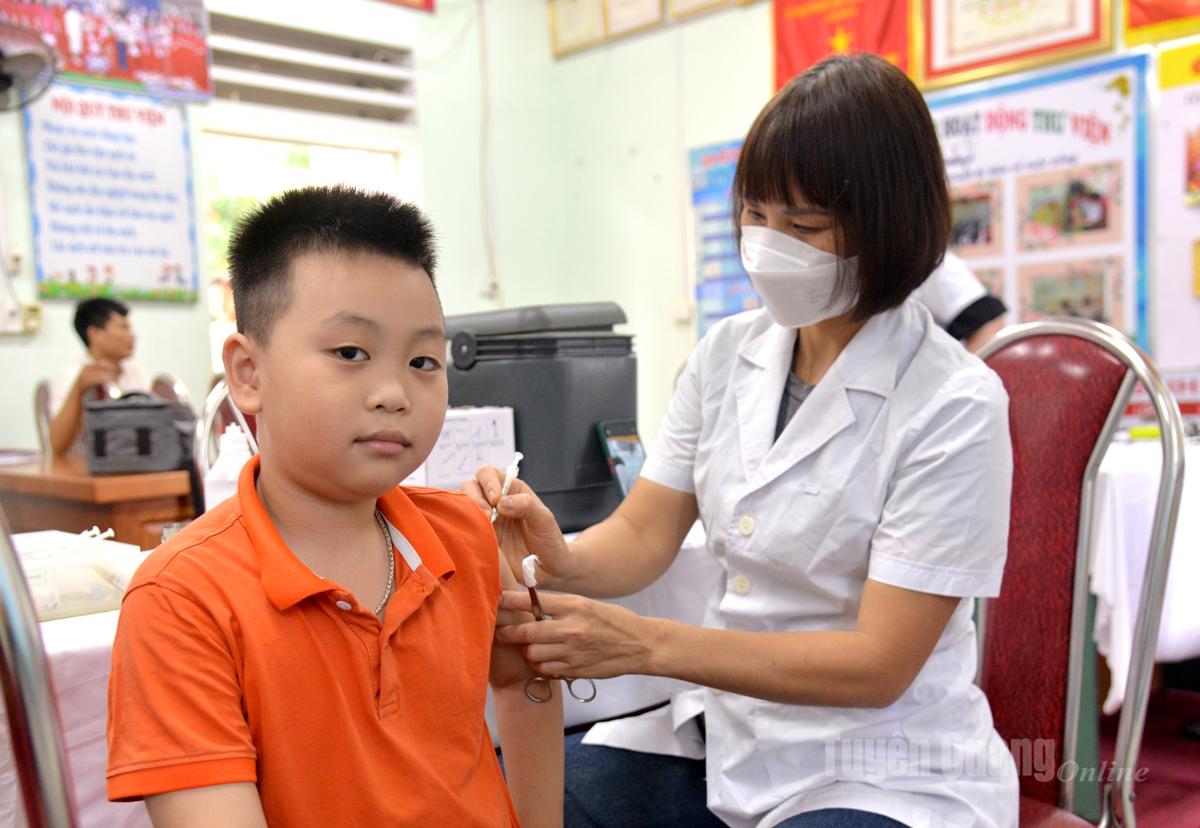 |
| Doctors at Ha Giang 2 Ward Health Station are vaccinating children against diseases. |
The goal is to strengthen the front line.
Implementing Project 192 of the Provincial People's Committee, the entire province has now completed the transfer of 101 commune/ward health stations and 26 regional polyclinics, along with all their staff, to the People's Committees of the communes and wards for direct management of their organizational structure, staffing, and operations. At the same time, these commune-level health facilities remain under the guidance and professional supervision of the Provincial Department of Health and other relevant provincial agencies.
Comrade Vu The Phuong, Deputy Secretary and Chairman of the People's Committee of Thong Nguyen commune, said: "When the health station is under the direct management of the commune-level People's Committee, the leadership and guidance role of the Party committee and government is more clearly demonstrated. Preventive health care; primary healthcare; disease prevention and control; and population and family planning tasks are more closely linked to local management, understanding the people, being close to the people, and being responsive to their needs. Coordination between the health station and other departments, agencies, and mass organizations in the commune becomes more convenient and synchronized, especially in public health emergencies."
Practical experience in many localities shows that addressing emerging issues in people's healthcare is more timely; people access medical services right at the grassroots level, reducing travel costs and easing pressure on higher-level facilities. This is an important prerequisite for gradually improving the quality of grassroots healthcare, especially in remote, mountainous, and border areas. Alongside these initial advantages, there are also many difficulties in operating the new model. One of the biggest challenges is ensuring a high-quality healthcare workforce for the commune level.
Through a review, it was found that currently 24 communes have 1 doctor per health station; 72 communes have 2 doctors per health station; 22 communes have 3 doctors per health station; and 6 communes/wards have 4 doctors per health station. Along with organizational restructuring, the province has also developed appropriate roadmaps and solutions to meet the criteria and conditions of commune-level health stations. In particular, the training and development of medical personnel is considered a key and ongoing task.
In particular, according to Resolution No. 72 of the Politburo , one of the important goals by 2030 is that 100% of commune-level health stations will be comprehensively invested in terms of facilities, equipment, and human resources according to their functions and tasks; striving to have at least 4-5 doctors at each health station by 2027. This is both a foundation and an immediate requirement, as well as a long-term orientation to fundamentally address the "bottleneck" in high-quality medical personnel, creating a foundation for grassroots healthcare to truly play its role as the "front line" in caring for, protecting, and improving the health of the people.
Text and photos: Ha Hoa
Source: https://baotuyenquang.com.vn/xa-hoi/y-te/202601/gonut-thatnhan-luc-y-te-co-so-1f14cb3/
![[Photo] General Secretary and President To Lam presides over a meeting on preparations for the review of one year of operation of the three-tiered government system.](https://vphoto.vietnam.vn/thumb/1200x675/vietnam/resource/IMAGE/2026/06/02/1780391821195_a1-bnd-4595-9717-jpg.webp)




































































Comment (0)