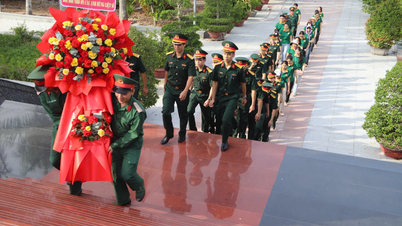
"Towards the commemoration of the War Invalids and Martyrs Day on July 27th, this campaign reminds each of us that: Gratitude is not just about lighting an incense stick, but also about concrete, persistent, and responsible actions to bring the heroic martyrs back to their names, hometowns, families, and comrades."
A command from the heart and the sacred responsibility of a soldier in peacetime.
There are military missions that don't involve gunfire, but still embody the noble qualities of Uncle Ho's soldiers: loyalty, dedication, commitment, discipline, compassion, and loyalty. Searching for, collecting, and identifying the remains of fallen soldiers is one such mission.
It is a journey through deep forests and high mountains, through old battlefields, through lands once stained with the blood of fallen comrades, to find those who fell so that the Fatherland could rise again. It is also a journey through the dust of time, through incomplete records, fading memories, changed landscapes, and war relics obscured by trees, rocks, and new life. Every step of the officers and soldiers on that journey is a step back to history; every remains found brings a moment of national emotion; every identified person is a comfort to a family after years of weary waiting.
 |
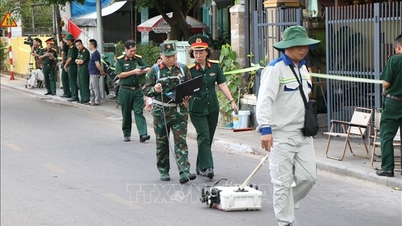
| The search and recovery team for the remains of fallen soldiers, under the Tuyen Quang Provincial Military Command, discovered one set of remains in Nam Ngat village, Thanh Thuy commune, Tuyen Quang province. Photo: qdnd.vn |
The war is long over, but in many Vietnamese families, it still lingers. It remains in an altar without a photograph. It remains in a faded death certificate. It remains in the agonizing question of mothers, wives, and children: Where are my loved ones buried? Some mothers have spent their entire lives waiting. Some families, for generations, have only hoped to welcome their loved ones home. Some war cemeteries still bear many tombstones inscribed with the words "unidentified." These inscriptions represent not only a void of information, but also a silence in the national consciousness.
Therefore, the "500-Day Campaign" cannot be viewed as a typical operational plan. It was a political , military, scientific, and humanitarian mission, but more profoundly, a cultural and ethical one. Vietnamese culture has always placed individuals in relation to their family, homeland, ancestors, community, and nation. The deceased are inseparable from the lives of the living. They remain present in the incense offered on death anniversaries, in martyrs' cemeteries, in family memories, in national history, and in every lesson about patriotism and sacrifice.
Therefore, searching for the remains of fallen soldiers is also about rediscovering a part of the nation's memory. Identifying the remains of fallen soldiers is returning to them the most sacred thing a person can have: a name, a hometown, a family, a place to return to in the hearts of their loved ones and in the heart of the nation. A fallen soldier being called by their correct name is not only a comfort to a family, but also a fuller part of the nation's history. A grave with added information not only warms the hearts of relatives, but also illuminates the moral principle of a nation that never forgets those who sacrificed for it.
In that mission, the Vietnam People's Army plays a special role. From wartime to peacetime, soldiers have always been present in the most difficult, quietest, and most sacred places. Today, these soldiers continue to return to the old battlefields, not to fight the enemy, but to fight against time, against lost information, against difficulties related to terrain, climate, records, witnesses, and data. If in wartime, soldiers spared no blood and sacrifice to protect the Fatherland, then in peacetime, they continue to endure hardships to bring their comrades home.
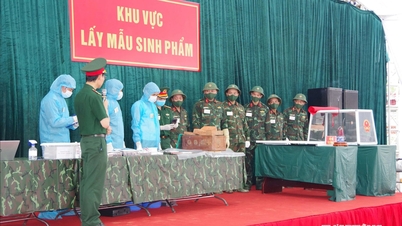
This is a task that demands courage, perseverance, and reverence. Every artifact discovered, every bone fragment unearthed, every handful of soil uncovered requires utmost care. There can be no carelessness, indifference, or formality in such a sacred undertaking. Behind each biological sample lies a human life. Behind each file lies a family. Behind each search location lies a part of the nation's flesh and blood.



In the current context, the search, collection, and identification of the remains of fallen soldiers must be carried out through a close combination of tradition and modernity. Tradition provides us with morality, gratitude, and a sense of responsibility. Modernity provides us with DNA testing technology, databases, digital maps, and methods for investigation, verification, and information cross-referencing. But no matter how advanced science and technology become, the soul of this task remains compassion and righteousness. Technology helps find the right people, but morality helps us understand why we must pursue the search to the very end.
That is the quintessentially Vietnamese beauty of this campaign: using science to serve humanity, using organization to foster compassion, and leveraging the power of the political system to execute a command from the heart.
Transform gratitude into a way of life, so that the memory of martyrs continues to guide us today.
The annual War Invalids and Martyrs Day on July 27th is a sacred milestone in the spiritual life of the nation. However, honoring the heroic martyrs cannot be confined to a single commemorative day, a wreath, a ceremony, or an incense stick. Gratitude must become a living culture, a regular action, and a conscious responsibility of every agency, unit, locality, family, and every Vietnamese citizen.
The "500-Day Campaign" therefore has the significance of a widespread political, cultural, and moral movement. The campaign not only mobilizes specialized forces but also needs to inspire the participation of the entire society. Because there are clues not found in archived records, but also in the memories of the people. There is information no longer on maps, but still preserved in the stories of a veteran, a resident of a former base area, a family that once sheltered soldiers, a locality that was once a fierce battlefield. There are seemingly small mementos—a letter, a comb, a piece of canvas, a hastily engraved inscription—that can open the way to identifying a fallen soldier after decades.
Therefore, every citizen can become a subject of the culture of gratitude. Providing information, preserving a memento, recounting a memory, supporting search and rescue efforts, maintaining cemeteries, disseminating data to find the relatives of fallen soldiers – all are concrete, practical, and humane actions. When the entire population participates, the campaign is not just the work of government agencies, but becomes a movement of the people's hearts, of national morality, and of the will to ensure that no one is forgotten after the war.
This is also a way to educate the younger generation. They were born in peace, grew up in the digital world, and may never have heard the sound of bombs and bullets, but they need to understand that peace doesn't come naturally. Peace was bought with the blood and bones of countless generations. Independence, unity, and territorial integrity are not just concepts in textbooks, but the culmination of countless real sacrifices, real people, and real families. When students, young people, and youth union members participate in caring for martyrs' cemeteries, learning about local history, digitizing information, and sharing stories of searching for the remains of martyrs through new media methods, gratitude will no longer be a dry lesson, but a living experience.
In today's journey of national development, while we talk extensively about innovation, digital transformation, international integration, and rapid and sustainable growth, we must remember that national strength lies not only in economic or technological potential, but also in the depth of Vietnamese culture, ethics, and character. A country that wants to go far cannot lose its memory. A nation that wants to be modern cannot abandon its moral principles. A society that wants sustainable development cannot be indifferent to those who have sacrificed for its present-day existence.
Therefore, the search, collection, and identification of the remains of fallen soldiers is an important part of building Vietnamese culture in the new era. It is a culture of gratitude, a culture of responsibility, a culture of humanity, a culture that places people at the center, even after they have sacrificed themselves and become one with the nation. When we search for these heroes, we are also rediscovering the most beautiful aspects of the national soul: loyalty, compassion, and never forgetting our roots.
From ancient battlefields to today's war cemeteries, from DNA testing laboratories to the families of fallen soldiers, the 500-day campaign is extending a sacred lineage: the lineage of gratitude. Each day of the campaign is a race against time, against the fading of memories, against the unhealed losses. But each of those days is also a day we illuminate Vietnamese morality, strengthen the people's faith, affirm the humane nature of our regime, and the noble qualities of our Army.



As we approach the War Invalids and Martyrs Day on July 27th, what we need is not just solemn commemorative activities, but concrete, practical, and sustained actions. As long as there is one martyr yet to be found, we will still feel remorse. As long as there is one grave without a name, we still have a responsibility. As long as there is one martyr's family yet to receive news of their loved one, we must continue our efforts.
500 days and nights is not just the duration of a campaign. It is 500 days and nights of conscience, responsibility, and camaraderie. It is a solemn promise of honor from the living to the fallen. It is a continuation of the qualities of Uncle Ho's soldiers in peacetime. And above all, it is a profound reminder that: A nation that remembers is a nation that knows how to live; a nation that knows how to be grateful is a nation with a future; a country that persistently searches for each fallen son to bring them back to their names, homeland, families, and comrades is a country that will never lose its noblest essence.
Source: https://www.qdnd.vn/xa-hoi/chien-dich-500-ngay-dem-tri-an-liet-si/goi-ten-cac-anh-giua-long-dat-me-1046376
![[Photo] "Hanoi Lotus Festival" honors the lotus flower that has been associated with Vietnam for thousands of years.](https://vphoto.vietnam.vn/thumb/1200x675/vietnam/resource/IMAGE/2026/06/27/1782516943048_sen-ha-noi-2026-minh-duy-1-jpg.webp)











































![[Infographic] 16 fireworks display locations to celebrate the 50th anniversary of Ho Chi Minh City being honored with the name of President Ho Chi Minh](https://vphoto.vietnam.vn/thumb/402x226/vietnam/resource/IMAGE/2026/06/27/1782539591308_man-ban-phao-hoa-ruc-ro-dem-khai-mac-638jpg-17242995540161175940469.jpeg)