

Nowadays, when people have spare money, many choose to deposit it in a bank to earn interest. This is considered the safest and least risky way to keep money, and anyone can do it. To maximize the effectiveness of your savings, you should understand the relevant issues, including the maturity of your savings account. So, what is a non-term deposit? How is interest calculated when a savings account matures without being renewed?
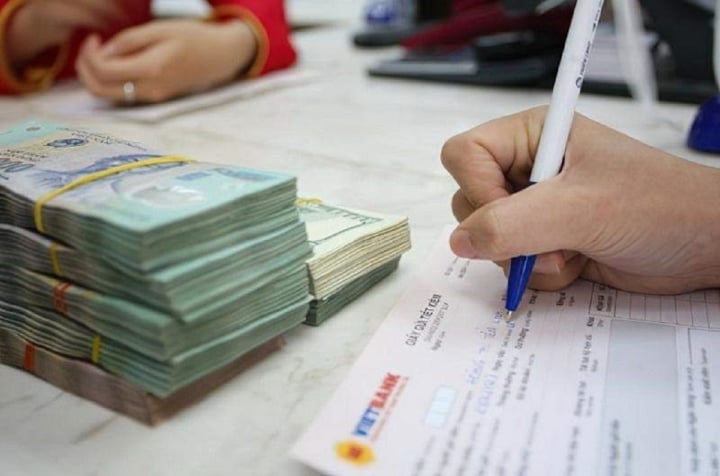
Many people often choose to deposit their savings in a bank to earn interest.
What is a non-returnable savings account?
Non-recurrent savings accounts, also known as non-recurrent maturity accounts, are accounts where, upon maturity, customers must go to the bank to complete the procedures, withdraw both principal and interest, and cannot continue depositing. With this non-recurrent maturity method, customers need to remember the maturity date to go to the bank to withdraw their money.
Currently, banks allow customers to open both fixed-term and non-fixed-term savings accounts. With fixed-term savings accounts, customers can close their accounts at any time. However, with term deposits, the time limit depends on the account's expiration date.
Conditions for non-returnable maturity
To activate a non-returnable savings account, customers must meet all the conditions set by the bank as follows:
- Currently have a savings or loan account at the bank and the payment due date has arrived.
- Customers must be between 22 and 65 years old and have full legal capacity.
- Customers must have a household registration/temporary residence permit (KT3) in areas where the bank has branches.
Non-returnable loan renewal procedures
After the savings period expires, if customers do not wish to continue depositing, they can go to the bank to settle both the principal and interest for the account holder whose name is on the savings passbook. The maturity date is the last day of the deposit term. When the savings passbook matures, it is not recycled; customers only need to bring their savings passbook and ID card to the bank for assistance from the staff.
In the event that the customer does not come to the bank to withdraw their savings by the maturity date, the bank will automatically renew the savings account with the same term. The interest rate will be calculated at the time the bank renews the savings account.
How to calculate interest on non-returnable savings accounts.
When depositing savings, interest rates are the most important concern for many customers. Typically, the interest rate at maturity will vary depending on the depositor's withdrawal date. If you withdraw your savings on the maturity date of the term, you will receive a fixed interest rate for that term.

When depositing savings, interest rates are the most important factor for many customers.
If a savings account matures without the customer closing it, the bank will automatically extend the deposit period, and the interest from the previous term will be automatically added to the principal and transferred to the new term. Therefore, the overdue interest will be calculated using the following formula:
Interest earned = Deposit amount x interest rate (%/year) x number of deposit days / 365
If a customer wishes to close their savings account earlier than the maturity date, the bank will calculate the interest rate based on a non-term deposit. Accordingly, the number of days for which interest is earned will be calculated from the first day of the term to the date of closure.
Interest for half a year = 500,000,000 x 0.5%/365 x 180 = 1,233,000 VND
Linh Chi (Compiled)
Source


![[Photo] Prime Minister Pham Minh Chinh presides over the conference announcing the establishment of the International Finance Centre in Vietnam.](/_next/image?url=https%3A%2F%2Fvphoto.vietnam.vn%2Fthumb%2F1200x675%2Fvietnam%2Fresource%2FIMAGE%2F2025%2F12%2F21%2F1766309817714_ndo_br_dsc-3400-jpg.webp&w=3840&q=75)


![[Photo] Prime Minister Pham Minh Chinh presides over a meeting on private sector economic development.](/_next/image?url=https%3A%2F%2Fvphoto.vietnam.vn%2Fthumb%2F1200x675%2Fvietnam%2Fresource%2FIMAGE%2F2025%2F12%2F20%2F1766237501876_thiet-ke-chua-co-ten-40-png.webp&w=3840&q=75)





























































































Comment (0)