

THE OATH WITH ZENG
Participating in the "Hue Crafts and Ao Dai" program at the end of June in Hue City, the ao dai dresses made from zèng fabric (traditional brocade of the Ta Oi ethnic group) delighted many tourists. Even more unique, the national intangible cultural heritage – the zèng weaving craft – with the participation of veteran artisan Mai Thi Hop, made the program even more captivating. With nimble hands and a confident demeanor, Ms. Hop showed her expertise in interacting with the audience. "At first, I was very shy sitting and weaving zèng in front of a large audience. But having traveled so much, now I work as if I'm performing, and performing as if I'm working…," she said with a gentle smile.
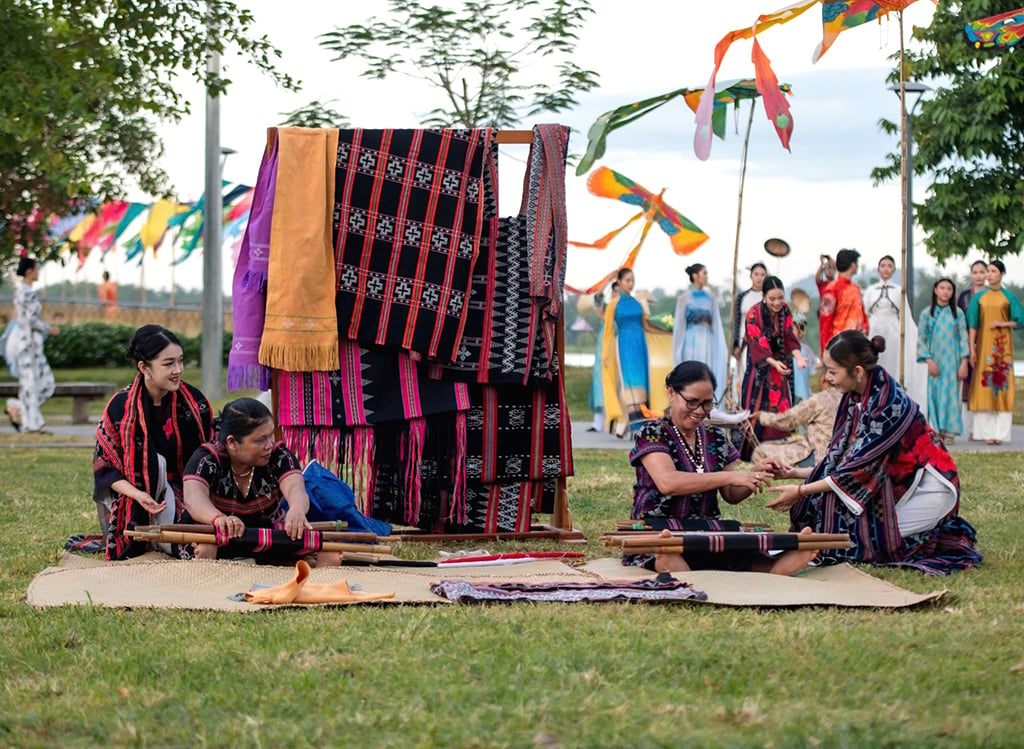
Ms. Hop (second from the right) demonstrates the Zèng weaving craft in Hue City at the end of June 2024.
Choosing artisan Mai Thi Hop to represent the many zèng weavers in Ha Luoi to showcase their skills at major events both domestically and internationally is understandable. Besides possessing top-tier skills in the Truong Son mountain range, she also has a deep understanding of the cultural values embodied in each zèng fabric. She understands the hard work of the women who toil day and night at their looms, and she understands the market and customer preferences. Born in the "cradle" of zèng weaving (Lam Dot commune), she was exposed to cotton yarn and looms from a young age. Thanks to her skillful hands, by the age of 15 she had mastered the most difficult technique in zèng weaving: threading beads to create patterns.
"When I got married, I brought my loom to my husband's house, along with my dowry: a silk brocade woven by my mother. One day, a district official borrowed the brocade for an exhibition, and because of its high price, he... sold it. That night, I had a dream warning me to keep the brocade, otherwise I would have to pay the price. Afterwards, for some reason, the buyer returned the brocade...", Mrs. Hop recounted, explaining that this is why, from a very young age, she was determined to dedicate her life to brocade weaving. Decades ago, making a brocade woven piece involved many steps. From planting cotton, spinning yarn, dyeing the yarn with wild roots (black from the roots of the rattan plant, red from the roots of the a chất plant) to assembling the loom, threading beads, and weaving... it took 4-6 months to complete one piece.
"It's hard work, not difficult. The difficulty lies in the fact that, although zèng fabric is closely associated with the life and culture of ethnic minorities, it's too expensive; few people can afford to buy it," Ms. Hop said, adding, "Solving the problem of how to lower the cost and increase the daily wage of weavers is the only way to hope to preserve and promote the value of zèng." Thinking it through, in 2004, Ms. Hop established a weaving group in the former A Ðớt commune. She became both a weaving teacher for the women and a trader to buy their products.
IGNITING CREATIVITY
Having succeeded in lowering production costs, artisan Mai Thi Hop received orders from her first customers, who were ethnic minority communities in the district, such as the Pa Koh, Co Tu, and Van Kieu. Gradually, her name became known to many people in the mountainous regions of Quang Nam and Quang Tri provinces, and she began to study the aesthetic tastes of each ethnic group. "I know the preferences of the three major ethnic groups with large populations in the Truong Son mountain range when it comes to using zeng (a type of woven fabric). The Pa Koh people like red and simple patterns. The Co Tu people prefer small patterns and muted colors. And the Ta Oi people like more elaborate designs and cheerful colors," Ms. Hop concluded.
Ms. Hop explained that from the three colors of black, red, and white yarn, the traditional images commonly seen on each zèng fabric include fishbone patterns, palm trees, ferns, stars, etc. She realized the need to preserve the traditional values on each zèng fabric and firmly pass on her knowledge to young artisans, but consumer tastes also change with modern life, demanding new designs and materials... After many sleepless nights spent experimenting at her loom, Ms. Hop finally created many new patterns along with brightly colored cotton yarns, such as yellow, dark blue, and green…
In 2015, Ms. Mai Thi Hop upgraded her weaving group into the Aza Koonh Green Brocade Cooperative, bringing together 120 women artisans. Also in 2015, at the Hue Traditional Craft Festival, Ms. Hop carried zèng (a type of brocade) along with her loom to the streets for both display and demonstration. For the first time, under the dazzling lights, models wore outfits designed from zèng. In the same year, artisan Mai Thi Hop carried zèng on a plane to Japan to demonstrate her craft at the Fukuoka International Convention Center. From then on, in less than 10 years, zèng has had a miraculous journey to reach the world .
Ms. Hop became accustomed to traveling abroad to "show off" her zèng weaving in countries like Thailand, France, and Japan. She also delighted her fellow artisans by securing large orders for markets in Europe and America. In 2016, when the zèng weaving craft was recognized as a national intangible cultural heritage by the Ministry of Culture, Sports and Tourism, people once again remembered the contributions of artisan Mai Thi Hop. "I try my best to do whatever I can for the craft and the livelihood of the Ta Oi people. What makes me happiest is that in 2021, I retired and let my daughter, Blup Thi Ha, become the director of the cooperative. By then, my daughter had mastered the craft and had many creative ideas to give zèng weaving even more vitality," Ms. Hop shared.
As a young person, Blup Thi Ha has devoted much effort to researching new products inspired by zèng fabric. While previously the cooperative only sold zèng as a regular fabric, now it designs shirts for men and women, skirts, belts, etc., that can be easily paired with modern clothing. The cooperative has also created about 30 products for souvenirs such as clogs, earrings, clips, hairpins, handbags, face masks, scarves... (to be continued)
Source: https://thanhnien.vn/nhat-nghe-tinh-gui-zeng-ra-the-gioi-185241224235056974.htm






























































































Comment (0)