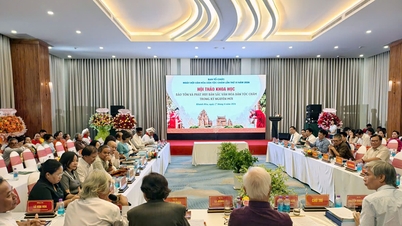
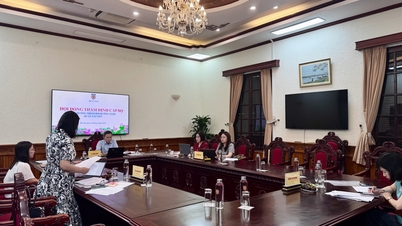
In Ho Chi Minh City on the morning of June 8th, the National Steering Committee for the Search, Collection, and Identification of the Remains of Martyrs (National Steering Committee 515) held a workshop to verify and conclude information about martyrs and their graves in the Do Thanh Cemetery area (Chi Hoa - Saigon), now Le Thi Rieng Park, Hoa Hung Ward, Ho Chi Minh City.
Thorough research
The workshop was chaired by Ms. Pham Thi Thanh Tra , Secretary of the Central Committee of the Communist Party of Vietnam, Deputy Prime Minister, and Head of the National Steering Committee 515. Also attending were Lieutenant General Nguyen Van Gau, Member of the Central Committee of the Communist Party of Vietnam, Deputy Minister of National Defense, and Deputy Head of the National Steering Committee 515; and Mr. Nguyen Van Duoc, Member of the Central Committee of the Communist Party of Vietnam and Chairman of the People's Committee of Ho Chi Minh City.
Information from the workshop indicated that identifying mass graves of soldiers and martyrs who died during the Tet Offensive of 1968 initially presented several difficulties. Specifically, the initial information provided about the mass graves was vague; diagrams, maps, and coordinates were based on a previous reference system, but now they use a different one; and images of the site reflected significant changes in terrain.
Subsequently, through methods of information gathering and analysis such as matching aerial photographs and satellite images taken during the war with historical documents; decoding and converting coordinates to pinpoint and narrow down the area and locate the site… the research team concluded that there are 3 burial trenches at Chi Hoa - Cho Quan cemetery (Do Thanh cemetery) containing approximately 900 fallen soldiers.
"Now the methods are very scientific , the techniques are modern and highly reliable; the sequence of steps is very logical and rigorous," said Colonel, Dr. Bui Yen Tinh, Deputy Director of the Operations Department, General Staff of the Vietnam People's Army, regarding the authenticity of the information.

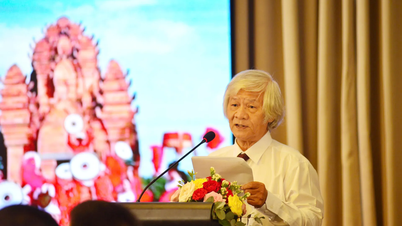
Mr. Nguyen Thanh Phuoc recalls his memories.
Witness accounts
At the seminar, as one of many witnesses, Mr. Nguyen Thanh Phuoc (70 years old) recounted that when he was a child, he lived in the Bac Hai area, adjacent to what is now Le Thi Rieng Park. One morning in 1968, after a round of gunfire, he and his friends ran to the cemetery to play and witnessed the old regime's engineering troops using bulldozers to dig tunnels. Many trucks and vans appeared, followed by firefighters and cemetery staff who helped remove the bodies from these vehicles.
The cemetery caretaker at the time, named Mười Bi, said those were bodies from the battle at the radio station and the US Embassy. According to Mr. Phước, Mr. Mười Bi estimated that one bunker contained 350 people, and two others contained 600 to 700 people, many of whom were wearing white shirts and black trousers, and looked very young.
Another witness, 70-year-old Nguyen Dinh Dat, recalled the days after the Tet Offensive in 1968. When the gunfire in the city had temporarily subsided and martial law had ended, his father drove him and his siblings to the Do Thanh Cemetery. From Le Van Duyet Street, now Cach Mang Thang Tam Street, he saw many bodies. "I can confirm that these were all our soldiers, not mixed with Republic of Vietnam soldiers or civilians. To clear the battlefield, the enemy would take the guns first, then use the AK rifle magazines left next to the bodies as markers. After that, forces would come to carry the bodies with AK rifle magazines or other markings such as wearing sandals or carrying pistol ammunition belts to the cemetery for mass burial," Mr. Dat recounted.
Results from gratitude


In her concluding remarks at the workshop, Deputy Prime Minister Pham Thi Thanh Tra acknowledged that after nearly six decades, drawing on archived records, declassified information, the memories of comrades, and historical witnesses, relevant agencies have taken a significant step forward in their quest to uncover historical truth and locate the mass grave of fallen heroes still lying in the heart of Ho Chi Minh City. Currently, there is sufficient historical, scientific, legal, and practical evidence to confirm the high reliability of the mass grave at Le Thi Rieng Park. Furthermore, conditions are now met to proceed with in-depth surveys, searches, and excavations according to regulations.
Ms. Pham Thi Thanh Tra emphasized the need to focus on accurately identifying the location of mass graves, organizing surveys, searches, excavations, and the collection of the remains of fallen soldiers. Following this, DNA testing should be carried out as quickly as possible to gradually bring the heroic martyrs back to their hometowns, families, and comrades. This must be done with responsibility, respect, and the deepest gratitude towards the heroic martyrs.
On the part of Ho Chi Minh City, the City People's Committee is tasked with urgently taking the lead in developing a comprehensive plan to implement the next steps, coordinating closely with the Ministry of National Defense, Military Region 7, and relevant agencies. The guiding principle is "do what is clear first, continue to clarify what is unclear," "do the easy things first, the difficult things later," ensuring a systematic, scientific, and thorough approach.
The Deputy Prime Minister requested that the entire plan be developed soon, with excavation to commence no later than the beginning of July 2026, in anticipation of the 79th anniversary of the War Invalids and Martyrs Day on July 27th. "The more difficult the situation, the more determined we must be," the Deputy Prime Minister emphasized.
Affirming determination
Prior to the seminar, earlier that morning, a ceremony was held at Le Thi Rieng Park in Hoa Hung Ward, Ho Chi Minh City, to lay flowers and offer incense in commemoration of the late General Secretary Tran Phu and other heroic martyrs.
Attending the ceremony were Pham Thi Thanh Tra, Secretary of the Central Committee of the Communist Party of Vietnam, Deputy Prime Minister, and Head of the National Steering Committee for the search, collection, and identification of the remains of fallen soldiers; Lieutenant General Nguyen Van Gau, Member of the Central Committee of the Communist Party of Vietnam and Deputy Minister of National Defense; and Mr. Nguyen Phuoc Loc, Member of the Central Committee of the Communist Party of Vietnam, Deputy Secretary of the City Party Committee, and Chairman of the Vietnam Fatherland Front Committee of Ho Chi Minh City.

Delegates laid wreaths and offered incense to pay tribute to the heroic martyrs.
In a solemn atmosphere, delegates respectfully laid flowers and offered incense, observing a moment of silence to remember and pay tribute to the late General Secretary Tran Phu and the heroic martyrs who fought and sacrificed for the independence and freedom of the nation.
Le Thi Rieng Park is the site where many sources and witnesses suggest that a mass grave may contain remains of soldiers and martyrs who died during the Tet Offensive and Uprising of 1968.
The act of laying flowers and offering incense demonstrates the principle of remembering one's roots and showing gratitude, while also affirming the determination of the authorities to continue collecting and verifying information to support the search and repatriation of the remains of fallen soldiers.
Healing the wounds of war
According to information from the workshop, the verification and conclusion regarding the mass grave of fallen soldiers buried at Chi Hoa - Cho Quan cemetery involved the participation of American veterans.



Deputy Prime Minister Pham Thi Thanh Tra affirmed that the results of the conference are not only the achievements of scientific research but also the result of perseverance, responsibility, and gratitude towards those who fell for the Fatherland. This is also a vivid testament to the spirit of closing the past, healing the wounds of war, strengthening humanitarian cooperation, and fostering Vietnam-US relations for peace, friendship, and development.

Deputy Prime Minister Pham Thi Thanh Tra and Robert Ambrose Connor, a former police sergeant at Bien Hoa Airport, who received a commendation from the Prime Minister for his outstanding achievements in providing information. Photo: THIEN AN
According to the Deputy Prime Minister, the search and identification of fallen soldiers must closely combine records, documents, maps, and historical witnesses with modern scientific and technological methods. The implementation process must be urgent but extremely thorough, cautious, scientific, meticulous, and accurate. Importantly, it must minimize the impact on the normal functioning of the urban center and the lives of surrounding residents.
Source: https://nld.com.vn/hanh-trinh-tim-dong-doi-giua-long-thanh-pho-196260608215615132.htm