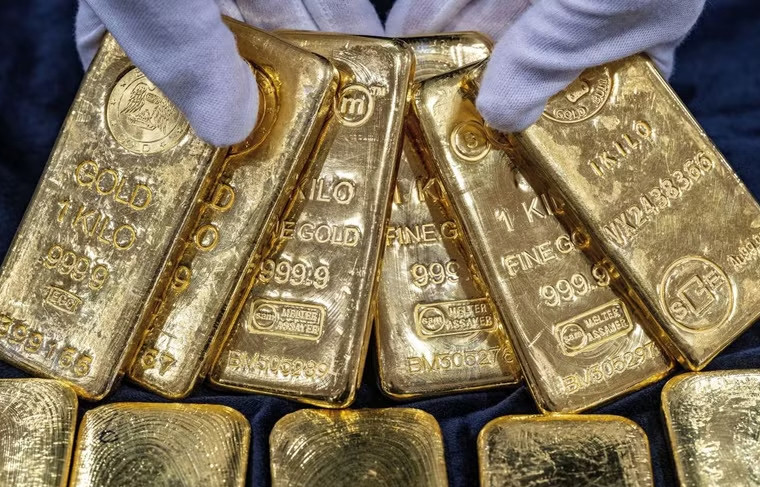
On June 26th, spot gold prices fluctuated around $4,000 per ounce, significantly lower than the historical peak set in 2025. Meanwhile, spot silver futures were around $57.5 per ounce, nearly 20% lower than at the beginning of the year and still unable to return to the crucial psychological threshold of $60 per ounce. This development is in stark contrast to the previous year, when gold prices surged by 66% and silver by over 135%, becoming two of the best-performing assets in the global financial market. Persistent inflation, geopolitical instability, and aggressive buying by central banks worldwide have fueled demand for safe-haven assets.
However, the current context has changed significantly. Following signs of de-escalation in the Middle East, gold prices have weakened as its appeal as a safe-haven asset has diminished, while the US dollar has strengthened and major central banks have begun signaling a more hawkish stance in the fight against inflation.
According to experts at Macquarie Financial Group, investors are now focused on a bigger question: whether inflation will continue to remain high, forcing central banks to prolong their monetary tightening cycles. The market currently expects the Federal Reserve (FED) to raise interest rates in the fourth quarter of 2026.
According to CME's FedWatch tool (a forecasting tool that helps predict potential actions by the Fed), investors are betting on the possibility that the Fed could raise interest rates as early as September 2026. The European Central Bank (ECB) and the Bank of Japan (BOJ) have also recently raised interest rates to respond to energy price pressures.



For gold and silver, a high-interest-rate environment is a significant disadvantage. Unlike stocks or bonds, precious metals do not generate cash flow or yields. When interest rates rise, the opportunity cost of holding gold and silver also increases, causing capital to shift towards higher-yielding assets. Macquarie experts believe that gold prices may remain volatile for the remainder of this year before entering a downward cycle in the following years if the global economy recovers and monetary policy continues to tighten.
Macquarie has lowered its year-end gold price forecast from $4,400 to $4,300 per ounce. According to the firm, gold prices are projected to fall to around $4,200 per ounce from 2027 onwards and continue their downward trend until the end of the decade as the global economy stabilizes and capital flows back into higher-yielding assets.
Compared to gold, silver is considered more vulnerable in the current period. Macquarie experts say that profit-taking pressured silver prices in May 2026, and the market is currently being affected by macroeconomic factors, especially expectations of a Fed interest rate hike. According to the organization, similar to gold, silver prices are likely to fluctuate within a narrow range in the remaining months of this year before gradually declining from 2027. Macquarie experts predict that silver prices could reach around $70/ounce in the fourth quarter of this year thanks to short-term recoveries, before falling to around $65/ounce by the end of 2027.
Although the short-term upward trend has stalled, the long-term outlook for gold remains supported by central bank reserve purchases. The latest survey by the World Gold Council shows that the majority of global central banks expect to continue increasing their gold holdings next year to diversify reserves and hedge against inflation and geopolitical risks. This indicates that the underlying demand for gold has not disappeared. However, in the short term, the gold market still faces several headwinds.
In a report published on June 25th, analysts at Singapore-based Oversea-Chinese Banking Corporation (OCBC) stated that, after losing the crucial $4,000/ounce mark, gold prices are under significant pressure from rising real yields. According to OCBC, while the medium-term outlook for gold remains positive, recent hawkish signals from the Fed and the high real interest rate environment require investors to exercise more caution in the short term.



Last week, Germany's Deutsche Bank stated that "hawks are outnumbering optimists" in the gold market. The bank predicted that gold prices could recover to $4,300 per ounce in the third quarter if the Fed continues to keep interest rates unchanged. In a more negative scenario, Deutsche Bank warned that if the Fed raises interest rates three to four more times, gold prices could fall to around $3,800 per ounce.
Source: https://hanoimoi.vn/hao-quang-cua-vang-bac-dang-nhat-dan-1209408.html