

List of 8 official planets
In order from closest to the Sun to farthest, the eight main planets of the Solar System are:
Mercury
Venus
Earth
Mars
Jupiter
Saturn
Uranus
Neptune
Each planet has its own unique characteristics in terms of size, atmosphere, orbit, and environmental conditions. But they all have one thing in common: they are officially recognized as planets by the International Astronomical Union (IAU).
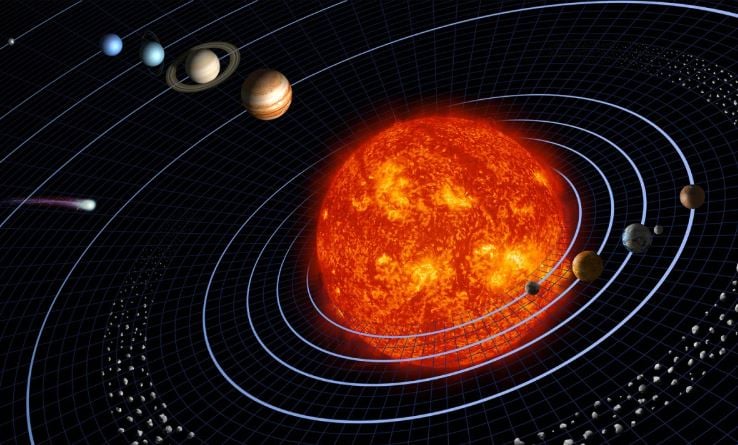
Illustrative image.
Pluto: The "Demoted" Planet
For nearly 76 years, Pluto was recognized as the ninth planet in the solar system since its discovery in 1930. However, in 2006, the IAU introduced an official definition of "planet"—and Pluto did not meet the criteria.
To be recognized as a planet, a celestial body must:
Orbiting the Sun.
It has a nearly round shape due to its own gravity.
It clears the space around its orbit, meaning it does not share its orbit with similar celestial bodies.
Pluto did not meet the third criterion because many other small celestial bodies coexist within the Kuiper Belt region where it is located. Therefore, Pluto was "downgraded" to a dwarf planet – in the same group as celestial bodies such as Eris, Haumea, and Makemake.
Reactions from the scientific community and the public
The removal of Pluto from the list of planets has sparked considerable controversy among astronomers and the public alike. Many still hold fond memories of this "little planet" that was once a part of their childhood. However, from a scientific perspective, this decision helps create a clearer and more consistent standard for classifying celestial bodies.
Goodbye Pluto, but it's not the end.
Although no longer officially a planet, Pluto remains an incredibly fascinating celestial body. In 2015, the New Horizons spacecraft flew past Pluto, sending back valuable images and data that revealed a frozen world with a thin atmosphere and impressive icebergs.
Meanwhile, astronomers continue their search for undiscovered planets at the far edge of the solar system – there may even be a true "Ninth Planet," located further away than Neptune.
Conclusion: The Solar System – a microcosm full of change.
From nine planets down to eight, from Pluto's "demotion" to the never-ending debates, the Solar System has always been a vivid testament to the constant evolution of science. And even though Pluto is no longer a planet by definition, it remains an indispensable part of the wondrous story of the universe that we are discovering every day.
Source: https://doanhnghiepvn.vn/cong-nghe/he-mat-troi-co-bao-nhieu-hanh-tinh/20250415111119086

![[Photo] General Secretary and President To Lam meets with National Assembly delegates from ethnic minorities.](https://vphoto.vietnam.vn/thumb/1200x675/vietnam/resource/IMAGE/2026/04/20/1776696701056_a1-bnd-8331-3342-jpg.webp)



![[Image] National Assembly discusses the implementation of the socio-economic development plan.](https://vphoto.vietnam.vn/thumb/1200x675/vietnam/resource/IMAGE/2026/04/20/1776696707422_ndo_br_img-20260420-185419-jpg.webp)






























































































Comment (0)