


Updated: 10/08/2023 05:19:45
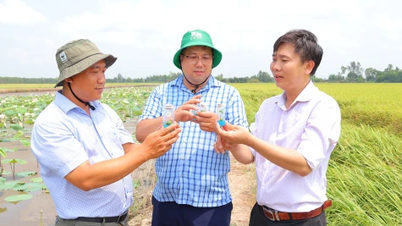
DTO - After nearly two years of implementation (2022-2023), the Sustainable Rice Production (SRP) model at Phu Tho Agricultural Cooperative in An Long commune, Tam Nong district, has achieved impressive results and received high praise from local farmers. The model has helped farmers reduce costs, protect the environment, increase productivity, and boost profits by over 3.6 million VND/ha compared to rice grown outside the model using traditional techniques.
Farmers participating in the Sustainable Rice Farming Model (SRP) are supported with containers for used pesticide bottles and packaging.

The Sustainable Rice Platform (SRP) is a global multi-partner alliance convened in 2011 by UNEP and IRRI, involving 29 related organizations. The SRP model promotes efficient resource use and resilience within the rice system – in the field and along the value chain – while also strengthening income for smallholder farmers.
Rice production according to SRP standards is a new production model based on the "3 reductions, 3 increases" and "1 must, 5 reductions" approach. This helps farmers manage irrigation water, improve the efficiency of fertilizer and pesticide use, and apply integrated pest management (IPM). Furthermore, farmers avoid burning rice straw, use a combination of inorganic and organic fertilizers, and implement integrated pest management according to the "4 correct principles." Applying this model not only reduces production costs and increases profits for farmers but also changes perceptions and production practices, contributing to environmental protection and ensuring the health of producers and consumers.
Mr. Phan Hoang Em, Deputy Director of Phu Tho Agricultural Cooperative, said: “Initially, when encouraged to participate in the Sustainable Rice Production (SRP) model, some farmers in the cooperative were still hesitant about the model's effectiveness. In the first season, only 26 households participated in the model with a scale of over 55 hectares. However, in subsequent seasons, many households producing rice around the model proactively applied to participate. Currently, the model has 28 participating households with a scale of over 81 hectares. It is expected that more households will join the model in the upcoming autumn-winter season. Implementing the model in the past rice seasons has shown that the rice grows very well, with reduced pests and diseases, resulting in lower costs compared to rice fields cultivated using traditional methods, and therefore higher profits compared to rice production outside the model...”
According to the Provincial Plant Protection Department, the sustainable rice farming model not only offers economic benefits but also has a positive impact on environmental protection. Farmers participating in the model are guided not to burn fields after harvest; straw is collected and used for mushroom cultivation and organic fertilizer production. In addition, farmers are instructed to use Trichoderma LHC fungi to rapidly decompose straw, reducing environmental pollution and greenhouse gas emissions. Furthermore, the model guides farmers in applying technical solutions such as the "1 must, 5 reductions" approach, Integrated Pest Management (IPM), and using drones for pesticide spraying. These solutions contribute to limiting the release of harmful chemicals into the environment, protecting farmers' health, and safeguarding the environment.
Mr. Nguyen Phuong Binh, Vice Chairman of the People's Committee of An Long commune, shared that in recent times, Phu Tho Agricultural Cooperative has had access to many advanced new rice production models such as: organic rice production models linked with consuming businesses, sustainable rice cultivation models (SRP)... Through these models, farmers have made many positive changes in their production mindset, becoming more aware of producing quality products, producing according to market demand, bringing high efficiency and protecting the environment...
My Ly
Source
![[Photo] Prime Minister Pham Minh Chinh receives the Minister of Emergency Situations of the Russian Federation.](https://vphoto.vietnam.vn/thumb/1200x675/vietnam/resource/IMAGE/2026/03/05/1772712011395_ndo_br_thiet-ke-chua-co-ten-76-png.webp)
![[Photo] General Secretary To Lam working with the Central Inspection Committee](https://vphoto.vietnam.vn/thumb/1200x675/vietnam/resource/IMAGE/2026/03/05/1772718314670_a1-bnd-8682-5192-jpg.webp)





![[Infographic] Action Program of Candidates for the 16th National Assembly - Constituency No. 4](https://vphoto.vietnam.vn/thumb/402x226/vietnam/resource/IMAGE/2025/9/26/1331532306fb4ad18e4a849e5c64202a)


































Comment (0)