

 |
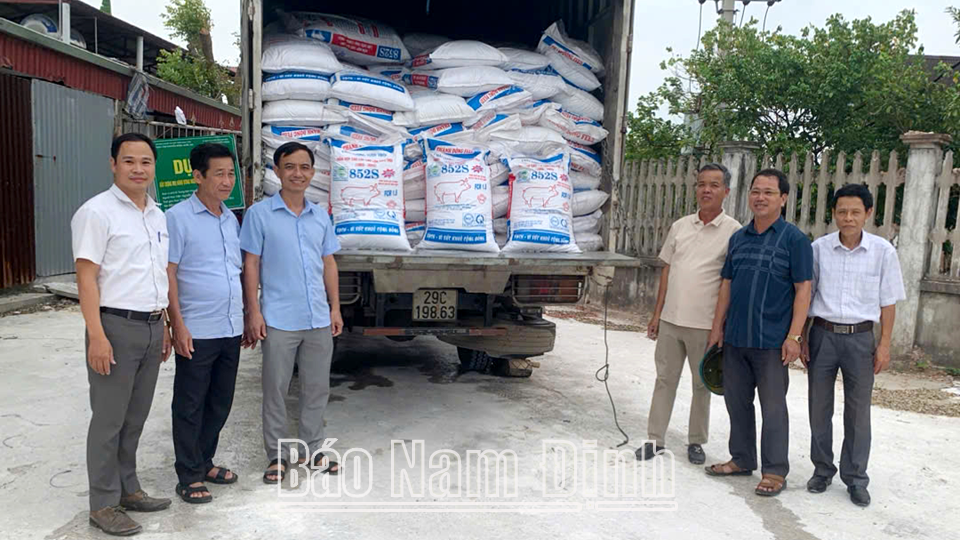
| The Provincial Agricultural Extension Center handed over raw materials to support households participating in the project "Building a model of a safe pork raw material chain area". |
As a key agricultural province, Nam Dinh has long had a strong advantage in livestock development, especially pig farming. The province has implemented many policies to encourage livestock development, aiming to increase the proportion of the livestock sector in the value of agricultural production. According to statistics, in 2024, the total pig population in the province reached over 587,000 head. However, in recent years, the province's livestock industry has continuously had to cope with dangerous diseases such as: blue ear disease, African swine fever, foot-and-mouth disease, and increasingly complex climate change. In addition, traditional livestock farming models, with their small-scale, scattered operations interspersed within residential areas, have revealed many shortcomings, causing serious environmental pollution and difficulties in disease control and product consumption. One of the inherent weaknesses of Vietnam's livestock industry in general, and Nam Dinh in particular, is the lack of linkages. Livestock farmers often handle everything themselves, from breeding stock and feed to disease prevention and securing product outlets. As a result, pig farmers are frequently subjected to price manipulation by traders, easily falling into the trap of "bumper harvest, low prices," while consumers are gradually losing confidence in the quality of pork products on the market due to concerns about antibiotic residues, lean meat enhancers, chemicals, growth hormones, and unscientific farming practices. Pig farming has great potential but also contains many risks. A question for relevant authorities is, "How can pig farming develop sustainably, minimize risks, and truly bring economic benefits to producers?"
To address this issue, in 2024, the Agricultural Extension Center implemented the project "Building a model of a safe pork supply chain" with a scale of 300 pigs in Xuan Thuong and Xuan Giang communes (Xuan Truong district). The model follows a closely linked approach from production to consumption – not only helping farmers master biosafety farming techniques, but also creating conditions for them to participate in the pork value chain as an important link, maintaining long-term relationships with purchasing businesses. Participating farmers receive training on biosafety pig farming techniques, techniques for making bedding in pig pens; prevention and control of common diseases in pig farming; and cooperation with businesses in product consumption linkages. Simultaneously, the farm received government support covering 50% of feed costs (equivalent to 112.5 kg/animal), 900 doses of vaccine, 10 liters of disinfectant per animal, and 15 kg of biological products for the entire herd. Throughout the process, the farmers changed their practices based on experience in animal husbandry and disease prevention. In particular, they strictly followed the farming process with advanced technical measures, from creating biological bedding and using microbial products in feed and drinking water to monitoring, preventing, and controlling diseases.
Therefore, despite unpredictable weather conditions and complex disease outbreaks in the region, the pigs in the model farm still grew and developed well, meeting the technical criteria set by the project. Specifically, in the 5 months from raising to slaughter, the pigs grew and developed well, with a survival rate of 100%; the average weight at slaughter reached 113.2 kg/pig. The average weight gain reached 756 g/pig/day - a very positive figure in the context of rising feed prices and input costs. All products from the model farm are contracted for purchase by Cong Danh Co., Ltd., An Xa Industrial Cluster (Nam Dinh city), which processes them into products such as sausages and ham, and sells fresh pork at convenience store chains, thus closing the value chain from farm to table. As a result, the economic efficiency of the model increased by 23.9% compared to mass production. The effectiveness of the model is not only reflected in "dry" statistics but also in the significant change in farmers' production mindset. Mr. Tran Kien Cuong from Xuan Giang commune shared that participating in the project not only taught him advanced livestock farming techniques but also helped him understand the value of linkages, chain production, adherence to procedures, and brand building. This has given him the confidence to expand his scale and create linkages between households to form a safe pork raw material area for sustainable development in the face of increasingly demanding market demands. The model has also been highly appreciated by local authorities and specialized agencies, considered a nucleus for wider replication, contributing to improving the economic efficiency of households and successfully implementing the agricultural restructuring program associated with building advanced and model new rural areas. By the end of 2024, the project had expanded to include two more models.
The initial success of the project shows that, for the livestock industry to develop sustainably, stronger involvement from all levels of government, relevant agencies, businesses, and the people is needed in building close, transparent, and efficient supply chains. Besides technical support, it is essential to continue promoting biosafety in livestock farming and strictly control the use of antibiotics and chemicals in animal husbandry. At the same time, it is necessary to encourage processing businesses to participate deeply in the production chain and create conditions for the development of new-style cooperatives and livestock production groups, acting as a bridge between people and the market. This will not only bring stable income to the people but also open up opportunities for the province's livestock industry to develop more sustainably, safely, and efficiently in the future.
Text and photos: Ngoc Anh
Source: https://baonamdinh.vn/kinh-te/202504/hieu-qua-tu-mo-hinh-vung-nguyen-lieuchuoi-thit-lon-an-toan-e722563/

































































Comment (0)