

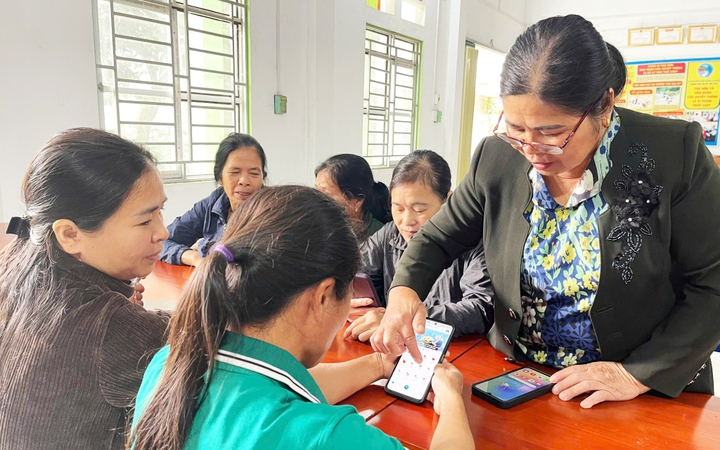
The digital transformation team of Ban Vieng hamlet, Thong Nong commune, provided hands-on guidance to residents on how to use VNEID level 2.
According to representatives from the Cao Bang Provincial Department of Science and Technology, localities have established 1,431 community-based digital transformation groups with 12,151 members. The Department and communes/wards have organized training and guidance on digital transformation knowledge for more than 4,000 people, thereby improving the quality of these community-based digital transformation groups.
Through popular education classes on "Digital Literacy for the People," people of all ages in remote villages and cities have accessed and used online public services, sold products on e-commerce platforms, made cashless payments, used applications connecting citizens with the government, learned about fraudulent schemes, and protected themselves in cyberspace...
Notably, after learning about, applying, and experiencing the benefits of digital transformation and the convenience of using online public services, many people have actively learned about, applied, and guided their neighbors and relatives to use online public services, becoming "key figures" in digital transformation in their villages.
The policy was implemented promptly after the reorganization of the apparatus.
Cao Bang province launched the "Digital Literacy Movement" at a time when it had just completed the reorganization of administrative units according to the two-tiered local government model. This is a period when the administrative apparatus is being streamlined, and the demands for governance and service to the people are higher, requiring digital transformation to be substantive and avoid formality. The Provincial Party Committee issued Plan No. 465-KH/TU dated May 16, 2025, and the Provincial People's Committee issued Plan No. 2554/KH-UBND dated August 14, 2025, on the implementation of the "Digital Literacy Movement" throughout the province.
Notably, the plan goes beyond mere appeals, defining specific goals and tasks, and clearly assigning responsibilities to each department, sector, and locality. The Department of Science and Technology is designated as the permanent agency, responsible for providing professional guidance, monitoring, and evaluating the movement, while also connecting it with ongoing science and technology, innovation, and digital transformation initiatives in the area.
According to the Director of the Department of Science and Technology, Nong Thi Thanh Huyen, the movement has achieved encouraging results through its implementation:
The entire province organized 2,622 conferences for learning, understanding, and disseminating information, with 60,214 delegates attending. The movement's content was integrated with the "Nationwide Emulation Campaign for Innovation and Digital Transformation," and was regularly reported on by the press and mass media, highlighting exemplary cases and best practices. The province maintains the "National Digital Learning Day" on October 10th every year, creating a rhythm for learning digital skills within the community.
These figures and activities demonstrate that the movement is organized in a coordinated, systematic manner, with a central coordinating body and a mechanism for dissemination. This is a crucial condition for digital skills learning to not only take place in conferences, but also reach villages and hamlets – where people "learn to do" and "learn to use."
Bringing digital skills to the grassroots by working closer to the people.
Given its mountainous terrain and dispersed population, Cao Bang province has chosen to implement "Digital Literacy for the People" in a practical way, focusing on skills people need in their daily lives. Instead of spreading content thinly, localities prioritize tasks close to the people, such as electronic identification, cashless payments, online application submission, and access to official and secure information in the digital environment.
Along with free digital skills training programs for officials, civil servants, and citizens, the province organizes conferences and workshops to guide the application of artificial intelligence in state administration and professional work; gradually bringing digital platforms supporting the movement such as MOOCs, digital citizen platforms, the digitization of records and documents, and virtual assistant applications into practice.
At the grassroots level, the Community Digital Technology Team is the core force. The motto "going door-to-door" is demonstrated through very specific actions, such as: guiding people on how to use smartphones, install and use applications, submit online public service applications, and make cashless payments. This "hands-on" approach creates significant change; people no longer "hear about digital transformation" but can practice it immediately, have their mistakes corrected right away, and gradually build confidence.
In Dong Tam - Ban Ra hamlet, Dam Thuy commune, the spread of the movement is most evident in hamlet meetings, Party branch activities, and community guidance sessions. Mr. Mac Duc Quan, Head of the Community Digital Transformation Team in Dong Tam - Ban Ra hamlet, shared:
Our community digital transformation team has implemented many initiatives right from the Party branch meetings and neighborhood meetings. Initially, many people in the neighborhood didn't know how to use smartphones or weren't familiar with cashless payments. After repeated guidance, they responded very positively. Now, with just a smartphone, they can shop and spend cashless, which is very convenient. When completing some online documents, they clearly see the benefits of saving time and reducing travel. Therefore, the people strongly support and embrace the digital transformation movement.
From Dam Thuy, we can derive a "key" to implementing digital skills appropriately in mountainous areas: for digital skills to spread, the learning content must be integrated into community activities; for people to be able to use them, specific and persistent guidance is needed, in a way that is "easy to understand, easy to do, and gradually familiarizes them with."
A model example that serves as a foundation for spreading the movement.
In the initial phase, exemplary models played a crucial role, serving both as proof of effectiveness and as a "foundation" for expanding the movement. Notable examples include the approach in Hoa An commune and the "One-Stop Shop" model in Be Van Dan commune.
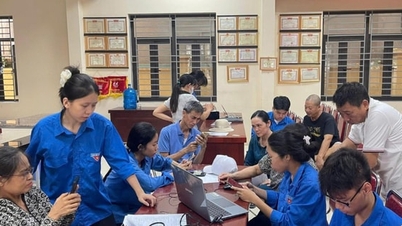
In Hoa An commune, two pilot models, "Outstanding Digital Cadre" and "Outstanding Digital Citizen," implemented since the end of 2025, have created positive changes. Mr. Be Kim Dat, Deputy Secretary of the Youth Union of the commune, was selected as an "Outstanding Digital Cadre." In a short time, Mr. Dat directly guided 38 people in carrying out administrative procedures and installing and using digital platforms on their phones.
In addition, Vu Quoc Thinh, Secretary of the Youth Union of Pho Giua Ward, Hoa An Commune, was selected as an "Outstanding Digital Citizen" for actively promoting and guiding people to install VNeID, use the electronic Party member handbook, and other essential digital applications.
Hoa An Post Office coordinated with relevant agencies to directly assist people in submitting online public service applications and making cashless payments. This model demonstrates a strong point in effectively mobilizing youth, organizations, and postal businesses to create a "support network" right at the grassroots level.
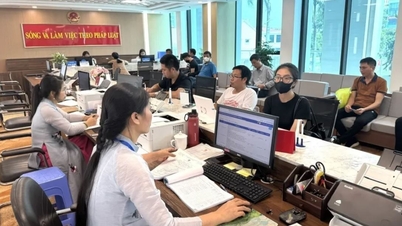
A highly practical model that directly impacts the people is the "One-Stop Shop" at the Be Van Dan Commune Public Administrative Service Center. Deputy Director Dam Kien Quoc affirmed: "We believe that 'Digital literacy for the people' must be linked to the specific interests of the people."
When citizens can submit applications themselves, make payments themselves, and track the progress of their procedures themselves, then digital transformation will truly become a part of their lives. The center organizes awareness campaigns and guidance in villages; supports people in creating electronic identity accounts, submitting applications online, making cashless payments, and receiving results via public postal services.
The good news is that after receiving guidance, many people have proactively supported their relatives and neighbors, gradually forming the habit of using public services in the digital environment.
"Popular Education in the Digital Age" is gradually entering the lives of the people of Cao Bang through simple and practical changes for the people.
Today's results are just the beginning, but with the right approach and community support, the movement is showing its potential for widespread impact.
When digital transformation begins with the real needs of the people, even small changes become meaningful, thereby gradually building the foundation for a digital society that is close to and for the people.
Source: https://mst.gov.vn/hieu-qua-tu-phong-trao-binh-dan-hoc-vu-so-o-cao-bang-197260320080651.htm
























































































Comment (0)