


Through infrared wavelengths, astronomers observe black holes tearing apart stars with their immense gravitational force.
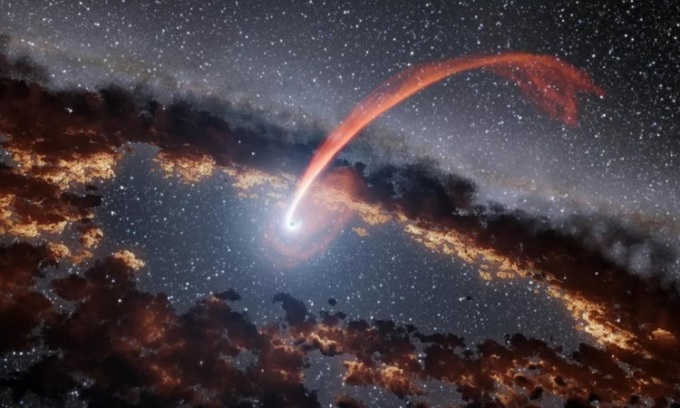
A simulation of a black hole devouring a star. Image: NASA/JPL-Caltech
A supermassive black hole tore a star apart in the center of the galaxy NGC 7392 quite some time ago. A flash of light from this event reached Earth in 2014, and astronomers have just discovered the event in their data. The newly discovered flash of light, originating from the center of the galaxy NGC 7392, is the closest example of a tidal disruption event (TDE), in which a star is ripped apart by the immense gravitational pull of a black hole. The research team published their findings in the Astrophysical Journal Letters, Space reported on May 6th.
The voracious black hole is located about 137 million light-years from Earth, approximately 35 million times farther than Proxima Centauri, the closest star to the Sun. While that distance sounds far, astronomers have only observed about 100 such events before, and this one is four times closer than the previous record. Scientists discovered the new TDE using infrared, a wavelength different from most other TDEs that are typically detected through X-rays, ultraviolet, and optical light.
After first detecting the TDE with observations from the NEOWISE space telescope, lead researcher Christos Panagiotou, an astronomer at the Massachusetts Institute of Technology, and his colleagues reviewed data from several other observatories to learn more about the supermassive black hole of NGC 7392. They wanted to unravel the mystery of why this TDE appeared in infrared light rather than other high-energy wavelengths.
Previously observed TDEs (Transit-Destructive Entries) primarily existed in green galaxies, which don't produce as many stars as blue galaxies but don't expend as much energy on star formation as red galaxies. However, NGC 7392 is a blue galaxy that produces a significant amount of new stars and dust. This dust obscures optical and ultraviolet light at the galactic center, where the supermassive black hole is located. But infrared light allows astronomers to see through the dust and observe what's happening. By searching for TDEs in the infrared wavelength range, they may be one step closer to understanding how black holes consume stars.
An Khang (According to Live Science )
Source link


























































































Comment (0)