

These are also the two major areas of his artistic creation, to which he has devoted his passion since he first picked up a brush. In particular, he not only paints horses very vividly, but also conveys very East Asian philosophies of life and the universe. The images of horses by Le Tri Dung, whether their manes are tossing and hooves are taut or they are leisurely strolling, all possess a unique and distinctive beauty. That is why he is affectionately called by the public and his colleagues as… “the horse painter”.
On the eve of the Lunar New Year of the Horse, I called to arrange a meeting with him to discuss his horse paintings, and he agreed. As scheduled, I rang the doorbell of his three-story house in a winding alley on Dang Van Ngu Street in Hanoi . The artist greeted me warmly, with a "announcement" instead of a greeting: "This morning, I had to postpone five phone calls from people introducing themselves as journalists wanting to meet me to write an article about horse paintings; I only agreed to meet you privately!"
I jokingly said, "Thank you. Perhaps it's because my accent is so charming?" The artist laughed aloud, "That's right, I recognized you as from Quang Tri the moment I heard your voice, I knew you were from the Quang Tri region..." Before I could recover from my astonishment at the words "from the Quang Tri region" coming from the mouth of this "Hanoi native" artist, he began to sing melodiously: "This beloved, gentle, and simple land / Still fragrant with the mother tongue of our Quang Tri homeland…" And so our conversation became engrossed in the topic of Quang Tri with great enthusiasm…
 |
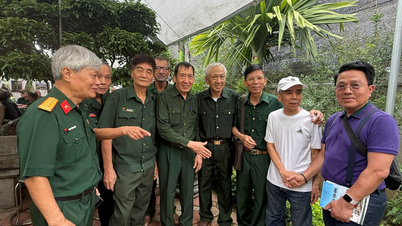
| Veteran Le Tri Dung and former political commissar Bui Tung, 2019 - Photo: Provided by the interviewee. |
He recounted that before 1975, he had visited Quang Tri three times. The first time was in May 1969, when he was in his third year at the Fine Arts University and joined a group for a field trip to Vinh Linh. Everyone was hunched over their rickety bicycles, laden with backpacks, bags of rice, easels, and other belongings. At that time, American planes had stopped bombing North Vietnam north of the 17th parallel, but Vinh Linh still felt the intense atmosphere of war. After more than three months of hardship in this "land of fire," both literally and figuratively, he created hundreds of sketches depicting the devastation caused by bombs and bullets, and images of soldiers and civilians simultaneously working and preparing for battle. At the end of August, after the field trip concluded, the group cycled to the Ngang Pass when they received news of President Ho Chi Minh's death. Everyone was determined to travel day and night to reach the capital in time for the memorial service at Ba Dinh Square.
The second time was at the end of May 1972. After three months of basic training in western Thanh Hoa province, his "Student Soldiers" battalion was ordered to "go to Ben Tre." At that time, the US was preparing to resume bombing in the North, so from the Ngang Pass southward, the unit had to march on foot, often at night. It took them more than half a month to reach the upper reaches of the Ben Hai River.
While assembled at a military depot, preparing to march further east towards Quang Tri, they received a directive from higher command: Soldiers of the 338th Division who were university lecturers and students working on their graduation theses were to be withdrawn to reinforce the technical branches of the military. He later learned that this directive was only for his 338th Division, which at the time belonged to the Hanoi armed forces and was being reinforced on the battlefields. He also later learned that his "Student Soldiers" Battalion had arrived to prepare for the defense of the Ancient Citadel and Quang Tri town during the "Summer of Fire" in 1972…
This was his third time in Quang Tri, this time as an artist. After being withdrawn to the North in early June 1972, he was assigned to the Armored Corps. After three months of tank driving training, preparing for battle, his unit discovered his artistic talent and transferred him to the Corps Headquarters to prepare for the 13th anniversary of the Armored Corps' tradition (1959-1972). Due to his outstanding performance, after the anniversary celebration, he was transferred to the Political Department of the Corps, working as a reporter for the Armored Corps' news bulletin. At the end of 1972, he was sent to Quang Tri, where detachments of the 203rd Tank Brigade were stationed from Cua Viet commune to Lang Vay and Khe Sanh, to paint propaganda posters and write articles for the Corps' news bulletin.
Private First Class Le Tri Dung was an "envoy" from his superiors, so he was allowed to eat and rest at the brigade headquarters. Thanks to this, he spent a considerable amount of time close to Political Commissar Bui Tung. One day, while being taken down to the political commissar's bunker, he saw many excellent novels on the bookshelves, such as: "The Golden Rose," "Quiet Flows the Don," "Virgin Soil," "War and Peace," etc. Le Tri Dung exclaimed, "Oh, these books are from my mother's place!" When Political Commissar Tung learned that Dung was the son of a female employee at the Quoc Van Trang Tien Bookstore, he was as happy as if he had met a dear older sister at a familiar address by Hoan Kiem Lake. On the day of their farewell before he went to work in the field, the political commissar gave him a blue ribbon and a dagger, which he still keeps to this day…
 |
| The year of the Fire Horse 2026 - Photo: Provided by the interviewee |
During his years in Quang Tri, he had countless unforgettable memories. Most memorable was the time he was captured alive by some female guerrillas in Vinh Linh while he was a student doing his internship. At that time, although the US had stopped bombing north of the 17th parallel, the situation along both banks of the Ben Hai River remained extremely tense. Entering Vinh Linh without wading into the Ben Hai River was like not entering the heart of the war zone. Thinking this, one moonlit night, he risked venturing to the Tung Luat ferry landing. From Rooc hamlet in Vinh Kim commune, he crawled through the trenches to Vinh Giang commune (now both communes belong to Cua Tung commune), ran across a stretch of fields, and headed towards the ferry landing. When he was only a few steps from the water's edge, a sharp, clear voice made him freeze: "Stop!" This was followed by the clicking sound of reloading. "Hands up!" He obeyed immediately. "I… I am a student from Viet's group." Viet was the group leader; he had reported to the local authorities upon arrival, and "Viet's group" had become a secret code. "Go back, and step in the exact same footprints you left on the way down!"
Three guerrillas, one woman and two men, escorted him to a bunker at the edge of the field. After a very careful "interrogation," confirming that he was indeed an art student, the guerrilla group informed him that he had just crossed a heavily minefield, as a precaution against frogmen commandos. The female guerrilla kept repeating: "How strange! Amazing! How come you didn't step on a single mine?"...
His attempt to wade across the Ben Hai River failed. It wasn't until 2017 that he was able to fulfill his youthful wish. That time, he accompanied the daughter and son-in-law of Political Commissar Bui Tung, who had returned from abroad to visit her father's former battlefield. Her husband was an American art collector. Having become acquainted through business, he learned that his client was the son-in-law of Political Commissar Bui Tung, and the son-in-law also learned that he had once served in his father-in-law's army…
The topic of selling paintings suddenly came up to me, and I asked, "Sir, what led you to become a 'horse painter'?" His voice softened as he confided that after 1975, many of his comrades in the Quang Tri battlefield were exposed to chemical toxins, leaving tragic consequences for their descendants. Therefore, he was very worried about himself. In 1978, he had his first son, who was healthy and normal, but he still felt uneasy. Fortunately, the child developed well, was intelligent and healthy. In 1990, on his son's 12th birthday, he was inspired to paint a magnificent horse as a gift. Everyone praised its beauty, and many offered high prices, but he refused to sell. From then on, his passion for the horse subject grew even stronger…
At this point, he excitedly led me upstairs to see the paintings. A world of horses unfolded before us, each one unique, difficult to describe in words… These were the horses he cherished most in his collection of horse paintings; he wouldn't sell them no matter the price. Beside them were more recent paintings of horses, mostly commissioned by newspapers for their Spring 2026 issue. All were vibrant, radiant, and dazzling… as if ready to gallop with the arrival of spring!
Mai Nam Thang
Source: https://baoquangtri.vn/van-hoa/202602/hoa-si-ngua-va-ky-uc-quang-tri-a246e6c/
















































Comment (0)