

"Stealing blessings" at the beginning of the year.
Nestled at the foot of Dragon Mountain, Lo Lo Chai is a small village in Lung Cu commune, Tuyen Quang province. It's less than 1.5km from the village center to the Lung Cu northernmost flagpole. Lo Lo Chai is described by tourists as a fairytale village, home to the Lo Lo and Mong ethnic groups.
As swallows soar, heralding the arrival of spring, the jagged stone road leading to Lo Lo Chai village is ablaze with a myriad of colorful flowers. Under the warm sunshine, the Lo Lo people in Lung Cu are busy cleaning their homes, preparing lavish feasts, and gathering together, waiting for the moment of midnight to welcome the new year with joy.
On the afternoon of the 30th day of the Lunar New Year, village elder Sinh Di Chai "sealed" everything from hoes, shovels, knives, machetes, and plows to trees and livestock sheds around the house with yellow and silver-colored paper. According to the Lo Lo people's belief, all farming tools, trees, and livestock sheds of the family are completely "resting for Tet." During the Tet holidays, no one is allowed to touch or move them elsewhere.
According to Mr. Sinh Di Chai, the Lo Lo people celebrate New Year's Eve starting with the first rooster crow in the village. At this time, the homeowner lights incense at the altar, offering prayers and inviting ancestors to celebrate Tet (Lunar New Year) with their descendants. Simultaneously, family members fetch water, feed the pigs, and wake up the animals. The sounds of pigs squealing, dogs barking, and horses neighing blend together, breaking the silence of the night, making the entire village lively at the moment of New Year's Eve.

After midnight on New Year's Eve, Lolo youths will practice the custom of "stealing blessings" for the new year. They believe that items in the kitchen are the most auspicious; if someone in a family successfully "steals blessings," the family will have good fortune, good health, bountiful harvests, and abundant livestock throughout the year. Usually, the "stolen blessings" are just a few pieces of firewood, some vegetables, or a few dried corn stalks, all symbolic.
However, if the thief is caught by the homeowner while "stealing," the items they were holding will be kept. Then, after subtracting 12 months, the thief's family will have to perform a ritual to ward off bad luck at the beginning of each month. When the thief is caught stealing, the homeowner will make them bow down with their backside facing the fireplace and lightly kick them in the buttocks for an amount equivalent to the number of items stolen as part of the ritual. Afterwards, the homeowner will invite the thief into the house to drink wine and celebrate the New Year, with everyone singing and having fun.
On the morning of the first day of the Lunar New Year, as the sun touches the thatched roofs, everyone in the village, young and old, men and women, are dressed in their finest clothes, joyfully going to wish their relatives, neighbors, and friends a happy new year. Amidst the warm, intoxicating aroma of corn wine, wishes and blessings echo through the vast gray mountains, and the village awakens with its millennia-old cultural essence. On the morning of the first day of the year, the Lo Lo people do not light fires, sweep the house, pick vegetables, or hang clothes to dry, hoping for a lucky and harmonious new year.
Mountain rocks bloom with flowers.
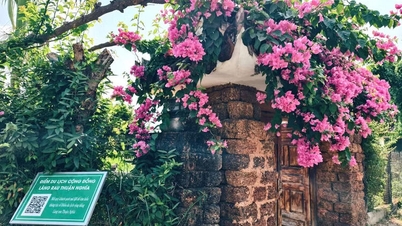
In springtime, the rocky plateau is adorned with countless colorful flowers. In gardens, in rocky crevices, on rooftops, and along fences, flowers overcome the harsh conditions to bloom and welcome spring. From the vibrant pink of peach blossoms, the resilient purple of buckwheat, to the brilliant yellow of rapeseed, they all stretch out and display their beauty, intertwining to weave a peaceful springtime atmosphere for Lo Lo Chai - Lung Cu.
Previously, Lo Lo Chai was a poor village, lacking enough corn to eat and drinking water, facing numerous hardships. After more than a decade of tourism development, Lo Lo Chai has now become a prosperous village, holding a prestigious position on the tourism map. Spring is also the most beautiful season in Lo Lo Chai, when tourists flock there hand in hand to admire the scenery, the Lo Lo people continue to welcome visitors, and spring seems to stretch on.
Sipping on fermented corn wine and enjoying the local specialty, thang co (a traditional stew), Mr. Sinh Di Gai, the head of Lo Lo Chai village, recalled that in the past, few people thought about growing or caring for flowers. Later, with the development of community-based cultural tourism, the Lo Lo people learned to plant more peach trees in their gardens and along the roads. In the autumn, they sowed buckwheat and rapeseed in the fields. Every spring, the rocky mountains of Lo Lo Chai bloom with colorful flowers, attracting tourists to explore and experience the area. Thanks to this, the Lo Lo people have escaped poverty and are becoming increasingly prosperous.

Ms. Hoang My Khanh, owner of Danh House, said she built the homestay to resemble the bronze drum, a sacred object in the culture of the Lo Lo people. At the end of November 2025, Ms. My Khanh's homestay was recognized by the Vietnam Record Organization as setting a record for the resort built according to the architecture of the characteristic bronze drums of the Lo Lo ethnic group. Thanks to its unique design, rooms were fully booked by tourists from all over for their trip to explore Lo Lo Chai during the Lunar New Year of 2026.
According to statistics, Lo Lo Chai village currently has 120 households, including 106 Lo Lo households and 14 Mong households. Over the past decade, from just a few initial households developing tourism, Lo Lo Chai now has 62 households involved in community tourism. The philosophy of developing tourism without losing its cultural identity has helped preserve the vibrant spring flowers on the rocky mountains. From the second day of the Lunar New Year, tourists flock to Lo Lo Chai to enjoy the spring scenery, admire the flowers, and immerse themselves in the joy of welcoming the new year with the Lo Lo people.
Mr. Tran Duc Chung, Chairman of the People's Committee of Lung Cu Commune (Tuyen Quang Province), said: "Previously, the people of Lo Lo mainly lived off farming, relying on self-sufficiency through growing corn, rice, and other crops. After more than 10 years of transitioning to tourism services, the poverty rate in Lo Lo Chai village has decreased from over 80% to less than 10% by 2024, and by the end of 2025, only 2 poor households will remain. Visiting Lo Lo Chai in the spring, in addition to experiencing the dazzling array of flowers blooming on the gray rocks, tourists can immerse themselves in the unique cultural space and, especially, transform themselves into authentic Lo Lo villagers."
The Lolo people have been present in Vietnam for approximately 500 years. Currently, there are about 3,300 Lolo people, divided into two branches: Black Lolo and Flower Lolo, residing mainly in the provinces of Tuyen Quang and Cao Bang. Legend tells that there were seven Lolo brothers; three left Po Ha to come to Vietnam, but one got lost, one stayed in Dong Van (formerly Ha Giang), and the other went to Bao Lac (Cao Bang) to live. In those days, the land was still wild and undeveloped, so the two brothers worked hard to cultivate the land and build a family, becoming the ancestors of the Lolo people today.
Source: https://baophapluat.vn/hoa-xuan-tren-nui-da.html























![[Video] Sunset at Lap An Lagoon – Where the sun sets over the fishing nets](https://vphoto.vietnam.vn/thumb/340x192/vietnam/resource/IMAGE/2026/05/31/1780192137701_beach-landscape-sea-water-nature-grass-745871-pxhere-com.jpeg)




![[Photo] The General Secretary, President and his wife lay flowers at the Ho Chi Minh Monument in Manila.](https://vphoto.vietnam.vn/thumb/1200x675/vietnam/resource/IMAGE/2026/05/31/1780219759477_anh-man-hinh-2026-05-31-luc-16-29-07.png)


































































Comment (0)