


The culture of the indigenous people remains subtly present, enduring and captivating, quietly nurturing the unique colors of the mountains, the forests, and the local communities…
Preserving the essence of our ancestors.
Early in the morning in Tay Giang, mist from the mountain slopes descended onto the communal courtyard, the air chilly. A circle of people gathered around the gong ensemble. Abiing Pao stood in the middle of the crowd, wearing a loincloth. Around ten years old, his shoulders were still thin, but Pao's clear eyes sparkled with joy. The gongs sounded, sometimes slow and gentle, sometimes rapid, following the rhythm of the village's gongs. Pao's gaze never left the circle of gongs, shining like a small flame just kindled in the hearth of a stilt house.
Elder Briu Pố sat on the veranda of the communal house, silently observing. He was familiar with countless festivals and rituals. More than anything, looking at the children, he understood that maturity takes time. He recounted that, for a while, many festivals existed only in the memories of the elderly. Many villages lacked drums and gongs. The forests were silent, and the community was no longer eager to participate in traditional ceremonies. This stirred up anxieties in his heart and in the hearts of many other village elders.
Then, with diligent dedication to his Co Tu people and his ethnic group, he quietly preserved and protected them. His presence at numerous cultural and customary events, both large and small, not only in his village but also up to the border, down to the lowlands for performances, and even traveling north and south with groups of artisans to participate in many ethnic cultural festivals, served as an affirmation: culture must be preserved, because culture is the essence of our people. The festival returns, like a seed sown on the hillside, it will naturally take root and grow green…
For many years, the story of preserving cultural traditions has continued, not only in Tay Giang but also among the Co Tu, Co, Bh'noong, Ca Dong, and Ta Rieng communities. In Kham Duc, after each harvest, the Bh'noong people prepare a ceremony to offer the hundred rice grains. The ceremony space is simple, but solemn.
The artisan Y Bẩm in Lao Đu village slowly placed the offerings and began her prayers. Following her instructions, the crowd performed the rituals in turn. Drums and gongs sounded, marking the moment the villagers united as one. They live with the festival and the community through their roles—small but inseparable, indelible. For them, the hundred-rice offering ceremony is like an opportunity to recite a "family tree" passed down from generation to generation through memory and practice, without the need for written records. They name their community, their ethnic group, through the festival.

Festivals are an indispensable part of the rich life of the highland people. Festival life brings together the most impressive and unique colors of each ethnic group, through costumes, traditional music , rituals, customs, and the unwavering beliefs of the community, even as the disruptions of modern life threaten to impact them.
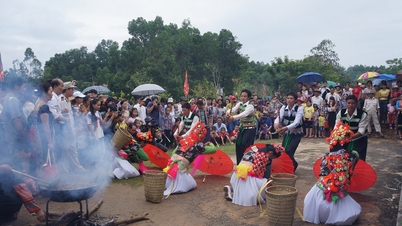
The elders perform the rituals. Children stand around, listening to stories about the forest, the streams, the droughts that once devastated the village, and the prayers for a peaceful and prosperous life for the villagers. On each such occasion, gongs resound in unison, rice wine is passed from hand to hand, and old stories are retold around the fire. These quiet festivals connect communities, allowing culture to transcend village boundaries and spread naturally, through the inherent beauty of each ethnic community.
The Cơ Tu, Bh'noong, Ca Dong, Co, Tà Riềng… each ethnic group carries its own unique way of telling stories about the mountains and forests. Some stories are told through the sound of gongs. Others are contained in the bowls of rice offered as sacrifices to the rice harvest, carried by the water from the streams to the villages. When placed together, these fragments create a multi-layered, multi-colored tapestry of the highland culture of Da Nang , awakening memories preserved for generations amidst the endless green of the forest.
Endogenous resources from culture
The mountainous western region of Da Nang city is home to over 161,000 people from ethnic minority groups. This number not simply reflects the population size, but also suggests the depth of cultural space accumulated over generations. In recent years, investment in preservation has been allocated in a sustainable, community-centered manner. Basic cultural institutions have been strengthened to ensure that festivals and traditional activities have a space to thrive. Culture is deeply ingrained in the community through its own life, rooted in pride in their ancestry and the unique identity of their ethnic group, especially among young people.

From that foundation, community-based tourism models rooted in local culture gradually emerged. Tourists come to the village, stay in stilt houses, eat meals grown in the fields, listen to gongs by the fire, and participate in festivals with the locals. They observe and live in the cultural space, even if only for a few days. The locals gain additional income. Young people have more reasons to stay in the village. The cultural identity is preserved through the direct participation of the community.
However, challenges remain. Many artisans possessing traditional knowledge are elderly, while the next generation has not been properly trained to adequately carry on the tradition. The allure of modern life strongly influences young people, making the teaching of rituals, customs, culinary arts, and traditional crafts less attractive. Some festivals face the risk of simplification and deviation from their original elements due to a lack of resources for maintenance. Therefore, the path to preservation still faces many obstacles…
According to Mr. Nguyen Manh Ha, Director of the Department of Ethnic Minorities and Religions, in the city's overall development orientation, indigenous culture is recognized as an important endogenous resource. "Preserving and promoting the cultural identity of ethnic minorities is not only about safeguarding traditional values but also about creating a breakthrough impetus for sustainable socio-economic development. This is not only the responsibility of Party committees and authorities at all levels but also an opportunity and condition to awaken the economic development potential of the western mountainous region of the city," Mr. Nguyen Manh Ha stated.
The mountains and forests to the west of Da Nang, the city's ecological buffer zone, hold a rich and profound cultural heritage capable of creating a unique identity. By appreciating, preserving, and awakening this wealth, the city will step out into the world with its own distinct identity, like the resounding gong of a festival…
Source: https://baodanang.vn/dai-hon-mot-tieng-chieng-3324832.html





















































































Comment (0)