

 |
| The Lolo people in their traditional spring attire. |
Distinctive costumes
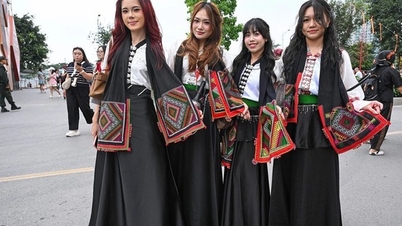
For those who love the highlands, the first impression often comes from the ethnic costumes. In the vibrant atmosphere of the festival, the girls of Tuyen Quang are like radiant flowers amidst the vast forest, bringing a fresh and lively spring atmosphere.
During the Lồng Tồng Festival, also known as the Rice Planting Festival, of the Tay, Nung, Dao, and San Chi ethnic groups, the image of Tay girls in elegant indigo-dyed ao dai (traditional Vietnamese dress) has become a symbol of gentleness. Teacher Nguyen Thi Thuyen from Thuong Nong Kindergarten shared: “From my grandmother's and mother's time, they taught that Tay girls must know how to sew and embroider. It's not just a virtue, but also a source of pride for Tay women.”
While the traditional clothing of the Tay people exudes a sense of tranquility, the dresses of Mong girls are as vibrant as the early spring sunshine. Each dress is a meticulously hand-embroidered masterpiece, showcasing the skill and perseverance of the women.
During the mystical Fire Dance Festival of the Pà Thẻn people, the vibrant red of their dresses stands out against the sacred night sky. Against the red fabric, delicate white, black, yellow, and green threads are subtly combined, creating a harmonious and dazzling overall effect. Ms. Phù Thị Xé, from Thượng Minh village, Minh Quang commune, said: “From a young age, girls learn to weave and embroider brocade so they can prepare their own wedding attire later. Each year, Pà Thẻn women usually make one or two sets of dresses to wear during festivals, New Year celebrations, or important events.”
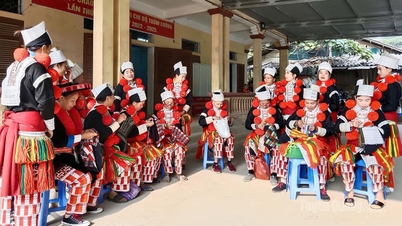
In Na Chac village, Na Hang commune, a place with a long-standing tradition of embroidery, Red Dao women are still diligently preserving ancient techniques.
Comrade Nguyen Van Hoa, Deputy Director of the Department of Culture, Sports and Tourism, affirmed: “Preserving and promoting the cultural identity of ethnic groups is not only the responsibility of the community but also an important task in sustainable development. These vibrant costumes are ‘cultural ambassadors,’ spreading traditional values to friends both domestically and internationally.”
 |
| Young women from ethnic minority groups in Lam Binh commune participate in the Long Tong Festival. |
Unique festivals
Unlike many boisterous festivals in the northern mountainous regions, the Lo Lo people celebrate spring with a simple yet sacred rain-praying festival, usually held in the third lunar month to pray for favorable weather and a bountiful harvest. They believe that since the beginning of time, bronze drums have existed, symbols of the universe and humanity. Comrade Duong Ngoc Duc, Secretary of the Party Committee of Lung Cu commune, said: "In the sky-worshiping ceremonies, the Lo Lo people use the 'mo danh' drums, including male and female drums, as sacred treasures of their ancestors."
Visitors to Tuyen Quang in the spring cannot miss the Khau Vai Love Market Festival, a place that preserves emotions difficult to put into words. "Khau Vai" means "two clouds," evoking images of close and intimate bonds. Ms. Nguyen Hai Ha from Minh Xuan ward shared: "I came here out of curiosity about the term 'love market,' but I saw that people only come to meet and chat innocently. There are even married couples who come here to meet their former lovers without any jealousy."
For the Hmong people, the Gau Tao Festival means "hill festival," the biggest spring celebration of the year. After the second day of the Lunar New Year, the festival takes place on the flat hillsides. According to shaman Sung No Gia from Yen Minh commune, "The opening ceremony is a khene dance, followed by folk singing. When the ceremony ends, the whole village joins in the lively festivities, which last until the full moon of the first lunar month."
The Dao people have a coming-of-age ceremony – a ritual marking a man's maturity. If a man has not been formally initiated, he is not considered mature, even at an advanced age; young men who have undergone the ceremony are recognized by the community. The coming-of-age ceremony is both sacred and an opportunity for the Dao people to meet, socialize, and sing in the joy of the new year.
The new status of Tuyen Quang tourism.
In October 2025, Tuyen Quang tourism received numerous prestigious regional and global awards. The UNESCO Global Geopark Dong Van Karst Plateau was honored by the World Travel Awards (WTA) as the “Leading Cultural Destination in Asia 2025”; and Panhou Retreat Thong Nguyen was awarded the “Leading Green Resort in Asia 2025”. These accolades are testament to the efforts in preserving local culture and developing sustainable tourism, considered a “brand passport” that brings Tuyen Quang to the world.
On October 17, 2025, in Huzhou City (China), UN Tourism announced the list of "World's Best Tourist Villages 2025," in which Lo Lo Chai village, Lung Cu commune, was honored. This achievement reflects the community's perseverance in preserving nature and culture and developing green tourism, contributing to affirming Tuyen Quang as a friendly, distinctive, and creative destination.
Every spring, amidst the lively drumming and vibrant colors of traditional costumes, Tuyen Quang dons a fresh new look. These spring festivals are not just celebrations, but also a journey to preserve the cultural soul of this mountainous region, where people and nature harmonize in a dazzling symphony of spring colors.
Notes by: Le Duy
Source: https://baotuyenquang.com.vn/van-hoa/du-lich/202602/tung-bung-hoi-xuan-1a9111a/
![[Photo] General Secretary and President To Lam presides over the meeting to approve the draft report on the results of the second inspection by the Politburo of the Standing Committee of the Hanoi City Party Committee.](https://vphoto.vietnam.vn/thumb/1200x675/vietnam/resource/IMAGE/2026/05/26/1779789811432_a2-bnd-4430-9620-jpg.webp)



















































Comment (0)