

Tram Tau - from a remote place to a land known for its happiness.
Not so long ago, Tram Tau ( formerly Yen Bai province, now part of Lao Cai province ) was still a hidden gem on Vietnam's tourism map. People often mentioned Tram Tau as a "very remote place." The lives of the Mong and Thai people there were tied to their fields, gardens, and mountain winds; few imagined that one day tourists would flock to the village.
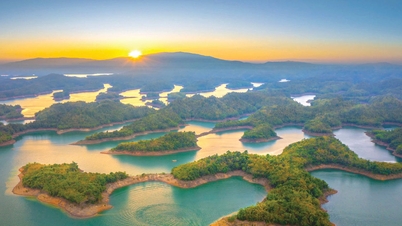
However, Tram Tau today is different. This land no longer bears its old name but is now called the Happy Commune - a name that evokes a sense of peace and tranquility. It's serene, beautiful, a small valley nestled amidst the majestic mountains of Northwest Vietnam, yet warm enough for people to experience happiness and reconnect with their true selves.
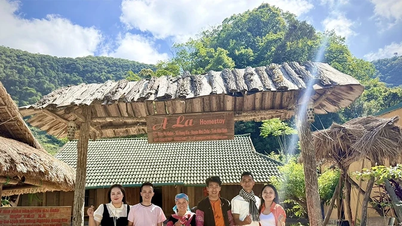
Happiness is now represented by charming homestays springing up in the valleys below the peaks of Ta Xua and Ta Chi Nhu. Guesthouses, experiential destinations, and community tourism services are spreading to every small village. The Hmong and Thai people no longer live solely on farming but have learned to welcome guests, share stories of their villages, and protect the forests and streams as if they were their very livelihoods.
That change partly stems from the source of the hot springs – or more precisely, from the person who knows how to exploit the hot spring resources – Vu Manh Cuong, the owner of the Cuong Hai hot spring resort.
The man lived many destinies in one lifetime.
My first impression of Cuong was very simple: deep eyes always looking straight ahead with a spirited air, a small, thin frame that couldn't hide a heroic demeanor. Especially when I heard him recount his journey of bringing tourism back to his hometown, I understood that I was standing before a man who had lived many different lives. Cuong wasn't the kind of person who stepped out of a movie; he wasn't glamorous, nor did he conform to the conventional standards of "success." He had experienced more dark than bright moments in his life.
Cuong's life story is like a movie – from fall from grace to rebirth, from anonymity to a journey of dedication to his homeland. But unlike the character in "Going to Where the Wind Comes," who seeks wind in the bustling city, Cuong chose to stay, choosing to "bring the wind back to his homeland."
Before becoming a name synonymous with tourism in Northwest Vietnam, Cuong was a literature teacher, passionate about literature, and dedicated his youth to teaching literacy to Hmong and Thai children in remote villages. But there was also a period in his life when he was a "wanderer." At times, he almost lost everything: his family's trust, his social standing, and even himself.
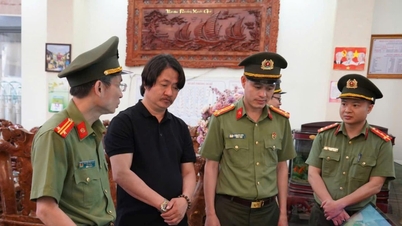
Cuong told me he couldn't remember exactly when he first fell into that spiral. He only knew that the bouts of drunkenness and the dark, gloomy nights seemed to pull him away from the path of a future as a teacher. But then, when all hope seemed lost, someone came along – a police officer named Chien, who not only rescued him from his addiction but also pulled him out of debt, starting a new chapter in his life. That person helped him get back on his feet time and again and was also the one who "rekindled the flame" in his heart.
I met Cuong when things had calmed down. When he was calm enough to talk about the past as if it were another life – without denial, without pride, but with respect for the fragments of his life.
The "Heart" of Happiness
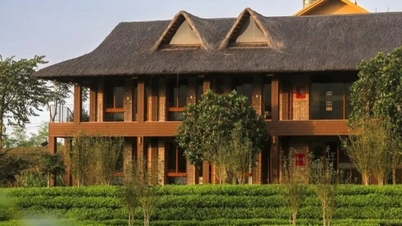
In 2015, Cuong recognized the potential of the natural hot springs in Tram Tau – a resource that had remained hidden deep within the mountains until then. Based on this potential, he decided to invest in building a hot spring resort – starting with a small bathing pool, gradually developing into a true resort with hot spring pools, guest rooms, and spaces for relaxation and enjoying the mountain views.
He recounted the early days of digging the mineral pools, channeling water, and building the rooms. He built the charming resort without relying on any blueprints, solely on his observation of nature and the instincts of someone who has lived in this land for a long time. Cuong understands the streams as well as he understands his own bloodstream. He knows when the water flows, where it is strong, and where it is gentle. He knows which areas should be left as they are and which areas can be modified.
From the silently flowing hot springs nestled amidst the mountains and forests, from the pristine, unnamed landscape, from the diligence and belief that beauty doesn't need to be artificial, and from a deep love for the land and its people, the Cuong Hai hot spring resort was formed. In the heart of Hanh Phuc commune today, Vu Manh Cuong's Tram Tau hot spring resort is like a heart – not the biggest, not the most dazzling, but visitors can feel its warmth, peace, and refreshing coolness.
Everything he created in this place had the necessary slowness. Slow enough for people to realize they were tired. Slow enough to absorb the flavors and sounds of the mountains and forests, slow enough to realize that happiness, it turns out, doesn't need much.
Cuong told me, "I don't want to make a big deal out of it. I just want to do what's right. Right with nature, right with people, and right with myself."

When one person changes, the whole land transforms.
What is most noteworthy about Vu Manh Cuong is not just the hot spring resort, but his subtle influence on Tram Tau - Hanh Phuc today.
When Cuong started his tourism business, many were skeptical. When he failed, some shook their heads. But when the hot spring resort became stable, when tourists started coming, and when money began flowing back to the village, confidence spread. People learned how to run homestays. They learned how to preserve their homes, their forests, and their way of life. Tourism was no longer something "for outsiders," but became a part of their lives.
Amidst that vibrant scene, Cuong's hot spring resort remains unchanged – its rhythm unaltered. It serves as a reminder that development doesn't mean losing one's identity.
During my stay with the locals, they told me that Cuong never considered himself a competitor. He didn't keep his secrets to himself. On the contrary, he often visited each homestay and family to guide them on everything from cleaning rooms and caring for guests to sharing stories about local culture – from customs and clothing to cuisine. "He showed us everything step by step," one homestay owner told me gratefully.
The locals call him a benefactor – not only because he brought tourism to this land, but also because he was willing to share, guide, and not keep any immediate benefits for himself.
They told me that, thanks to Cuong, they learned how to tell stories about their village to tourists; they learned how to create experiences, how to welcome visitors with sincerity, and they learned that they could preserve their culture and nature while still living better lives as a result.
Beyond simply supporting the local people, Cuong always emphasizes that tourism must be linked to the preservation of indigenous culture and nature. He confided: "I love the Hmong people, I love this land... wherever the Hmong live, that place is a paradise for tourism. But the unfortunate thing is that in the past, the Hmong people didn't know how to do tourism."
For him, tourism is not just a service; it's a bridge between cultural identity and the younger generation, a way for people to be proud of themselves and of the long-standing values that many places have lost.
Cuong is still nurturing a plan to help build the most beautiful Hmong village in Northwest Vietnam – a place where tourists not only come, but also live, learn, and share with the community. He believes that tourism will only be truly effective and sustainable when the voice of the people's hearts motivates them to act.
We owe the land and we owe the people two words: gratitude and affection.
Vu Manh Cuong is a man who has experienced profound setbacks, yet possesses the courage to rise again, using his own sweat and tears to build a destination that many call happiness; he has the patience to slow down and understand the value of where he lives. He wasn't born to be a role model, but he became a pillar of support. He navigated life with real scars, and it is precisely these experiences that have made him strong and trustworthy.
In our conversations, Cuong never spoke of his contributions. Just as he quietly went about his work, letting the land and its people change in the most natural way. To the people of Hanh Phuc commune, he is not a "businessman," not a "media personality," but a family member – someone who brought livelihoods and opened a different, brighter future for the people around him.
Some people do tourism with money. Some people do tourism with vision. Cuong does tourism with his own life. He once fell very low. And because he was at rock bottom, he understands the value of helping others get back on their feet. His willingness to guide others, his fearlessness in the face of competition, and his refusal to seek advantages solely for himself – these are rare qualities. They don't stem from business strategy, but from a philosophy of life, because he entered the tourism industry with a deep belief: people, land, and a debt of gratitude. He exploited the hot springs not with scientific knowledge, but with the intuition of someone who has lived long enough with the land, who has listened attentively to its whispers.
Conclude
Compared to the male protagonist in "Going to Where the Wind Blows," Cuong... isn't as romantic, even though, outside of his life dedicated to the hot springs, he still has moments of "getting carried away" with his organ, strumming guitar notes by the fire... And this character outside of film is more authentic. Therefore, the writer doesn't need to embellish his story, just tell it accurately. Because his life itself is strong enough to stand firm on the page, truly a beautiful cinematic example.
Cuong Hai hot spring remains the focal point of tourism in Hanh Phuc. Many visitors, after their first visit, instead of exploring new tourist destinations, return to Cuong Hai hot spring whenever they have the chance, because of the peaceful atmosphere this place offers them. It's safe to say that Cuong's journey, and the journey of these visitors, can be called " returning to the place of happiness ."
Source: https://baophapluat.vn/di-ve-noi-hanh-phuc.html

![[Photo] General Secretary and President To Lam presides over a working session with the Central Policy and Strategy Committee on the development of the materials industry.](https://vphoto.vietnam.vn/thumb/1200x675/vietnam/resource/IMAGE/2026/05/21/1779359935432_a3-bnd-3129-1412-jpg.webp)
![[Photo] National Assembly Chairman Tran Thanh Man working with the Standing Committee of the Law and Justice Committee](https://vphoto.vietnam.vn/thumb/1200x675/vietnam/resource/IMAGE/2026/05/21/1779378929214_ndo_br_1-4610-jpg.webp)

































































Comment (0)