

When pocket calculators can store… "the whole world "
Many students, like NNL (a 9th-grade student in Ho Chi Minh City), accidentally stumbled upon and were drawn to a YouTube video titled "How to cheat on a Casio calculator that teachers don't want to tell you." Specifically, the method described by the channel owner involves entering a command to display a 4-column matrix frame resembling the four multiple-choice answers A, B, C, D, then entering the answer you know beforehand from tutoring or asking questions from other classes into the frame and saving it to the calculator until the exam. "That's how you successfully cheat," the video concludes.
The video, posted on September 21st, garnered a massive 1.9 million views and hundreds of mixed comments. Under the post, besides comments expressing amusement at the cheating method, there were also critical opinions. User NHQ angrily commented: "Don't do this because it will destroy logical thinking; instead, just circle the answer without knowing what the question is asking…" User BLGC argued that this method isn't "easy to get," and that the content creator was simply "hungry for views."
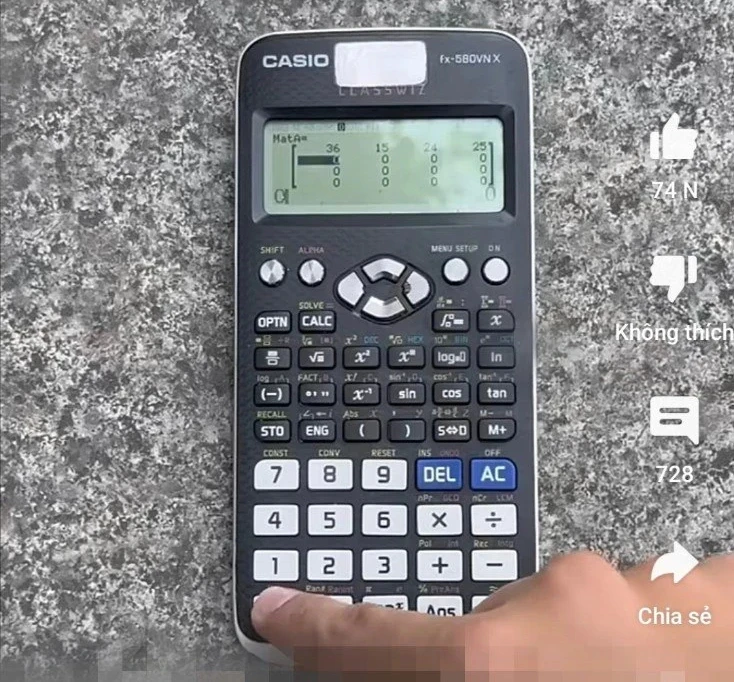
Video from September 21st showing how to cheat using a calculator.
This isn't the only video about saving answers on a calculator; there are even methods for different calculator models or "tricks" for saving subject knowledge in numerical form, such as the number of sides of a polygon or historical dates. However, this trick is easier to fool teachers with when applied to science subjects that require the use of a calculator during exams.
Many risks
Some students, like Vu Phuong Linh (11th grade, Pham Hong Thai High School, Hanoi ), said they were unaware of the tricks shared on social media but realized the risks involved in applying them. "Teachers only need to change the question and students will be left struggling," Linh said.
According to MT (a business administration student at Saigon University), simply changing the exam questions can solve the cheating problem because some teachers use a common set of questions for all the classes they teach, so the class taking the test first will inform the class taking the test later to "prepare." Besides relying on the exam questions, T. believes that if teachers/invigilators require students to reset their calculators before the test, students will be unable to cheat.
From the teacher's perspective, Mr. Nhat Tuan, a high school math teacher in District 6, Ho Chi Minh City, noted: "The matrix function of a calculator only has a limited number of cells, so it cannot store too much data. Students under exam stress also cannot remember the answers for each question to smoothly circle the answers on multiple-choice tests."
From this, Mr. Dinh Xuan Nhan, a math teacher at Tran Khai Nguyen High School (District 5, Ho Chi Minh City), concluded that videos on YouTube mainly "attract views" from gullible students because this tactic only works with small, internal tests where the test setters are dishonest, and is not useful in large exams with high security.
Therefore, Mr. Xuan Nhan advises students to be vigilant about risks and not fall for tricks. In the long run, teachers agree that the biggest risk is the direct impact on students' thinking and learning attitudes.
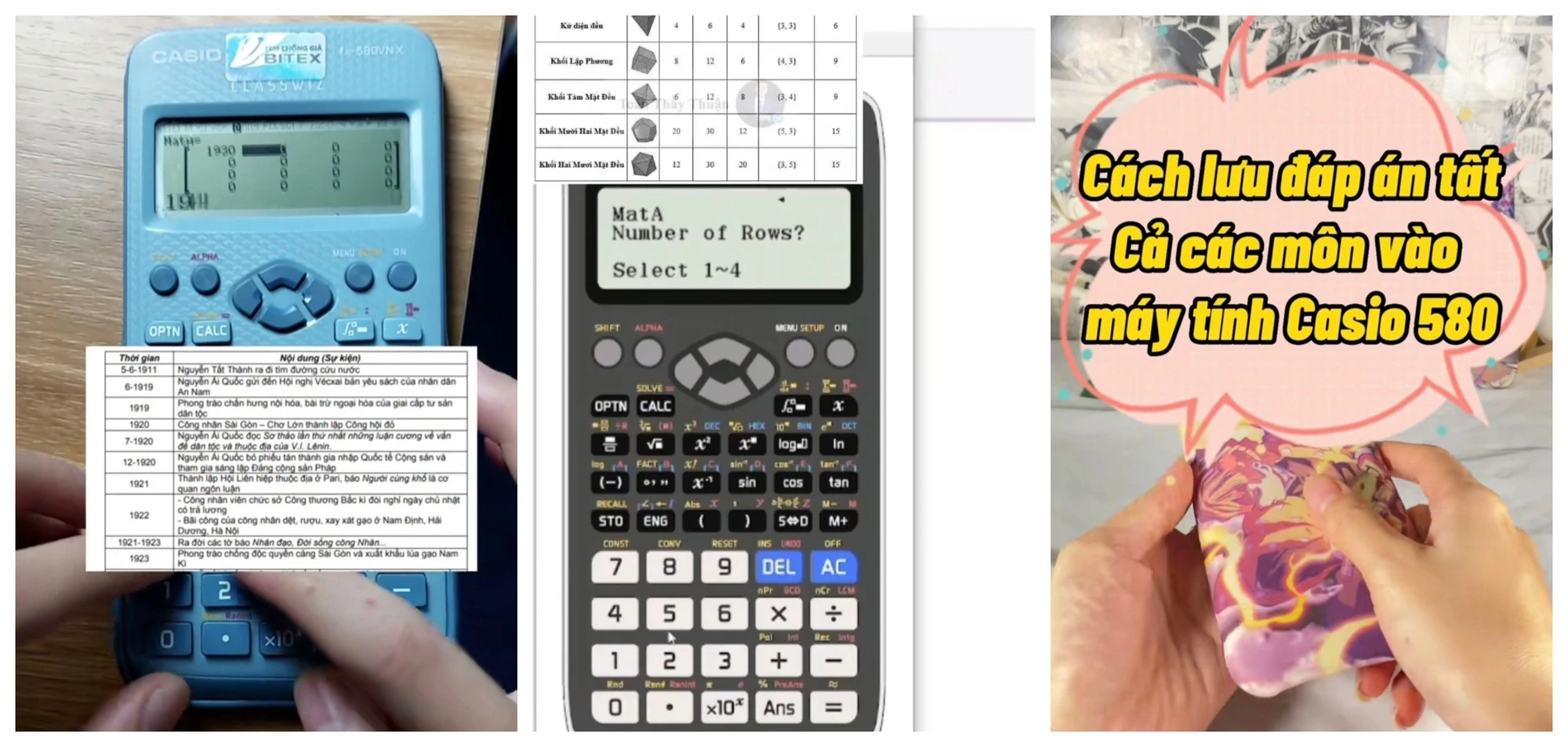
Some TikTok videos show how to save them on a laptop computer.
Why the gimmick?
While in high school, TMH (a student at the University of Social Sciences and Humanities in Ho Chi Minh City) also used the storage feature shown in the video to reduce the burden of memorizing about 30 mathematical polygon data points. "I tried to memorize them, but every time I encountered a question, I felt overwhelmed, so I resorted to this trick," H. recounted. Similarly, MT (a student at Saigon University) thought that no one could possibly memorize all the polygon data points when this topic was only covered in one question on the exam.
According to Mr. Xuan Nhan, the functions of a pocket calculator are all aimed at assisting with calculations, so the fact that some features are "distorted" is not the fault of the calculator but of the user.
Meanwhile, teacher Nhat Tuan argues that tools with many features always come with "loopholes" that students can exploit, becoming dependent on calculators without developing problem-solving skills.
Some teachers assert that cheating using calculators during exams is unacceptable. According to the regulations for the high school graduation exam issued by the Ministry of Education and Training, candidates are prohibited from bringing devices containing information that could be used for cheating into the examination room. Candidates are only allowed to bring the prescribed types of calculators, which do not have text editing functions or memory cards for data storage. Violators will be penalized, have their devices confiscated, and be suspended from the exam.
To avoid the "reckless" cheating that can lead to unforeseen consequences, teacher Xuan Nhan suggests that students follow these steps if they want to memorize effectively during the learning process:
- Identify the core knowledge areas and the main ideas within each area.
- Ask yourself questions to proactively acquire knowledge.
- Distinguish the similarities and differences between different pieces of knowledge.
- Review the material using mind maps and solve practice problems regularly.
Regarding the teachers, he emphasized the importance of test design and security if they are aware of the trick, noting that the test questions should use new data and avoid duplication with existing materials.
Source link











































































































Comment (0)