

From ruins to a world- renowned heritage city.
Half a century ago, Hoi An was a fierce battlefield during the resistance war against the US. From villages to towns, from courageous soldiers to ordinary citizens, all contributed to a courageous people's war. On March 28, 1975, the army and people of Hoi An rose up simultaneously, defeating enemy strongholds and recapturing the entire city. This event is not only a source of pride for the people of Hoi An but also contributed to the Spring 1975 victory and the reunification of the country.
The years of resistance left behind immense losses. Hoi An was then devastated and ruined, with thousands of wounded soldiers and martyrs, and the wounds of war deeply etched in the hearts of its people. However, with unwavering spirit, the officials and people of Hoi An quickly embarked on the reconstruction effort, gradually bringing their homeland back to life from the ashes.
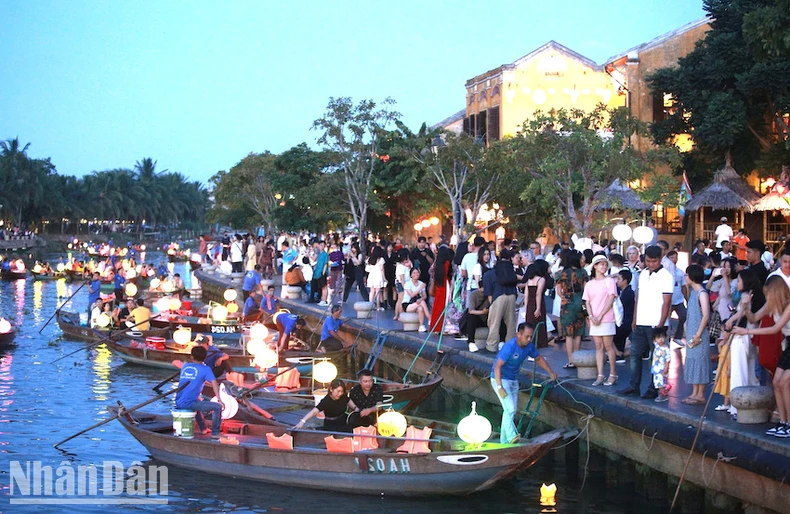
Tourists participate in releasing lanterns on the Hoai River (Hoi An). (Photo: Dinh Tang) |
In the days following liberation, the people of Hoi An faced countless difficulties: food shortages, scarce jobs, and a destroyed infrastructure. In the early years, the government and people of Hoi An implemented a series of measures to restore production and stabilize livelihoods. Fields were reclaimed, cooperatives gradually formed, and traditional crafts such as weaving and rattan weaving were revived to create jobs for the people.
A major turning point came for Hoi An in the 1990s when the country entered a period of reform. Recognizing the potential of the ancient town with its invaluable cultural values, Hoi An chose the path of sustainable tourism development. A policy of conservation combined with economic development helped Hoi An gradually transform. In 1999, UNESCO recognized Hoi An Ancient Town as a World Heritage Site, opening a new chapter for this region.
Hoi An - a model of sustainable development
Today, Hoi An is not only a top tourist destination in Vietnam but also a model for preserving and promoting cultural values. Every year, the city welcomes nearly 5 million visitors, 70% of whom are international tourists. The ancient streets with their moss-covered roofs and narrow alleys bearing the marks of time are an irresistible attraction. Traditional festivals such as the Lantern Festival, the Full Moon Festival in the first lunar month, and the Hoi An Old Town Night are regularly held, helping visitors gain a deeper understanding of the local culture.
Besides tourism, Hoi An's economy has also undergone significant transformation. From a poor area after the war, the city's budget revenue now reaches nearly 1,800 billion VND per year, a thousandfold increase compared to 50 years ago. Notably, since 2017, Hoi An has had no poor households, a testament to the comprehensive development of this region.
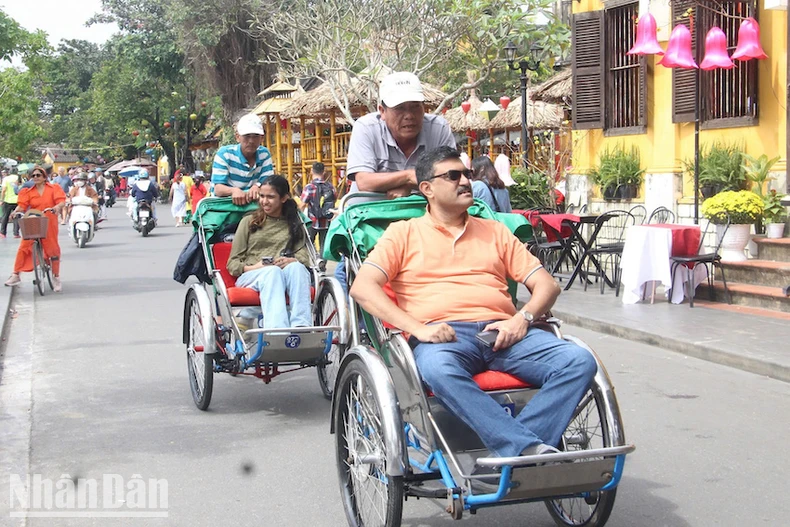
Tourists explore Hoi An by cyclo. (Photo: Dinh Tang) |
However, despite its significant achievements, Hoi An still faces many challenges. The pressure from the large number of tourists poses a problem of conservation and sustainable development. Climate change and rising sea levels are also threatening coastal areas and the Hoai River. In this context, Hoi An is focusing on building an eco-city, minimizing environmental pollution, and promoting green tourism models.
It is noteworthy that Hoi An will no longer be a district-level administrative unit due to the restructuring of the state apparatus. However, the name Hoi An and the cultural and historical value of this land will forever endure, not only in the hearts of the people but also on the international tourism map.
Looking back over the 50 years since liberation, Hoi An has undergone a spectacular transformation. From a war-torn wasteland, it has become a world-renowned heritage city, a testament to resilience and adaptability. These achievements provide a solid foundation for Hoi An to continue its growth, maintaining its position as one of the most attractive destinations in Vietnam and the world.
Source: https://nhandan.vn/hoi-an-50-nam-hanh-trinh-doi-thay-post868249.html














![[Infographic] Highlights of the Hung Temple Festival and the Ancestral Land Culture and Tourism Week 2026](https://vphoto.vietnam.vn/thumb/402x226/vietnam/resource/IMAGE/2026/04/18/1776502670666_le-hoi-vietnam-1-7877-jpg.webp)



































































Comment (0)