

When mentioning the folk legend of Saint Gióng, many people are familiar with the image of the saint riding on the back of a four-legged horse; but when Saint Gióng is depicted in a painting by the renowned artist Nguyễn Tư Nghiêm, he takes on a different appearance. To this day, the composition of the painting remains a mystery.
The work was created using lacquer. Although at the time of its creation, Nguyen Tu Nghiem had ample opportunity to use the newer colors of industrial lacquer, he remained faithful to traditional materials. The painting uses only a few basic colors: black from lacquer, vermilion red from cinnabar powder, reddish-brown from cured lacquer, ivory white from eggshells, and yellow from gold leaf. Simple as it is, the painting encapsulates the spirit of traditional lacquer painting.
 |
| The artwork "Giong" is preserved at the Vietnam Fine Arts Museum. |
Particularly in the painting, the image of Saint Gióng and his horse is condensed into a unified, robust, and fierce whole, becoming an inseparable subject. He also stylizes the subject with crisp, concise geometric shapes. The horse's hooves and the character's clothing are depicted using typical motifs found on Đông Sơn bronze drums, including tangent circles, sawtooth shapes, and zigzag S-shapes. Instead of detailed anatomical descriptions, the artist chooses to symbolize the form, turning Saint Gióng and his horse into a "living bronze drum," where layers of ancient culture are stacked, interwoven, and resonate. Notably, the iron horse in the painting is a horse with a strong, powerful body stretching to carry Saint Gióng to heaven. Artist Lương Xuân Đoàn, President of the Vietnam Fine Arts Association, commented: "The renowned painter Nguyễn Tư Nghiêm did not simply copy a real horse, but breathed life into it, making it seem to fly and dance, carrying Saint Gióng to heaven."
The renowned painter Nguyen Tu Nghiem fills the frame with surrounding decorative elements, creating a sense of compressed, yet intensely energetic feeling. The artist skillfully blended the cubist and abstract spirit of Western painting, creating a rare visual depth for Vietnamese lacquer art. Researcher Nguyen Hai Yen suggests that the painting, recreated within the Dong Son space, embodies both mythological and modern elements. Indeed, "Giong" is not merely an illustration of a legend, but a dialogue between the past and the present, between ancient visual language and modern artistic thinking.
Furthermore, it's no coincidence that the figures in Nguyen Tu Nghiem's paintings are facing to the right. The artist mimics the counter-clockwise rotation, a characteristic direction of movement on the Dong Son bronze drums. However, this choice is not solely for sculptural or archaeological purposes. According to visual studies, the direction a figure's gaze in a painting can evoke different psychological reactions in the viewer. Figures facing to the right often suggest a feeling of safety, peace, and protection. This creates a subtle layer of meaning, supplementing the image of the saint after completing their mission and returning to the sacred realm.
The lacquer painting "Giong" is not only an outstanding work in Nguyen Tu Nghiem's career but also marks a significant innovation in Vietnamese lacquer art. The unique combination of folk decoration and modern Cubism has opened up new possibilities for expression.
Source: https://www.qdnd.vn/van-hoa/van-hoc-nghe-thuat/hon-dan-toc-trong-tac-pham-giong-1027603
![[Photo] Capturing each moment at the "People We Meet" photography exhibition.](https://vphoto.vietnam.vn/thumb/1200x675/vietnam/resource/IMAGE/2026/04/15/1776245695648_1-8944-jpg.webp)
![[Image] Overview of the Tam Trinh-Giai Phong connecting road section after land clearance is completed.](https://vphoto.vietnam.vn/thumb/1200x675/vietnam/resource/IMAGE/2026/04/15/1776245679644_ndo_br_dji-0195-jpg.webp)
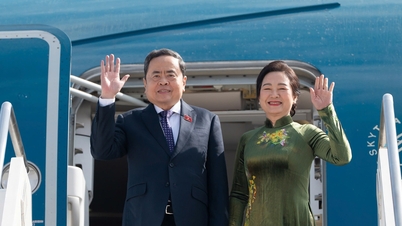
![[Photo] National Assembly Chairman Tran Thanh Man concludes official visit to Italy, departs for IPU-152](https://vphoto.vietnam.vn/thumb/1200x675/vietnam/resource/IMAGE/2026/04/15/1776253436109_vna-potal-chu-tich-quoc-hoi-ket-thuc-tham-chinh-thuc-italy-len-duong-du-ipu-152-tai-tho-nhi-ky-8702876-7969-jpg.webp)
![[Photo] General Secretary and President To Lam and his wife, along with General Secretary and President Xi Jinping and his wife, attending a tea party.](https://vphoto.vietnam.vn/thumb/1200x675/vietnam/resource/IMAGE/2026/04/15/1776245678527_vna-potal-tong-bi-thu-chu-tich-nuoc-to-lam-va-phu-nhan-cung-tong-bi-thu-chu-tich-nuoc-tap-can-binh-va-phu-nhan-du-tiec-tra-8702812-9829-jpg.webp)
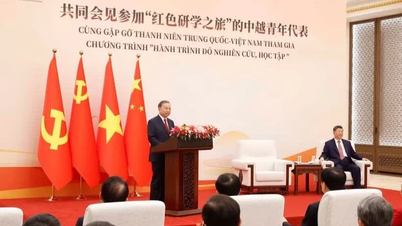
![[Photo] General Secretary and President To Lam and General Secretary and President Xi Jinping meet with youth from both countries.](https://vphoto.vietnam.vn/thumb/1200x675/vietnam/resource/IMAGE/2026/04/15/1776245687540_vna-potal-tong-bi-thu-chu-tich-nuoc-to-lam-va-tong-bi-thu-chu-tich-nuoc-tap-can-binh-gap-go-thanh-nien-hai-nuoc-8702371-jpg.webp)
![[Image] Current status of the land area of over 5.5 hectares that Ho Chi Minh City is considering reclaiming.](https://vphoto.vietnam.vn/thumb/1200x675/vietnam/resource/IMAGE/2026/04/15/1776245690095_1-3102-8409-jpg.webp)








































Comment (0)