


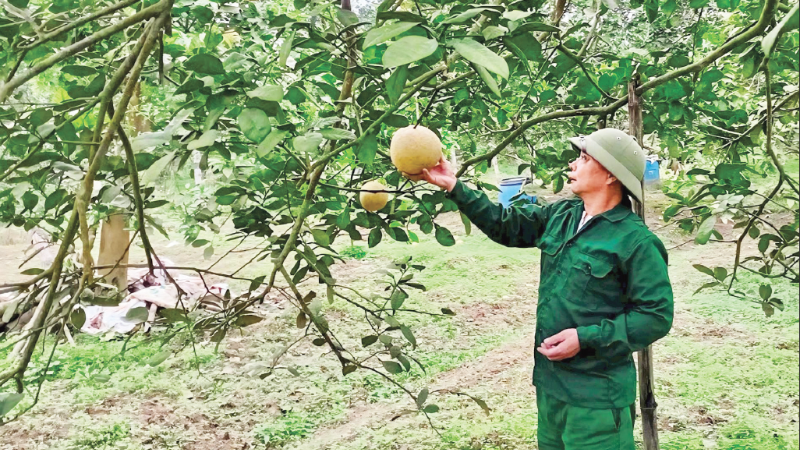
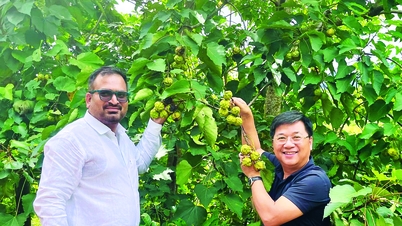
In the early days of spring, the Lo River seems to calm down in the cool, misty weather. Pointing to the grapefruit orchards in the distance, Comrade Nguyen Van Han, Deputy Head of the Agriculture Department of Chi Dam commune, introduced us: "During harvest season, walking through Chi Dam, you can smell the gentle, fragrant scent of grapefruit wafting in the wind everywhere. Doan Hung grapefruit, when harvested, has high sides, bright yellow skin, and thin rind; when cut open, the segments are firm, juicy, and have a sweet, refreshing taste and a very unique aroma."
In the Đoan Hùng pomelo variety, while Bằng Luân pomelo is renowned for its consistent quality and rich sweetness, Sửu Chí Đám pomelo is closely associated with the alluvial soil of the Lô and Chảy rivers and the story of an old farmer named Sửu.
According to the people of Chi Dam commune, long ago, a farmer named Suu grafted branches from a delicious pomelo tree in his garden, spreading the precious pomelo variety throughout the region. People then named it after him: Suu Pomelo. This story, passed down through generations, has become a part of the memories of this pomelo-growing region. Besides its sweet and fragrant flavor, this pomelo variety is also special for its long shelf life: after 5-6 months, it still retains its quality, delicious taste, large size, and smooth yellow peel...
According to grapefruit growers, what makes Sửu grapefruit unique is not just the variety, but the soil. The strip of land along the Lô River is enriched with alluvial deposits tens of meters deep, creating a nutrient-rich layer of soil; therefore, Chí Đám is almost the only area where Sửu grapefruit is grown.
According to statistics from the Agriculture Department of Chi Dam commune, the total area of pomelo orchards in the commune is 543.22 hectares, including 91 hectares of Chi Dam pomelo and 25 hectares of Bang Luan pomelo; the remainder consists of other pomelo varieties such as Cat Que, Xuan Van, Dien, and Da Xanh Duong La Nhen… The area producing fruit is 524.27 hectares, with an expected average yield of 13 tons/ha, an estimated production of over 6,800 tons, generating an average income of 250-300 million VND/ha/year.
These figures show that Chi Dam commune has maintained a significant area dedicated to grapefruit cultivation. However, behind the bountiful harvests, grapefruit growers are facing a considerable challenge: inconsistent quality, uneven appearance, declining demand, and sharply falling prices…
When mentioning Sửu Chí Đám pomelos, everyone knows Mr. Đỗ Trung Kiên, Chairman of the Board of Directors and Director of the Chí Đám Commune Pomelo Production and Business Cooperative.
Mr. Kien said that the cooperative was established in 2003; at that time, many households embarked on the path of planting and caring for the very finicky pomelo variety with a simple belief: that the alluvial soil along the Lo River would produce sweet and fragrant fruit, just as their ancestors had preserved. “The biggest difficulty for the households is that the pomelo variety is not easy to grow, sensitive to weather, and prone to pests and diseases. Therefore, to have delicious, standard-quality pomelos, growers must maintain a strict care process, from selecting the right variety, creating a suitable canopy, pruning branches correctly, prioritizing organic fertilizers, and controlling pests and diseases naturally. It's not simply a matter of planting and getting delicious fruit,” Mr. Kien shared.
But the market doesn't always meet expectations. What worries the leaders of pomelo-growing cooperatives here is the increasing competitive pressure. Sửu Chí Đám pomelo – a specialty variety with a geographical indication – is now competing with too many other varieties that are brought to market at much lower prices.
In previous years, the price of Sửu pomelos sometimes reached 70-80 thousand VND/fruit and there weren't enough to sell, but now it's only around 30-35 thousand VND/fruit and sales are still slow. Pomelo growers are very worried; sometimes they produce a product but can't sell it, and competition is happening right in their locality, not to mention in other areas.
As the head of the cooperative, Mr. Kien believes that the most important thing right now is to preserve the brand and reputation of Suu Chi Dam pomelo, a fruit he calls "the essence of the alluvial soil."
When we asked how to identify Sửu Chí Đám pomelos, Mr. Kiên explained: The distinguishing features are quite clear: the pomelo has a smooth peel (oil sac), the segments are firm, and the flesh is very fragrant and sweet; when tasted, you will notice that the seeds are not white like other types of pomelos but are dark brown and horse-tooth shaped.
Previously, the village only had a few old pomelo trees, but now they are gone. However, the cooperative has still preserved the source of high-quality mother trees, serving as a basis for propagating nearly 20 hectares of pomelo trees.
Mr. Kien pondered: If the generation that has dedicated half their lives to grapefruit cultivation gradually grows old, who will continue to preserve this precious grapefruit variety? Meanwhile, new market opportunities are opening up. From 2024-2025, the Cooperative has received proposals for export cooperation to Russia, the US, Europe, New Zealand, etc. However, unfortunately, the production volume is not yet large enough, and the supply is not stable enough to meet the orders.
In return, regarding production standards, Mr. Kien's cooperative has VietGAP certification; and its products have achieved OCOP 4-star rating. These are important "passports" that will allow Suu Chi Dam pomelos to go further in a context where consumers are increasingly demanding transparency in origin and quality.
What worries many pomelo growers in Chi Dam the most in recent years is the decrease in purchasing power and the shrinking market. Consumers are becoming increasingly demanding; even a single crop of pomelos with dry, shriveled segments or inconsistent appearance is enough to ruin a brand's reputation.
According to Mr. Nguyen Hai Do, Director of Hung Xuyen Pomelo and General Services Cooperative, to produce pomelos in a systematic and sustainable way, it is necessary to continue strengthening the cooperative model, increasing consumption linkages, building brands, standardizing quality, and supporting people to gradually shift to safe and controlled production. The cooperative connects its members' pomelo products with consumers, supports promotion and introduction, and ensures technical procedures. In addition, the cooperative acts as a "facilitator" in science and technology, guiding people in cultivation according to procedures, organizing training, and helping to improve productivity and fruit quality.
Currently, Hung Xuyen Cooperative has a production scale of over 200 hectares, with an average yield of about 14-15 tons/ha and revenue of approximately 450 million VND/ha (depending on the year). Pomelo production still faces many difficulties such as unpredictable weather, pests and diseases, and increased investment costs. Therefore, the mandatory path for the pomelo growing region today is not just "planting more," but "standardizing": from care and pest control processes to traceability, VietGAP and OCOP certifications, and planting area codes. Mr. Do's cooperative also grows bonsai pomelos and ornamental pomelos to serve the Tet market.
The scent of pomelos along the Lo River is therefore not only the fragrance of the harvest season, but also the scent of the persistent efforts to preserve the established brand of this region's specialty product.
Source: https://nhandan.vn/huong-buoi-ben-dong-lo-post944241.html

![[Photo] General Secretary To Lam meets with and extends New Year greetings to the Central Party Office.](https://vphoto.vietnam.vn/thumb/1200x675/vietnam/resource/IMAGE/2026/02/23/1771822040571_a1-bnd-6844-9653-jpg.webp)
![[Photo] Nhan Dan Newspaper's New Year's gathering in the year of the Horse 2026](https://vphoto.vietnam.vn/thumb/1200x675/vietnam/resource/IMAGE/2026/02/23/1771825639110_gap-mat-dau-xuan1-8272-jpg.webp)

![[Photo] Prime Minister Pham Minh Chinh working with the Vietnam Academy of Science and Technology](https://vphoto.vietnam.vn/thumb/1200x675/vietnam/resource/IMAGE/2026/02/23/1771832245861_image-2-6431-jpg.webp)










![[Photo] Prime Minister Pham Minh Chinh working with the Vietnam Academy of Science and Technology](https://vphoto.vietnam.vn/thumb/402x226/vietnam/resource/IMAGE/2026/02/23/1771832245861_image-2-6431-jpg.webp)


































































Comment (0)