


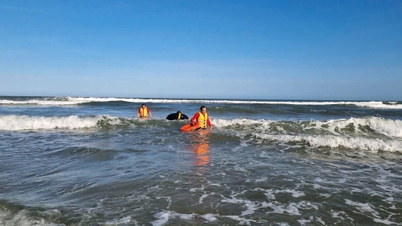
Illustration.
According to Associate Professor Hoang Bui Hai, Director of the Emergency and Intensive Care Center at Hanoi Medical University Hospital, summer is the time when the risk of drowning increases as many people go to the beach, swim in rivers and lakes, or participate in outdoor activities.
Those at high risk include unsupervised children, people who cannot swim, people who use alcohol or drugs while swimming, and people with underlying conditions such as cardiovascular disease, epilepsy, or heart rhythm disorders.
When a person is found drowning, it is crucial to quickly call for help and bring the victim to safety on shore. If the victim stops breathing or their heart stops, cardiopulmonary resuscitation (CPR) should be performed as soon as possible. Doctors recommend performing chest compressions at a rate of 100-120 times per minute, combined with 30 chest compressions and 2 consecutive breaths, until medical personnel arrive.

Experts advise against turning the victim upside down or performing the Heimlich maneuver to "expel water" as this can waste precious emergency time. After first aid, wet clothing should be removed, the body kept warm, and the victim transported to a medical facility in a specialized vehicle, even if they are conscious or breathing on their own again.
To prevent drowning, doctors advise young children not to swim alone, to always be supervised at swimming pools or bodies of water, to use life vests when necessary, and to absolutely avoid drinking alcohol before swimming. Teaching children to swim and water safety skills from an early age is also considered an important solution to reduce the risk of drowning accidents in the community.
Source: https://vtv.vn/huong-dan-so-cuu-duoi-nuoc-dung-cach-100260525101621603.htm















































































































Comment (0)