These days, in the sugarcane fields of Phu Hoa village, farmers are working diligently to prepare the land for experimental planting of biomass corn.
Ms. Nguyen Thi Hau's family in Phu Hoa village is one of the pioneering households participating in the model. Previously, her family maintained rice production on 2 sao (approximately 2,000 square meters) during the summer-autumn season. However, the yield only reached about 1.5-2 quintals per sao, while the costs of fertilizer, seeds, and labor increased. In recent years, this rice-growing land has been left fallow, with no suitable alternative crop available.
“After receiving information, technical guidance, and having a product buyer, my family decided to switch to growing biomass corn. Currently, we have planted 2 acres of corn. What reassures us most is the guaranteed market for our product. Instead of worrying about finding buyers like with many other crops, the entire biomass corn yield after harvest will be purchased by the partnering company. Not only my family, but many other households in Phu Hoa village have also boldly converted their regenerated rice fields or abandoned land to growing biomass corn…,” Ms. Hau shared.
 |
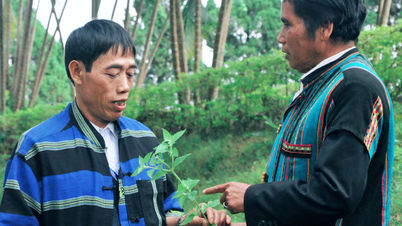
| Farmers in Phu Hoa village, Truong Phu commune, are conducting a trial planting of biomass corn - Photo: NH |



According to Mr. Pham Van Quyet, Chairman of the Board of Directors and Director of Phu Hoa Agricultural Production, Business and Service Cooperative, the conversion to biomass corn cultivation was carried out based on surveys of areas where rice production had been inefficient for many years. To date, the cooperative has planted 18 hectares of biomass corn. This model is implemented with the support of the Provincial Agricultural Extension Center regarding seeds, fertilizers, and product consumption linkages. Farmers receive 50% support for seed and fertilizer costs, contributing to reducing initial investment pressure and creating motivation to boldly change the crop structure…
“When implementing the biomass corn model, the cooperative coordinated with specialized units to organize propaganda and mobilize people to participate. Initially, the cooperative members were very supportive. According to calculations, the biomass corn that the cooperative members planted is the NK7328 variety, which can achieve a yield of 50-55 tons/ha,” said Mr. Pham Van Quyet.
According to Nguyen Van Thuan, Head of the Economic Department of Truong Phu Commune, the implementation of the biomass corn model is one of the appropriate solutions to restructure agricultural production towards efficiency and adaptation to the local conditions. More importantly, the model has contributed to revitalizing fields that were previously abandoned or underutilized. Agricultural land that was at risk of being wasted is now being utilized more effectively, creating additional income for the people…
“In reality, in Truong Phu commune, there are some areas where summer-autumn rice and ratoon rice production is ineffective. Therefore, the Economic Department has proactively advised the Commune People's Committee to switch to planting other crops such as biomass corn and cassava… Currently, the locality has received support from the Provincial Agricultural Extension Center in terms of biomass corn seeds. This year, the locality has implemented a pilot project in Phu Hoa village, with a total area of 18 hectares. If biomass corn proves highly effective, we will continue to promote and expand it to areas with low-yield rice production and abandoned land…”, Mr. Nguyen Van Thuan said.
Although still in the early stages of pilot implementation, it is hoped that the biomass corn cultivation model will provide the people of Phu Hoa village with more options in agricultural production; at the same time, it will open up a new direction in the efficient exploitation of land resources, increase income and promote local agricultural development.



Ngoc Hai
Source: https://baoquangtri.vn/kinh-te/202606/huong-di-moi-tren-dong-dat-phu-hoa-c792a09/





![[Photo] "Hanoi Lotus Festival" honors the lotus flower that has been associated with Vietnam for thousands of years.](https://vphoto.vietnam.vn/thumb/1200x675/vietnam/resource/IMAGE/2026/06/27/1782516943048_sen-ha-noi-2026-minh-duy-1-jpg.webp)