Agricultural officials visit a sesame cultivation model farm in My Thoi ward. Photo: Nguyen Hung
For many years, rice has been the main crop in My Thoi ward. However, facing increasing production costs, unstable rice prices, and shrinking profits, many households have been forced to change their production mindset. In Thoi An A hamlet, My Thoi ward, farmers have introduced sesame cultivation. Starting from small, scattered plots, the model has gradually expanded, forming a concentrated production area, creating favorable conditions for the application of science , technology, and mechanization in production. Currently, My Thoi ward has about 15 households growing sesame with a production area of nearly 40 hectares.
Regarding the development of this model, many locals believe that Mr. Mai Tan Phuoc, residing in Thoi An A hamlet, is one of the pioneers in introducing sesame cultivation to the area. Having recognized the potential of sesame after attending training courses organized by the agricultural sector, Mr. Phuoc experimented with planting a few acres, then gradually expanded the area, while actively encouraging other villagers to participate in production. According to Mr. Phuoc, sesame has economic value and helps improve agricultural land. After each rice crop, rotating sesame helps reduce soil acidity and creates favorable conditions for the next rice crop to thrive. This is considered a sustainable production approach, both increasing productivity and contributing to the protection of agricultural land resources.


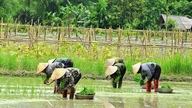
After harvesting the winter-spring rice crop, Mr. Nguyen Van Tam, also residing in Thoi An A hamlet, boldly planted over 1.2 hectares of sesame. Years of experience cultivating sesame have helped him accumulate expertise and become more proactive in the production process. Mr. Tam stated: “Sesame is an easy-to-grow crop, requiring little care and having a short growing season, only 70-75 days to harvest. Compared to rice, sesame doesn't need much water, mainly utilizing the soil's natural moisture, thus significantly reducing production costs. Sesame is also less susceptible to pests and diseases and is easy to control.”
Thanks to good sesame cultivation techniques, from seed selection and soil preparation to field monitoring, Mr. Tam's family has maintained stable sesame yields in recent years. On average, each hectare of land yields 140-160 kg of sesame. With a selling price of 60,000-70,000 VND/kg, this year's harvest has brought significant income, making many farmers more enthusiastic and confident in this model.
Mr. Tran Quang Khai, residing in My Thoi ward, also chose sesame as a crop rotation on his family's rice fields. According to him, sesame is a relatively "easy-to-grow" crop, with few pests and diseases, and is particularly suitable in conditions where water resources are increasingly limited. Mr. Khai believes that production efficiency still depends heavily on the weather. In favorable years, the yield and profit from sesame are significantly higher than from rice cultivation. Conversely, if unfavorable weather conditions occur, the yield may decrease. However, with years of accumulated experience, he still affirms that this is a suitable direction to help his family maintain a stable income. The exchange and learning of experiences among local farmers also contributes to improving production efficiency.
According to Ms. Vuong Mai Trinh, Chairwoman of the People's Committee of My Thoi Ward, in the past, most local people produced according to traditional methods, resulting in low economic efficiency and unstable income due to the impact of weather, diseases, and market fluctuations. In recent years, many farmers have boldly switched to crop structures suitable to local conditions and actively applied scientific and technical advancements to production, contributing to increased income and improved living standards.
From the transforming fields of My Thoi, the 2 rice crops - 1 sesame crop model is gradually proving its sustainable economic effectiveness. Not only does it help farmers increase their income on the same area of land, but the model also opens up a direction for agricultural development that adapts to market fluctuations and natural conditions.


Source: https://baoangiang.com.vn/huong-di-moi-tu-cay-me-a488418.html
![[Photo] General Secretary and President To Lam receives Palestinian Ambassador Saadi Salama](https://vphoto.vietnam.vn/thumb/1200x675/vietnam/resource/IMAGE/2026/06/25/1782365384740_a1-bnd-9423-8322-jpg.webp)

![[Image] Ho Chi Minh City: Ma Lang area, Chicken-Rice Market about to change its appearance](https://vphoto.vietnam.vn/thumb/1200x675/vietnam/resource/IMAGE/2026/06/25/1782377698627_ndo_br_m1-jpg.webp)
![[Image] Schools organize meetings and introduce teaching models to students admitted to grade 10.](https://vphoto.vietnam.vn/thumb/1200x675/vietnam/resource/IMAGE/2026/06/25/1782368077271_ndo_br_z7970052192242-1ec8daeb77a6eed1a4e9f58c564ddd3e-jpg.webp)