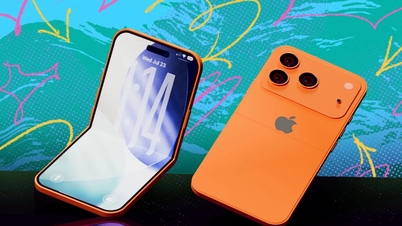
Apple enthusiasts will likely need more patience to experience the first foldable iPhone. Although the supply chain is ready, the device's launch is likely to be delayed until the end of the year, instead of the earlier release as initially expected. Reports from the Economic Daily News and key component partners have indirectly confirmed this change.
Delay signals from the component supply chain
Supply chain data reveals a clear shift in production schedules. The CEO of Largan Precision, a camera supplier for Apple, revealed that several major projects in the third quarter of this year have been postponed to early next year. Meanwhile, Xinrixing – a partner developing the folding hinge system – is also awaiting an official delivery schedule.

The timing of these two major suppliers confirms that the iPhone Fold is undergoing some adjustments to its production schedule. However, this wait is predicted to be worthwhile, as the device boasts groundbreaking hardware specifications.
A versatile hybrid design combining features of both smartphones and tablets.



According to analyst Ming-Chi Kuo, the iPhone Fold will offer an optimal experience for both mobile use and demanding work. The device uses a flexible folding mechanism with two separate display areas:
- Secondary display: A 5.3-inch screen on the outside, providing a comfortable and familiar grip similar to standard iPhone models.
- Main screen: When fully unfolded, the display area expands to 7.7 inches with a 4:3 aspect ratio, transforming the device into a true tablet.
Compared to its Android competitors in the same segment, Apple's design prioritizes a wider width, providing a comfortable workspace for work and entertainment, even though the height is slightly lower.
Record-breaking thinness and bold hardware trade-offs.
The most notable technical highlight of the iPhone Fold is its thickness of only about 4.5mm when unfolded. This is a record in the world of foldable devices today. To achieve this ultra-thin design, Apple made bold hardware trade-offs to optimize every millimeter of component space.
Notably, the iconic Face ID system will be completely removed. Instead, the Touch ID fingerprint sensor will return, integrated directly into the power button, similar to the iPad Air series. Furthermore, the telephoto camera supporting optical zoom will also be absent to maintain the ultra-slim form factor. This shows that Apple is willing to prioritize aesthetics and slimness over the most advanced photography and biometric security features currently available.
Scarcity launch roadmap and marketing strategy
The tech world expects Apple to introduce the iPhone Fold at the same time as the iPhone 18 Pro lineup in September. However, the actual delivery time may be delayed until December or later. Below is a summary of the device's expected specifications:



| Parameter | Expected details |
|---|---|
| Home screen | 7.7 inches (4:3 aspect ratio) |
| Secondary screen | 5.3 inches |
| Thinness (when open) | 4.5 mm |
| Security | Touch ID integrated into the power button. |
| Release time | September |
Initially, this flagship product will only be available in extremely limited quantities. This move gives Apple more time to perfect the product, while also creating a scarcity effect to stimulate the market, similar to the strategy successfully applied with the first generation of AirPods.
Source: https://baonghean.vn/iphone-gap-sap-ra-mat-do-mong-ky-luc-45mm-va-nhung-danh-doi-tao-bao-tu-apple-10341785.html
![[Photo] Prime Minister Le Minh Hung presides over the thematic session on promoting science and technology development and innovation.](https://vphoto.vietnam.vn/thumb/1200x675/vietnam/resource/IMAGE/2026/06/23/1782207872934_ndo_br_dsc-1724-jpg.webp)
![[Image] Paris's oldest bridge goes viral after transforming into a giant cave.](https://vphoto.vietnam.vn/thumb/1200x675/vietnam/resource/IMAGE/2026/06/24/1782283441197_ndo_br_dsc05314-jpg.webp)