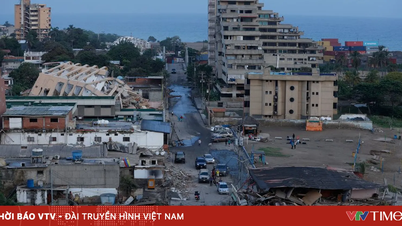
In its statement, the IRGC clarified that this military operation was in response to the attacks carried out by the US in the early morning of June 10 (local time) against southern Iran, including the Jask and Sirik areas (in Hormozgan province) and Qeshm Island in the Strait of Hormuz.
According to the IRGC, the attacks damaged some infrastructure. Additionally, the IRGC stated that it attacked four targets at a US military base in Jordan. The state news agency IRNA, citing an IRGC statement, reported that the force used "long-range missiles" to destroy the targets.


On social media platform X, on June 10th, Iranian Foreign Minister Abbas Araghchi emphasized that the country's armed forces would respond to any military actions or threats against Iran.
Earlier, on the evening of June 9th, US time, the US Central Command (CENTCOM) announced that it had conducted attacks on several Iranian targets in retaliation for Tehran shooting down a US Army Apache attack helicopter over the Strait of Hormuz. CENTCOM later announced that US forces had completed the airstrikes, which Washington described as acts of "self-defense."
Amid the escalating military retaliation between the US and Iran, countries in the region are stepping up diplomatic efforts to de-escalate tensions. Egyptian Foreign Minister Badr Abdelatty held separate phone calls with his counterparts from Saudi Arabia and the UAE.
Meanwhile, Gulf News, citing the Kuwaiti Army Command on June 10, reported that the country's air defense system was intercepting airborne targets in accordance with approved operational procedures. The Kuwaiti military urged citizens to comply with security and safety guidelines from authorities and to only follow information from official sources.



Source: https://www.sggp.org.vn/iran-tan-cong-tra-dua-my-post856690.html
![[Image] Schools organize meetings and introduce teaching models to students admitted to grade 10.](https://vphoto.vietnam.vn/thumb/1200x675/vietnam/resource/IMAGE/2026/06/25/1782368077271_ndo_br_z7970052192242-1ec8daeb77a6eed1a4e9f58c564ddd3e-jpg.webp)

![[Photo] General Secretary and President To Lam receives Palestinian Ambassador Saadi Salama](https://vphoto.vietnam.vn/thumb/1200x675/vietnam/resource/IMAGE/2026/06/25/1782365384740_a1-bnd-9423-8322-jpg.webp)
![[Image] Ho Chi Minh City: Ma Lang area, Chicken-Rice Market about to change its appearance](https://vphoto.vietnam.vn/thumb/1200x675/vietnam/resource/IMAGE/2026/06/25/1782377698627_ndo_br_m1-jpg.webp)














![[Video] Weather forecast for tonight and tomorrow, June 26, 2026: Northern Vietnam to end heatwave from tomorrow, Central Vietnam to continue experiencing a heatwave.](https://vphoto.vietnam.vn/thumb/402x226/vietnam/resource/IMAGE/2026/06/25/1782392692278_thumb-dem-png.webp)