"Only soldiers on remote islands have one-string guitars," only the artist Viet Anh sings with a 21-string guitar. I was mesmerized when a friend sent me a picture of a guy holding an extremely unusual guitar, with 21 strings instead of the usual 6.
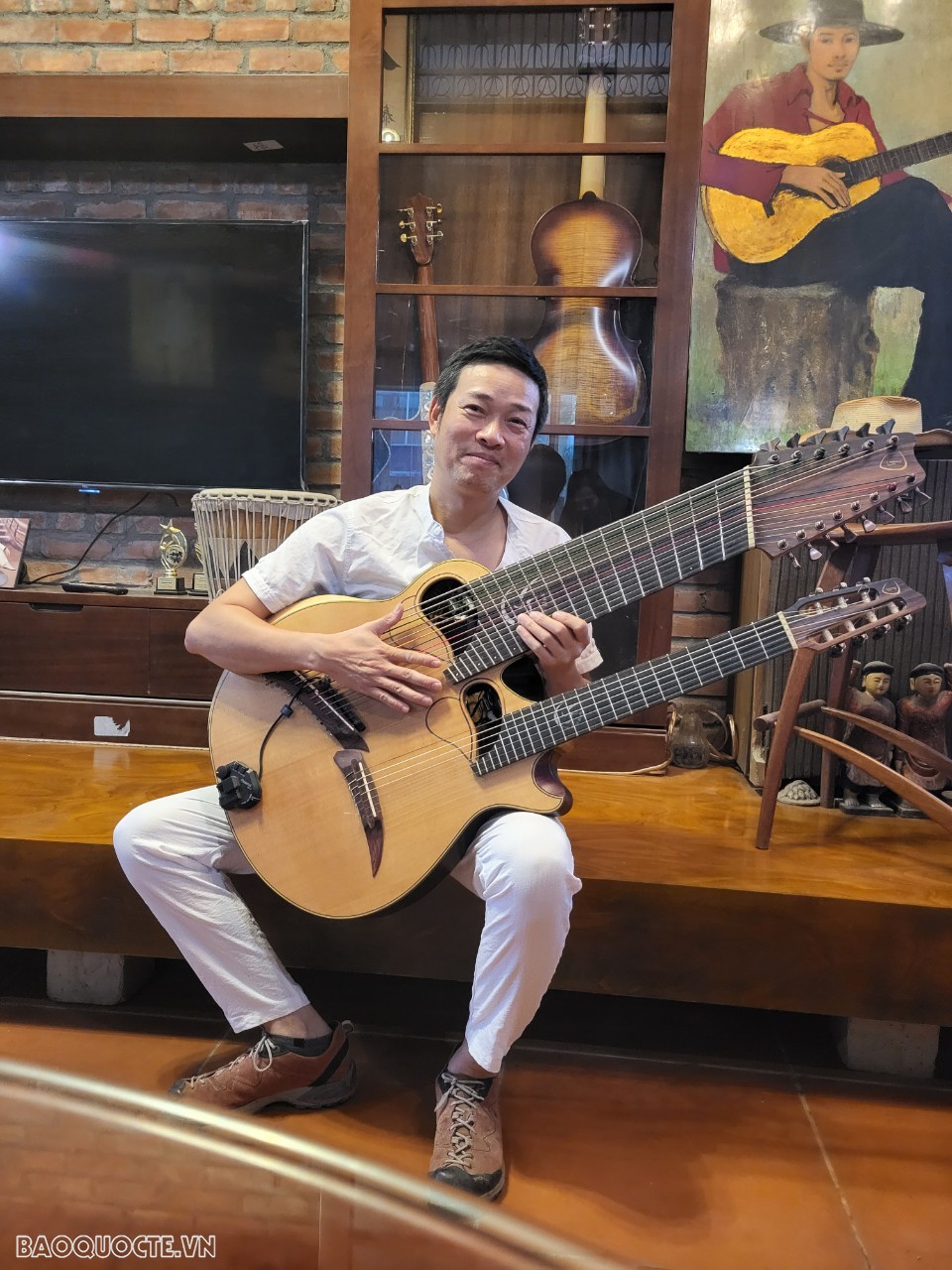 |
| The wanderer with the guitar - Artist Viet Anh. (Photo: MH) |
A musician from Hanoi told me: "This guy has retired from music for several years now, staying home to take care of his mother who is over 90 years old, but he still plays the instrument, dances to music, and practices 'vigorous meditation' at home. Just follow the Lang Hoa Lac road to that place, there's a house with three large royal palm trees like the ones at the Daewoo Hotel – that's the right place."
A sunny winter weekend. The crisp coolness in the dry, golden sunlight easily inspires romantic souls. Perhaps it was thanks to the beautiful weather that, after quickly changing his mother's clothes as she lay in her hospital bed, Viet Anh enthusiastically greeted me with, "You're such an enthusiastic journalist!" Then he spent an hour of his precious time talking incessantly about his profession, his career, and his struggles with his guitar playing.
Childhood yearning for… music
Leisurely offering me a cup of tea on the sun-drenched veranda, artist Viet Anh's eyes twinkled as he recalled his childhood – the days when he first discovered and "fell in love" with the guitar, a love that continues to this day. He recounted: "I was born in Hai Phong , the youngest of six siblings. When I was eight years old, whenever my siblings' friends came to visit and played music, I would listen and 'learn' guitar by eavesdropping. After only a short time, I could play the songs I had overheard."
During the subsidy period, everyone knew that life was extremely difficult and lacking in every respect. Therefore, a family that owned just a guitar was considered a cultured family. Viet Anh's family didn't have a guitar, so he often lingered at his neighbor's house to help carry water, using it as an excuse to borrow their guitar to practice.
He continued: “At the age of 10, I gathered a little ‘capital’ from my New Year's money and asked my mother for an additional 25 dong, enough to buy my first guitar for 130 dong at the Hai Phong General Department Store. The quality of the guitar was terrible, so bad that they didn't even file the brass frets smooth. When I was happily playing, I pressed a legato note and slid it downwards, and the sharp fret cut my palm. The cut was quite large, and it bled a lot, forcing me to stop playing for a while. I still remember that moment, looking at my new guitar, I felt so sad and helpless...”
A turning point in Viet Anh's life came when he was 12 years old. During the summer break, he applied to take drum lessons at the Hai Phong Children's Cultural Palace. Coincidentally, during a performance at the end of the course, Mr. Van - a vocal instructor - discovered that Viet Anh knew how to play guitar and immediately recruited him into the children's band at the Cultural Palace. Very quickly after that, Viet Anh officially became the lead guitarist of this band.
Making a living with herds
Viet Anh smiled gently: "To say I made a living playing music as a teenager might be an exaggeration, but it was a glorious time and marked the first time in my life I earned an income from playing music." That was when Uncle Kien, a music arranger and orchestra conductor with very progressive views at the time, taught the band Boney M and ABBA songs, in addition to their children's music practice.
Recalling this memory, Viet Anh said that Uncle Kien was incredibly brave because back then, if you played foreign music, you'd only see people playing Soviet or Cuban music... But thanks to playing world- famous songs, Viet Anh's children's band became famous. "We were busy performing at various events, from weddings to major city events. ...And, from then on, I started earning my first money playing music," Viet Anh said with a happy smile.
After finishing high school, driven by his passion for music , Viet Anh decided to go to Hanoi to study it in depth. “My family was very worried because back then, society didn’t consider art a ‘profession,’ let alone a career… My first girlfriend’s mother even scolded her daughter for falling in love with a ‘guy who played the flute and string instrument’…” – Viet Anh recalled his first love with amusement.


With just a borrowed bag from his neighbor and a few changes of clothes, he quietly hopped on a train to Hanoi. It sounds quite adventurous, but Hanoi wasn't unfamiliar to this wandering guitar enthusiast. His uncle, Pham Ngu, was a renowned guitarist, and his aunt worked at the Department of Music and Dance. There was also his cousin, Pham Thanh Hang, a graduate of the Vocal Department at the National Academy of Music, and his older brother, Pham Hong Phuong, a guitarist and lecturer at the Hanoi University of Music and Fine Arts. With such powerful backing, what did the wandering guitar lover Viet Anh have to worry about?
Then they went back to making a living and forgot about the flock.
But life isn't always a dream. Upon arriving in Hanoi, he also lost his livelihood – his regular job in Hai Phong.
"Changing my place of residence also means I can no longer continue playing the piano in Hai Phong, so I won't have an income to live on while studying."
"Back then, the amateur movement of singing political songs was very vibrant. I played the piano for the performing arts group at the Hai Ha Confectionery Factory. Luckily, I was hired as a part-time worker and also took charge of the factory's performing arts. Thanks to that, I had a stable minimum income to live on," he said.
After working as a laborer for over a year, one fine day, Viet Anh accompanied two female singers on the piano during their audition for the Border Guard's professional performing arts troupe. That day, the troupe was recruiting many actors, singers, musicians, dancers, etc. For some reason, Viet Anh's piano playing caught the attention of Lieutenant Colonel Bao Chung, the head of the troupe and a musician. Without even registering or submitting an application, Viet Anh was suddenly called upon to work officially.
Looking back, Viet Anh still can't understand why he loved music so much. He practiced day and night, overcoming all financial difficulties to survive and play his instrument. A year later, Viet Anh completed his military service with the rank of lieutenant and was assigned to manage the music practice room and arrange music for the orchestra of the unit.
Although stationed in Hanoi, during his five years working with the troupe, Viet Anh traveled all over the country. Despite the hardships, he was always proud that he had excellently fulfilled his duties, bringing culture and spirit to every soldier, every border post, and every person in remote areas... In some places inaccessible by any means of transport, the entire troupe marched on foot. Some routes required nearly two days of walking to reach a destination so remote that even ethnic minority communities couldn't reach it. Even at border posts perched high on mountaintops, the soldiers of the performing arts troupe still walked, their feet treading on clouds, their hair caressed by the mountain wind...
However, after years of wandering, the free spirit began to worry and think about a home and children. He requested to leave the army and went to several places to make a living, but found it unprofitable. He returned to Hanoi and worked as a diligent warehouse keeper at the Hanoi Metalworking Company. During his time there, he almost completely cut himself off from music and did not interact with anyone in Hanoi's art scene. During this period, he temporarily escaped poverty and managed to buy half of an old apartment, which, even with renovations, only amounted to a mere 18 square meters.
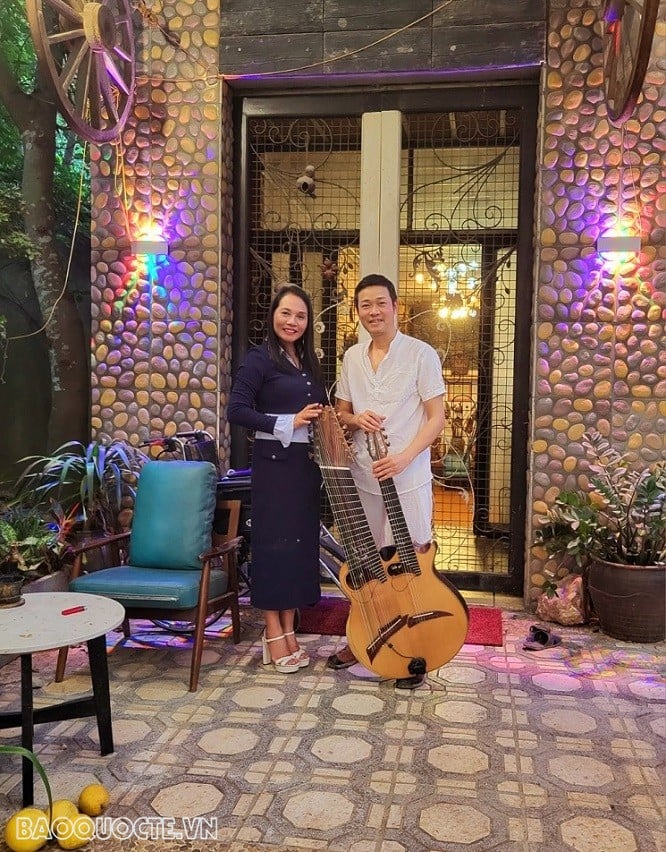 |
| Author and artist Viet Anh with his impressive 21-string guitar. (Photo: MH) |
"Starting over in love"
It seemed as though the life of this romantic wanderer had settled down and he had completely "quit" art. Yet, as if by fate, a random emotion suddenly returned when he passed by the Hanoi Daewoo Hotel. He said: "At that moment, I found it so beautiful and magnificent. The rows of royal palm trees seemed to rustle invitingly. I kept walking back and forth, admiring it, and a burning desire to play music there ignited within me. Everything happened as if by the law of attraction, and I was invited to play music there a few months before the hotel was inaugurated. That was the first time in my life I played music and received payment in dollars," he recalled.
However, working during the day at the metalworking company and then playing music at night became unsustainable. Viet Anh chose to follow his heart, quitting his job at the metalworking company to focus on developing his music. “When I truly returned to music, I wanted to delve deeper into its aspects, to learn more about things I didn’t know. In 1997, the first year the National Academy of Music opened its doors to independent candidates – those who didn’t need to have completed elementary or intermediate levels at the school to enter university – he took the entrance exam.” As a result, he passed the exam and was admitted to the Academy of Music's regular program in music theory, composition, and conducting (Ly Sang Chi).



And from this point on, he began to explore the essence and origins of guitar – Flamenco. Viet Anh started playing Flamenco, initiating a new musical journey and having a significant influence on subsequent generations. In 2000, Viet Anh officially formed the band Lang Du to fully express his passion for guitar.
Since 2000, the band Lãng Du has been very active and energetic, quietly participating in various events, both large and small, across different sectors, especially serving corporate events. This has given the band stability to play the music they want and good remuneration, allowing the members to continue their work.
He said, "I'm struggling to find something new, like I did with Flamenco, but it must still be a legitimate art form, professional, and not chase after fleeting social trends just because of difficulties."
The story led me to his 21-string guitar – something that astonished even someone like me, who dabbled in playing and singing at the amateur level.
(to be continued)
Part II: The 21-string guitar and the romantic game
Source



![[Image] National conference summarizing one year of operation of the overall organizational model of the political system, the three-tiered government model.](https://vphoto.vietnam.vn/thumb/1200x675/vietnam/resource/IMAGE/2026/07/01/1782882811691_ndo_br_1-jpg.webp)